
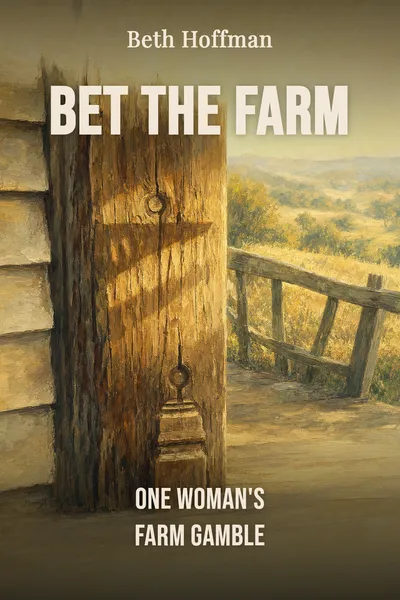
Bet The Farm
One woman's farm gamble
Description
When Sarah Jones opens the letter from a Kentucky lawyer, she is broke, recently unemployed, and living in a version of her life she never chose. Her grandmother has died and left her a farmhouse — an old, sagging place at the end of a gravel road in a town Sarah barely remembers visiting as a child. The obvious move is to sell. The money would cover a few months of rent while she figured out what came next, which is what a sensible, cornered person does. In Beth Hoffman's telling, this is where most of us would stop reading our own lives and start calculating.
Sarah doesn't sell. She drives down instead, meaning to size the place up, and ends up staying — first out of exhaustion, then out of something closer to stubbornness. The house is full of her family's traces: recipe cards in a drawer, a name scratched into a doorframe, land that once fed people. What starts as a decision about a property becomes a decision about whether she is allowed a second version of herself at forty-something, with no plan and no cushion. "Bet The Farm" is the story of what she risks to find out.
It would be easy to read this as a cozy tale about a woman who bakes her way out of trouble. It's warmer and stranger than that. Hoffman is interested in the actual mechanics of a gamble — what it costs, who has to be in on it, and what happens when the past you thought you'd left behind shows up at the door just as everything finally starts working.
The question we’re asking : What does it actually take to bet everything on a life you're not sure you're allowed to want?What we’ll see : How an inheritance, a small town, and a batch of bread turn one woman's cornered decision into a story about risk, belonging, and the debts we don't see coming.
Table of contents
01Chapter 1 — The farmhouse nobody planned to keep
Sarah arrives at the farmhouse expecting a chore. She's lost her job, her savings are thin, and the inheritance reads, at first, like a small mercy with an expiration date — something to liquidate before it costs her money she doesn't have. Hoffman lingers on this arithmetic because it's honest. A rundown property in a town with no obvious economy is a liability as much as a gift, and Sarah knows it. She walks the rooms with a mental spreadsheet running, tallying what a roof repair would eat, what the land might fetch, how long the whole thing could tide her over.
What undoes the spreadsheet isn't sentiment exactly. It's specificity. She finds her grandmother's recipe cards, the handwriting still confident, the margins full of corrections. She finds the kitchen where those recipes were made, a room built around feeding people rather than displaying a life. The house isn't valuable in the way the market measures value, but it's dense with a kind of information Sarah didn't know she was missing — proof that a woman in her family once built something durable out of very little.

02Chapter 2 — A town that came with the land
The farmhouse doesn't arrive alone. It comes with a town, and the town comes with people who knew Sarah's grandmother better than Sarah did. Hoffman treats the neighbors as more than color. They're the first thing that makes the gamble survivable. There's the type who shows up unasked with a toolbox, the one who talks too much and knows everything, the pair who've been feuding so long nobody remembers why. Sarah, a private person by habit, finds herself pulled into a web of favors she didn't request and can't quite refuse.
This is where the book quietly reframes what risk means. In the version we usually tell ourselves, the person who bets the farm bets it alone — a lone figure, all grit, staking everything on their own nerve. Sarah's version is different. Every step toward keeping the place involves someone else: a neighbor who fixes the wiring for the cost of the parts, another who explains which of the surrounding farms grows what, and when. The land taught these people to depend on each other, and Sarah is inheriting that logic along with the deed.
03Chapter 3 — Flour, risk, and a business that ran on trust
The idea, when it comes, is almost embarrassingly simple. Sarah loves to bake, the kitchen was built for it, and the farms around her grow the ingredients. She'll turn the farmhouse into a bakery, using what's grown nearby, feeding the town the way her grandmother once fed it. Hoffman resists the urge to make this look inevitable. It's a reckless plan for a woman with no capital and no experience running a business, and the early chapters of the venture are mostly about how hard it is to turn a good instinct into something that pays for itself.
The bakery works because it runs on trust before it runs on money. The neighboring farmers extend her ingredients on the promise of later payment. Customers come partly out of curiosity and partly because the town has decided, tentatively, to root for her. Sarah's loyal regulars become an informal safety net — the people who show up on slow mornings, who tell others, who turn a fragile new business into a fixture almost by force of collective will. Hoffman makes the point without stating it: Sarah's bet only works because the town is quietly betting alongside her.
04Chapter 4 — What we mistake for a fresh start
The word Sarah keeps reaching for is fresh start, and Hoffman spends the back half of the book quietly dismantling it. A fresh start implies a clean break, a self scrubbed of history, a life begun from zero. But nothing about Sarah's new life is actually new. The house is her grandmother's. The recipes are her grandmother's. The skills, the instinct for feeding people, the willingness to build something out of scarcity — all of it was handed down. What looked like reinvention turns out to be inheritance, claimed rather than escaped.
This is the story's real argument, and it lands hardest when the past catches up to her. Sarah can't outrun what she was because the thing she's building is made partly of it. Hoffman's insight is that reinvention isn't the erasure of who you were; it's the decision about which parts of your history you carry forward and which you finally set down. Sarah's crisis forces exactly that reckoning — not a choice between the old self and the new one, but a negotiation about what she's willing to own.
05Conclusion
The letter that opens the book offered Sarah an exit, and she chose the harder thing — to stay, to build, and to expose herself to the possibility of losing it all. By the time her past resurfaces, she has too much to lose for the safe answer to be tempting anymore. What she does with that moment closes the loop Hoffman opened on the gravel road: the cornered woman calculating her way out has become someone with a stake worth defending, and a town willing to defend it with her.