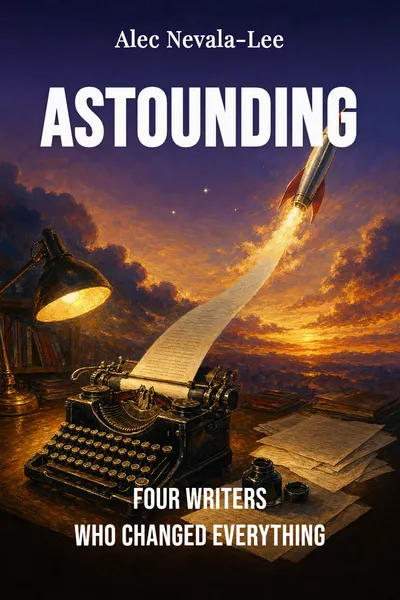
Astounding
Four writers who changed everything
Description
In September 1937, a tall, opinionated young man named John W. Campbell took over the editorship of a pulp magazine called Astounding Stories. He was twenty-seven, a Duke physics graduate who had already made his name writing planet-smashing adventure under his own byline and quieter, eerier stories as Don A. Stuart. The magazine he inherited was one of dozens of cheap monthlies crowding American newsstands, printed on paper that yellowed and crumbled within months. Within a few years, Campbell had turned it into the place where modern science fiction was being written, argued over, and, in a sense, manufactured—story by story, letter by letter, at a desk in New York.
Around that desk gathered a circle of writers who would become legendary, for reasons good and bad. A Brooklyn teenager named Isaac Asimov walked in with manuscripts and walked out with the seeds of the robot stories and the Foundation saga. A retired naval officer named Robert A. Heinlein arrived almost fully formed and became the genre's most influential voice. And a charismatic, fast-talking adventurer named L. Ron Hubbard sold Campbell pulp by the yard before leaving fiction to found a religion. Alec Nevala-Lee's Astounding follows these four through roughly three decades, treating them not as isolated geniuses but as a working ecosystem.
It is a story of collaboration and ego, of ideas that shaped the space age and beliefs that curdled into pseudoscience. The four men were brilliant, prolific, and, in various ways, deeply flawed—Campbell's politics drifted toward the reactionary, Hubbard's restlessness toward the messianic. Nevala-Lee neither celebrates nor condemns; he reconstructs how a commercial magazine became a forge for the way an entire century would picture its own future.
The question we’re asking : How did one editor and three writers turn a disposable pulp magazine into a machine that reshaped science fiction—and seeped into the wider culture?What we’ll see : The forging of a genre at a single editor's desk, the rise of its defining writers, the strange detour into a new religion, and the long reach of what they imagined.
Table of contents
01Chapter 1 — The editor who built a genre from a desk
John W. Campbell did not invent science fiction, but he came closer than anyone to inventing the version we recognize today. Before him, the pulps trafficked mostly in ray guns and bug-eyed monsters—adventure with a chrome finish. Campbell wanted something else. He wanted stories that took an idea seriously and worked out its consequences with the rigor of a thought experiment. His famous prompt to writers was deceptively simple: write me a creature that thinks as well as a man, or better, but not like a man. The demand forced authors past spectacle and toward genuine speculation.
Campbell ran the magazine, soon renamed Astounding Science-Fiction, less like an editor than like a creative collaborator who happened to control the checkbook. He fed plots to his writers, argued them out of bad endings, and sometimes handed over a premise wholesale—the famous Three Laws of Robotics emerged from his conversations with the young Asimov. He wrote enormous letters, held forth for hours, and treated the slush pile as raw material to be shaped. Writers complained that he never stopped talking. They also kept coming back, because his ideas were genuinely good and his enthusiasm was contagious.

02Chapter 2 — Three writers and the shape of the future
Isaac Asimov was the magazine's homegrown prodigy. A chemistry student selling stories on the side, he arrived nervous and eager, and Campbell took to him immediately. Out of their back-and-forth came the robot stories, built around the idea that artificial minds could be governed by explicit ethical rules rather than running amok in the old Frankenstein mode. The Three Laws of Robotics gave the genre a new template, and the sprawling Foundation stories—history as a predictable science, civilizations rising and falling on schedule—gave it intellectual ambition. Asimov would become one of the most prolific authors of the century, but his foundations were laid at Campbell's desk.
Robert A. Heinlein was a different case. A naval officer invalided out of the service, he came to fiction late and arrived almost preternaturally skilled. He had a knack for embedding a fully imagined future inside a story without ever stopping to explain it—the technique of the casual aside that implies an entire world. Campbell prized him above all his writers. Heinlein, more than anyone, taught science fiction how to feel lived-in rather than lectured, and his later books made him the genre's most influential and most argued-over figure, his politics shifting restlessly across the decades.
03Chapter 3 — From space opera to a religion
The strangest turn in the story belongs to Hubbard, and Campbell helped steer it. In the years after the war, Campbell grew restless with mere fiction. He wanted science fiction to do something in the real world—to produce, perhaps, an actual breakthrough in the workings of the human mind. When Hubbard began developing a self-help system he called Dianetics, claiming it could erase psychological trauma and unlock latent capacities, Campbell threw the magazine behind it. In May 1950, Astounding published Hubbard's article presenting Dianetics as a genuine science, not a story.
The response was enormous. Dianetics became a bestseller; for a time it seemed Campbell's gamble might pay off. He treated himself and others as test subjects, convinced the technique worked. But the claims did not hold up, the movement fractured, and Campbell eventually broke with Hubbard, disillusioned and embarrassed. Hubbard, undeterred, carried the ideas forward, layered them with cosmic mythology drawn from the very pulp tradition he had mastered, and reorganized the whole enterprise as the Church of Scientology. A man who had sold stories by the word built a religion out of the same imaginative machinery.
04Chapter 4 — What a magazine taught the twentieth century to imagine
Step back from the personalities, and Astounding becomes a study in how culture gets made at the margins. A cheap monthly aimed at teenage boys, printed on paper meant to be thrown away, turned out to be one of the more consequential publications of its century. The engineers who built rockets, the scientists who imagined computers and robots, the executives who later sold the space program to the public—a striking number had grown up reading these stories. The magazine did not predict the future so much as supply the vocabulary people used to picture it.
That influence flowed through specific channels. Asimov's robots gave generations a way to think about machine intelligence and its ethics, an argument still running through debates about artificial intelligence today. Foundation's notion of history as something that might be modeled and steered echoed in the rise of social science and systems thinking. Heinlein's confident, technically literate futures shaped how Americans imagined competence itself. The ideas escaped the pulps and lodged in the wider culture, often without anyone remembering where they came from.
05Conclusion
John W. Campbell stayed at his desk until his death in 1971, his magazine renamed Analog, his old authority faded but his influence permanent. Asimov became one of the best-known writers alive; Heinlein became the genre's most quoted and most quarreled-over voice; Hubbard built an empire of belief that outlived them all. The circle that had formed around a pulp editor in the late 1930s scattered into very different destinies, but each carried something of that desk with him.
Related books