
Asimov's New Guide to Science
The minds behind the science
Description
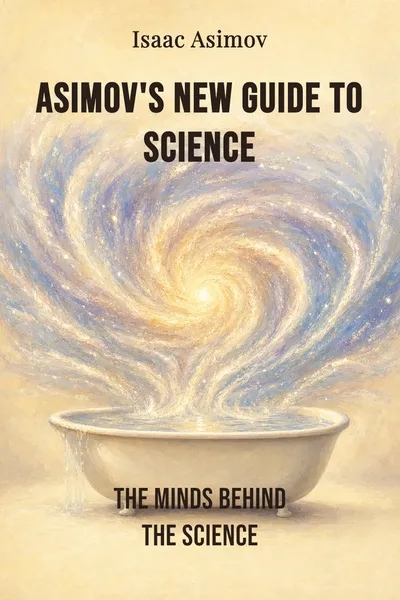
Sometime in the 1960s, a chemistry professor at Boston University started answering a question nobody had formally asked him: could one person, in one book, explain the whole of modern science to a curious adult who had never studied it? Isaac Asimov thought yes. The first version appeared in 1960 as The Intelligent Man's Guide to Science, and he kept rewriting it as the science moved. By 1984, the fourth major revision landed under the title Asimov's New Guide to Science — well over a thousand pages, moving from the size of the universe down to the chemistry inside a single cell, all in the same steady voice.
What makes the book unusual isn't its size. Plenty of reference works are big. It's that Asimov refused to treat science as a warehouse of finished facts to be filed away. He treated it as something people did — argued over, guessed wrong, corrected, and handed on. Archimedes in his bath, Galileo dropping questions the Church didn't want asked, Newton building on people he barely thanked, Einstein rethinking time itself: the discoveries arrive attached to the humans who made them, with their false starts left visible.
That choice is what lets a first-time reader come out the other side feeling, for once, that they actually followed it. The hardest concepts get carried in on the back of a story about a person facing a problem. We're used to popular science that either flatters us or loses us. Asimov does neither — he assumes we're smart enough to keep up if he does the work of being clear.
The question we’re asking : How did Asimov make the entire span of modern science understandable to someone starting from zero?What we’ll see : How one restless mind turned the whole of science into a single connected story told through the people who built it.
Table of contents
01Chapter 1 — One book against the fear of not understanding
Most of us carry a quiet assumption that science is for other people — that somewhere back in school a door closed, and now relativity or genetics belongs to specialists. Asimov built the New Guide as a direct answer to that feeling. His premise was blunt: there is no subject in science that an intelligent, patient reader cannot understand, provided someone explains it honestly and doesn't hide behind jargon. The failure, when it happens, is the explainer's, not the reader's.
So he set himself a genuinely strange task. Rather than write a book on physics, or one on biology, he wrote a single book on everything — organized so that a person could start at the largest scale we know, the universe, and travel inward through galaxies, stars, atoms, molecules, cells, and end inside the workings of the human mind. The structure itself makes an argument: it's all one territory, and you can walk across it without a passport for each field.

02Chapter 2 — Science as a chain of people, not a list of facts
The organizing decision that runs through every chapter is that discoveries have parents. Asimov almost never states a law and moves on. He tells us who was stuck, what they tried, and the moment it broke open. The result reads less like a textbook than like a very long, very well-informed account of what humans have been figuring out, one puzzled person at a time.
Take Archimedes, who supposedly worked out how to test a crown for pure gold while lowering himself into a bath and noticing the water rise. Whether or not he shouted in the street, the point Asimov keeps is the shape of the thing: a real problem, a physical observation, a principle that outlives the crown. Or Galileo, who insisted on measuring what fell rather than trusting what Aristotle had written centuries before, and paid for the insistence with a trial. The science and the life are told as one story because, in truth, they were.
03Chapter 3 — The everyday hook and the hard idea behind it
Asimov's other trick is to start where the reader already lives. Before he asks us to think about the speed of light or the structure of the atom, he anchors it in something ordinary — why the sky is blue, why ice floats, why a struck bell rings the way it does. The familiar thing turns out to have a surprisingly deep mechanism underneath, and by the time we've followed him down, we're standing in the middle of real physics without having noticed the descent.
The method matters most on the topics people find frightening. Radioactivity, for instance, arrives not as a menacing abstraction but as a puzzle: certain elements gave off something that fogged photographic plates in a sealed drawer, and the Curies spent years chasing what and why. Asimov lets the mystery pull us forward. By the time he names the particles and the decay, the strangeness has already been made concrete, so the vocabulary feels earned rather than imposed.
04Chapter 4 — A single library where all the fields talk to each other
Step back from any single chapter and the deeper claim of the New Guide comes into view. By putting astronomy, physics, chemistry, and biology between the same covers, in one continuous sweep, Asimov is quietly insisting that the divisions between the sciences are conveniences, not truths. The atom that a physicist studies is the same atom a chemist bonds and a biologist finds inside a cell. Splitting them into separate books, he suggests, hides how much they are one inquiry.
This is why the person-centered storytelling isn't just charm. If science were a static body of facts, the people would be trivia — nice to know, safe to skip. But if science is a conversation that has run for millennia, then the participants are the point. Understanding why Galileo measured, why Newton generalized, why Einstein doubted, is understanding how the whole enterprise moves. Asimov's method and his argument are the same thing: science is human, cumulative, and unfinished.
05Conclusion
The chemistry professor who set out to explain everything did something odd for a reference work: he made it warm. Across more than a thousand pages, Asimov's New Guide to Science keeps its promise from the first chapter to the last — that a curious adult, starting cold, can follow the largest ideas humans have had, provided they're told as human ideas. The universe shrinks to something we can hold, not because it was made smaller, but because it was made ours.