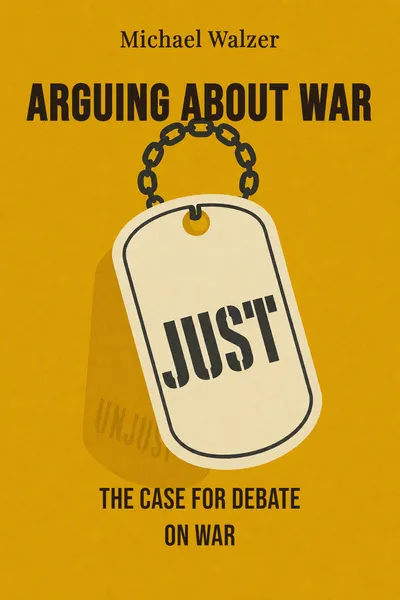
Arguing About War
The case for debate on war
Description
In 1977, a political theorist named Michael Walzer published Just and Unjust Wars, a book that took the oldest and most compromised subject in political thought — when killing is permitted — and treated it as something people could actually reason about. Nearly three decades later, after Kosovo, Rwanda, the two Iraq wars, and the campaigns that followed September 11, Walzer gathered his essays on those conflicts into a shorter, sharper book: Arguing About War. The title carries the whole argument. Not deciding about war, not moralizing about war. Arguing.
That verb matters because the two loudest positions in any war debate both try to end the argument early. The pacifist says war is always wrong, so there is nothing to weigh. The realist says war is beyond right and wrong, a matter of power and survival, so there is nothing to weigh either. Walzer refuses both exits. He thinks soldiers, generals, and citizens argue about the rightness of what they do all the time — in the field, in cabinet rooms, at kitchen tables — and that this arguing is not naive. It is the moral reality of war itself.
What makes the book bracing is that Walzer takes real cases and holds them to real standards, and lets the standards cut where they cut. He supported intervention in Kosovo and the toppling of the Taliban; he was sharply critical of the 2003 invasion of Iraq. The framework is consistent even when the verdicts sting, and it belongs to a tradition — just war theory — that most people assume is either obvious or useless, and is in fact neither.
The question we’re asking : Can war be judged by moral standards, or does it belong to a realm where morality simply falls silent?What we’ll see : How a working theory of just war applies to the conflicts that defined the turn of the century — and why the argument is the point.
Table of contents
01Chapter 1 — The rules nobody wants to admit they need
Walzer starts from an observation that is easy to miss: even in the middle of war, people talk as if certain things are allowed and others forbidden. Soldiers distinguish between an enemy combatant and a farmer in a field. Governments justify their strikes and condemn the enemy's. Prisoners are, in principle, not to be executed. None of this makes sense if war were truly a moral vacuum. The very language of accusation and defense that surrounds every conflict proves that a shared vocabulary of justice is already in use, however often it is violated.
This is his answer to the realist, whose slogan is that in war the law falls silent. If that were true, Walzer notes, we would not bother to lie about atrocities — we would announce them. The effort to hide, to excuse, to reframe a massacre as a regrettable accident is itself evidence that the perpetrators know a line exists. Hypocrisy, as he puts it, is the tribute vice pays to virtue. The rules are real precisely because people work so hard to appear to be following them.

02Chapter 2 — Justice before, justice during, justice after
The tradition Walzer works in splits the moral question into parts, and the split does real work. There is the justice of going to war — whether a country has a good enough reason to fight at all. And there is justice in the conduct of war — whether the fighting itself stays within limits, whatever the cause. Walzer's insistence is that these two are independent. A just cause does not license any means, and a soldier fighting for a bad cause can still fight cleanly or foully. You cannot buy your way out of a massacre by pointing to your righteous war aims.
The heart of the second category is the distinction between combatants and everyone else. Civilians have done nothing to forfeit their right not to be killed, and so deliberately targeting them is, for Walzer, close to absolute. He is skeptical of the easy phrase collateral damage, arguing that armies owe civilians more than the absence of intent to harm them. They owe what he calls due care — a willingness to accept some added risk to their own soldiers in order to lower the risk to noncombatants. A bomb dropped from high altitude to keep pilots safe, at the cost of civilian accuracy, is not automatically excused by good intentions.
03Chapter 3 — Humanitarian intervention and the duty to act
The cases that pull hardest on Walzer's framework are the ones where the crime is being committed by a government against its own people. Classic just war theory built its rules around aggression across borders: one state attacks another, and the victim may defend itself. But Rwanda, Bosnia, and Kosovo posed a different question. When a regime is slaughtering the population it governs, does sovereignty protect it? Walzer's answer is that there are acts so terrible — massacre, ethnic cleansing, enslavement — that they shock the moral conscience and override the usual deference to borders.
In those cases he argues not merely that intervention is permitted but that it is something closer to a duty. The horror of Rwanda in 1994 was not that the world lacked the power to stop the killing but that it lacked the will. Walzer is scathing about the international shrug, and he wants to convert the vague sense that someone should have done something into an actual obligation that falls on those who can act. The trouble, he concedes, is that duty does not name the duty-bearer. Everyone's responsibility easily becomes no one's.
04Chapter 4 — War as a moral argument, not a suspension of morality
Step back from the individual cases and Walzer's deeper claim comes into view: there is no zone of human action where moral language stops applying, and war is the hardest test of that conviction rather than an exception to it. The realist treats war as the place where ethics is suspended and only interest speaks. Walzer's whole body of work is a patient refusal of that idea. Even the most extreme human activity, the organized killing of other people, is shot through with judgments of better and worse, permitted and forbidden — which is why people never stop arguing about it.
And the arguing, he insists, is not decoration on top of the real business of force. It is the real business. When a general worries about a target, when a citizen protests a bombing campaign, when a court tries a war criminal, they are all doing the same thing: applying shared standards to particular acts and holding people answerable. Just war theory is simply the name for that practice when it is done carefully. It lives in the ongoing dispute, not in a settled rulebook handed down from above.
05Conclusion
Arguing About War is a slim book that carries a large ambition. Across the essays on Kosovo, Afghanistan, Iraq, and the wider war on terror, Walzer keeps returning to the same conviction he set out in 1977: that war is a human activity governed by human standards, and that those standards are discovered and defended in the act of disputing them. He supports some wars and condemns others, praises some conduct and attacks the rest, and the consistency lies not in the conclusions but in the method — the refusal to let anyone off the hook of judgment.
Related books