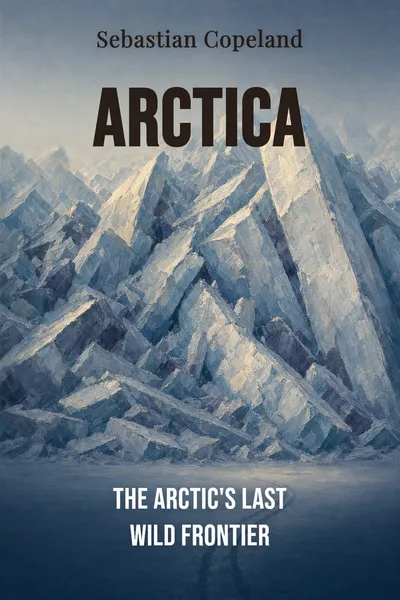
Arctica
The Arctic's last wild frontier
Description
Sebastian Copeland has walked across places most of us will only ever see as a screensaver. A polar explorer, an award-winning photographer, a journalist and a committed environmental campaigner, he has spent years hauling sleds across sea ice, sleeping in tents while the wind rewrites the horizon, and pointing a camera at a landscape that does not perform for anyone. Out of that experience came Arctica, a large-format book of photographs and text that is, on its surface, an act of homage. Copeland set out to pay tribute to what he considers the last true wilderness left on the planet: the Arctic, and above all the strange, ceremonial emptiness around the North Pole.
But a homage to the Arctic in the twenty-first century cannot be only celebration. The ice Copeland photographs is thinning, retreating, breaking up earlier each spring and re-forming later each autumn. The place he treats with something close to reverence is also, by his own account, in serious trouble. So the book carries a double charge. It wants us to fall for a landscape almost nobody visits, and then to understand that this remote, misunderstood expanse is not a scenic afterthought at the top of the map. It is closer to a control room for the whole system.
Copeland is candid that his method is seduction. He believes the numbers alone have failed to move people, and that beauty might succeed where warnings have not. The photographs are meant to make us care; the caring is meant to make us act. That is an unusual bet for an activist to place — that wonder can do political work.
The question we’re asking : What does a place almost none of us will ever see have to do with the lives the rest of us lead further south?What we’ll see : How an explorer turns beauty into an argument, and why the Arctic's fate is being read as a message to everyone below it.
Table of contents
01Chapter 1 — The place we imagine and the place that exists
Most of what we think we know about the Arctic is borrowed from cartoons, holiday cards and the vague geography of childhood. We picture Santa's workshop, a red-and-white pole planted in snow, penguins somewhere in the background — even though penguins live at the opposite end of the earth entirely. Copeland spends much of the book quietly correcting this fog of half-images, not out of pedantry but because the misunderstanding matters. A place we imagine as cartoon backdrop is a place we find easy to lose.
The Arctic he describes is, first of all, not land. The North Pole sits over ocean, on a drifting skin of frozen seawater that shifts under a traveler's feet through the night. There is no summit to plant a flag on, no fixed ground to claim. Copeland writes about the disorientation of this — of standing at the top of the world on something that is technically liquid, wearing a thin crust of ice. The Antarctic, by contrast, is a genuine continent buried under permanent ice. The two poles are opposites in almost every way, and treating them as interchangeable snowscapes is part of how we misjudge both.

02Chapter 2 — A camera as an argument
Copeland could have written a report. Instead he made a book of pictures, and the choice is deliberate. He is skeptical that graphs and projections change anyone's behaviour; we have had those for decades, and the ice has kept retreating. His wager is that people defend what they love, and that they cannot love an abstraction. So the photographs do the persuading. They are not illustrations attached to an argument — they are the argument.
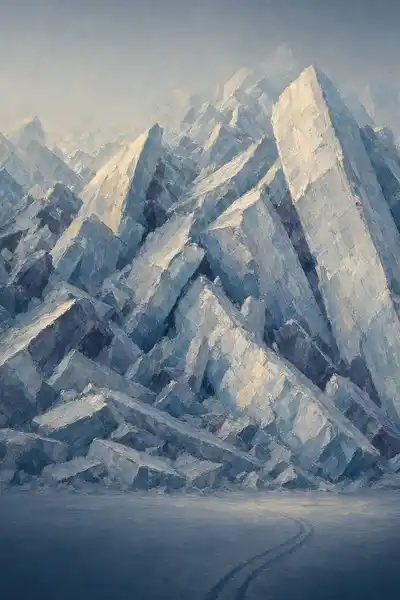
This shapes how he works. Getting the images means traveling the way the environment demands: on skis, by kite, dragging supplies for weeks, waiting out storms in a tent for the light to break the right way. The physical cost is part of the honesty. These are not scenes captured from a heated helicopter window but places earned slowly, which is partly why they carry the authority they do. When Copeland describes a wall of pressure ice or the particular blue at the heart of an old floe, he has usually stood beside it in punishing cold to get the frame.
03Chapter 3 — The ice that keeps the rest of us cool
The heart of Copeland's case is that the Arctic is not a remote curiosity but a working component of the planet's climate — and that its trouble is everyone's trouble. Sea ice is bright, and bright surfaces bounce sunlight back into space. As the ice shrinks, it exposes dark ocean underneath, which absorbs heat instead of reflecting it, which melts more ice, which exposes more dark water. The loop feeds itself. Scientists call this the albedo effect, and it means the Arctic does not warm at the global average rate; it warms far faster, several times faster than the planet as a whole.
That runaway quality is why Copeland keeps returning to the idea of the Arctic as a regulator. A frozen cap at the top of the world helps steady temperatures, ocean currents and weather patterns far to the south. Weaken it, and the effects do not stay politely at the pole. Shifts in the jet stream, in currents, in the timing of seasons ripple down into lives lived thousands of kilometres away, in cities that will never see an iceberg. The remoteness that makes the Arctic feel irrelevant is exactly what makes its decline so easy to ignore until it arrives.
04Chapter 4 — What a vanishing wilderness asks of everyone else
Step back from the photographs and the melting curves, and Copeland is really making a case about attention — about where a civilization looks, and what it is willing to notice in time. The Arctic functions, in his telling, as an early-warning system. It registers the strain on the climate first and most dramatically, precisely because it is the most sensitive part of the machine. A thermometer at the top of the world is showing a reading that the lower latitudes will eventually feel, just later, and by then with less room to respond. The tragedy he keeps circling is that the alarm is ringing in the one place almost nobody is standing to hear it.
This reframes the whole project. Copeland is not asking us to protect the Arctic out of charity toward a faraway landscape, the way one might sponsor something exotic and be done. He is arguing that the Arctic is us — an extension of the same system that grows our food, sets our weather and floods or spares our coasts. The distinction between here and there, which the map encourages, is the illusion the book is built to break. Wilderness at the pole is not separate from civilization further south; it is its foundation, quietly holding conditions steady.
05Conclusion
Arctica closes the loop it opened. It begins as a love letter to a place we mostly misremember and ends as a warning that this place is a gauge for all the others. Copeland set out to make the Arctic loved, on the theory that love outperforms fear as a motive to act — and the whole architecture of the book, the earned photographs, the plain facts about the ice, the refusal to let beauty become an anaesthetic, serves that single conviction. He is not documenting a loss so much as trying to prevent one.
Related books