

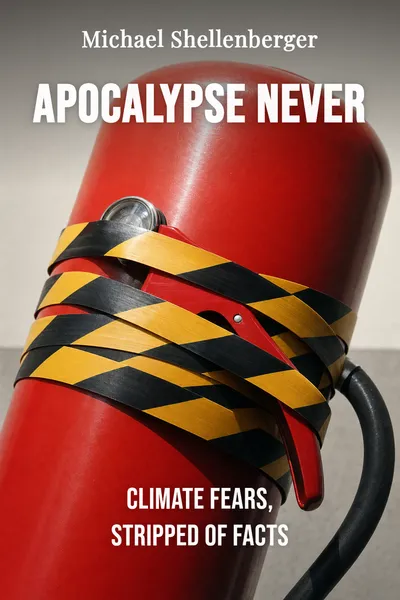
Apocalypse Never
Climate fears, stripped of facts
Description
In 2019, a British group called Extinction Rebellion blocked bridges in London, and speakers at climate rallies began telling crowds that billions of people were going to die. A sixteen-year-old Greta Thunberg told the world that her childhood had been stolen. Around the same time, surveys started picking up a new kind of dread among teenagers — a conviction that the planet had, more or less, run out of time. Michael Shellenberger watched all of this with a specific discomfort, because he had spent thirty years inside the environmental movement, and he did not recognize what it was becoming.
Shellenberger is not a skeptic in the usual sense. He helped protect the last unprotected old-growth redwoods in California. He co-authored a manifesto that fed into what became the Green New Deal. He organized scientists and activists to keep nuclear plants running so their emissions-free power would not be replaced by gas and coal. So when he sat down to write "Apocalypse Never" in 2020, it landed as something rarer than a contrarian pamphlet: a lifelong green telling his own side that the story it was telling had drifted away from the facts.
His claim is deliberately double-edged. Climate change is real, human-caused, and worth taking seriously — and it is not the apocalypse. It is not even, in his reading, our gravest environmental problem. The gap between those two statements is where the whole book lives, and it is a gap the daily headlines rarely let us see.
The question we’re asking : If a career environmentalist insists the world is not ending, what exactly is he arguing — and why does he think the panic itself has become the problem?What we’ll see : How a movement's most inconvenient insider reads the data, the politics, and the deeper hunger driving the fear.
Table of contents
01Chapter 1 — The activist who broke ranks
Shellenberger's credentials matter to his argument, because the book only works coming from an insider. As a young man in the 1990s he threw himself into campaigns most greens would recognize as sacred ground — labor rights, rainforest protection, the fight to save California's ancient redwoods from logging. He was, by any measure, one of the movement's own. That is the vantage point from which he writes, and he wants the reader to know it before he says a single uncomfortable thing.
In 2004 he and Ted Nordhaus published an essay called "The Death of Environmentalism," arguing that the movement had grown narrow and moralistic and needed a bigger, more hopeful vision. It was influential — the thinking behind it circulated into the policy conversations that eventually produced the Green New Deal framing. Shellenberger was not shouting from outside the tent. He was helping design it.

02Chapter 2 — The numbers the headlines skip
The spine of the book is a set of figures that Shellenberger says most people, after decades of coverage, still don't know. Deaths from natural disasters have collapsed — by his account, fatalities from extreme weather events fell roughly ninety percent over the last century, and around eighty percent over the last four decades, even in poorer countries. The reason is not that the weather got gentler. It's that people got richer, better warned, and better sheltered. Wealth, not weather, is the strongest predictor of who dies in a flood.
On emissions, he points to a pattern the daily narrative tends to skip: carbon emissions peaked years ago in most developed nations and have been drifting down since, in the United States driven substantially by the shift from coal to cheaper natural gas. Add slowing population growth to abundant gas, and the truly catastrophic warming scenarios — the ones built on burning ever more coal for the rest of the century — start to look, in his telling, less like forecasts and more like worst-case placeholders that got quoted as destiny.
03Chapter 3 — The alarmists who fight the fixes
Here Shellenberger arrives at the contradiction he finds most telling: the people most convinced the world is ending are frequently the people most opposed to the solutions that would cut emissions fastest. Chief among them, nuclear power. The physics is not in serious dispute — nuclear delivers vast amounts of reliable electricity with almost no carbon and, measured per unit of energy, one of the lowest death rates of any source, safer than wind or hydro once you count the accidents nobody films. Yet the mainstream movement has spent decades fighting to shut it down.
When Germany accelerated its nuclear phaseout, he notes, it leaned harder on coal and its emissions stalled even as it spent enormous sums on renewables. The lesson he draws is uncomfortable for both sides: good intentions plus the wrong technology can leave the air dirtier than before. To oppose nuclear while declaring a climate emergency is, in his reading, not a policy position but a tell.
04Chapter 4 — Fear without love, guilt without grace
Having spent most of the book on data, Shellenberger turns in the end to a stranger question: why does the apocalyptic story hold on so tightly, even against the numbers? Some of the answer, he says, is ordinary — financial interests that profit from renewables subsidies, and the pull of status and power that comes with leading a righteous cause. But the deepest driver, in his reading, is spiritual. Apocalyptic environmentalism has quietly become a religion for people who thought they had left religion behind.
It has the full architecture of faith. A fall from grace, when humanity corrupted a once-pure nature. A coming judgment in the form of climate catastrophe. Sinners, in the shape of oil companies and meat-eaters and frequent flyers. Rituals of atonement — recycling, flying less, counting one's footprint. What it conspicuously lacks is the thing religions usually offer in return: redemption. It preaches guilt without grace and fear without love, and Shellenberger's charge is that this is precisely why it leaves its most devout believers so miserable.
05Conclusion
The book closes where it began, with a father watching a generation absorb the message that its future has already been cancelled. Shellenberger's answer is not to argue the danger away but to shrink it back to its real size: a serious, manageable, centuries-long challenge rather than a countdown to extinction. Climate change, in his telling, is a problem to be worked — with nuclear power, with cheaper energy for the poor, with attention to the local damage that never trends — not a verdict to be mourned.