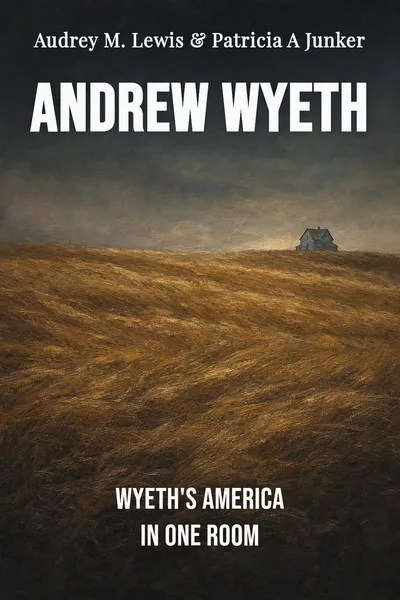
Andrew Wyeth
Wyeth's America in one room
Description
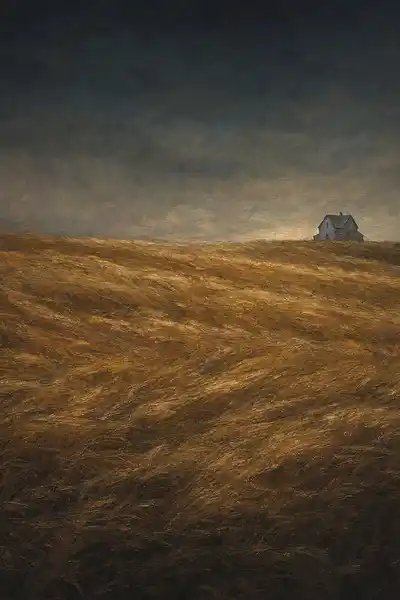
In 1948, a thirty-one-year-old painter in Chadds Ford, Pennsylvania, finished a picture of a woman lying in a field, her back to us, dragging herself up a slope toward a gray farmhouse on the horizon. The woman was Christina Olson, a neighbor in Maine who could not use her legs and moved across the ground by hauling herself with her arms. Andrew Wyeth called the painting Christina's World. The Museum of Modern Art bought it for $1,800. Within a generation it had become one of the most reproduced images in American art, printed on posters, dorm walls, and greeting cards — recognized by millions who could not have named the man who made it.
That gap between the fame of the pictures and the uncertainty about the painter runs through Wyeth's whole career. He was, by most measures of public affection, the most beloved American artist of the twentieth century. He was also, for much of that century, the one the critical establishment could least agree on — dismissed by some as a sentimental illustrator, defended by others as a genuine modernist working in disguise. He painted the same few square miles, the same handful of people, in egg tempera and dry-brush watercolor, for roughly seventy years.
Audrey M. Lewis and Patricia A. Junker set out to survey that entire span, from the boy trained by his illustrator father to the old man still painting his Maine neighbors, and to place the milestones of his art inside the larger movement of American life across the century that produced him.
The question we’re asking : How did a painter of a few Pennsylvania and Maine rooms end up carrying, and dividing, the story of twentieth-century American art?What we’ll see : How a boy from Chadds Ford turned a shrinking world into a mirror for the country outside it.
Table of contents
01Chapter 1 — The most famous painter nobody could place
Andrew Wyeth was born in 1917, the youngest child of N.C. Wyeth, the most successful American illustrator of his generation — the man whose paintings filled editions of Treasure Island and Robin Hood. Andrew was a sickly child, kept out of school and taught almost entirely at home. His father trained him in drawing, in the discipline of observation, and in the illustrator's craft of making a picture tell you exactly where to look. He never went through the academies or the European tours that shaped most serious painters of his time. His schooling was his father's studio, and it left a mark he spent the rest of his life both honoring and pushing against.
His first solo show, watercolors of the Maine coast, sold out in New York in 1937, when he was twenty. He was a prodigy by any measure. But the world he chose to paint kept narrowing rather than widening. Where his father had illustrated pirates and knights, Andrew painted the fields behind his house, the hill where the Kuerner farm sat, the rooms of the Olson place in Cushing, Maine. The subjects were small, local, and repeated. The ambition inside them was not.

02Chapter 2 — The room and the world outside it
Wyeth's method was to stay put. He kept two studios, one in Chadds Ford and one in Maine, and he moved between them by season for his entire adult life. He painted the same neighbors for decades — Karl and Anna Kuerner, the German immigrant farmers up the hill; Christina and Alvaro Olson in Maine; later Helga Testorf, a caretaker he painted secretly over fifteen years. He knew these people, these buildings, these fields the way most of us know only our own hands. The repetition was the point.
And yet the pictures are almost never busy. A Wyeth interior is usually a single room, sparely furnished, with a window that looks onto a field. A person, if present, is turned away or seen from behind, absorbed in something we are not shown. Objects carry weight far past their size — a pair of boots, a hanging coat, a bucket, a shaft of light crossing a floorboard. The world outside the window is enormous and mostly empty, and the room holds itself against it.
03Chapter 3 — Realism as an argument, not a style
The medium matters more than casual viewers realize. Wyeth worked mostly in egg tempera — powdered pigment bound with egg yolk, laid down in thousands of fine crosshatched strokes. It is a slow, unforgiving technique, closer to the early Italian Renaissance than to anything modern. A single tempera could take him months. The surface it produces is dry, matte, and strangely airless, and it gives his fields their peculiar quality of arrested time, as if the wind had stopped mid-blade.
Lewis and Junker argue that this choice was itself a position. In an era when the advanced painters were pouring, dripping, and flinging paint, Wyeth was doing the most laborious, most controlled thing possible. His realism was not a failure to be modern; it was a deliberate refusal, and the refusal had teeth. The dry-brush watercolors and the tempera share an abstraction of their own — vast fields of near-monochrome, compositions built on a few hard geometries, color drained almost to gray. Stand close to a Wyeth field and it dissolves into marks. He was, in that sense, more abstract than his reputation allowed.
04Chapter 4 — A century's self-portrait in tempera
Step back from the single room and Wyeth's seventy years of painting start to read as a slow record of what twentieth-century America was willing to look at. He was born the year the country entered the First World War and he died in 2009, having outlived nearly every movement that once made him look old-fashioned. Across that span, the nation was urbanizing, industrializing, going to the moon, building suburbs and highways over exactly the kind of farmland he kept painting. Wyeth simply did not look at any of it. He turned his back on the century, the way his figures turn their backs on us.
Lewis and Junker suggest that this turning-away is precisely what made him a mirror. The America that bought Christina's World in reproduction by the millions was a country moving fast and feeling, somewhere underneath, that it was leaving something behind. Wyeth painted the thing being left behind — the farm, the plain interior, the aging body, the field going to seed — and he painted it without nostalgia's sweetness, which is why it lasted. His popularity was not an accident of taste. It was the country recognizing its own backward glance.
05Conclusion
Christina Olson died in 1968; the farmhouse in Cushing is now a museum. The Kuerner farm, the hill, the studios in Chadds Ford — the whole small territory Wyeth painted for seven decades has been preserved, mapped, and hung with the pictures made from it. The woman dragging herself up the field is still on the wall at MoMA, still recognized by people who have never set foot in Maine. The man who painted her spent his life being told he was either too easy or not serious, and outlasted the argument entirely.
Related books