
An Apology for the Builder
History's trades now in print
Description
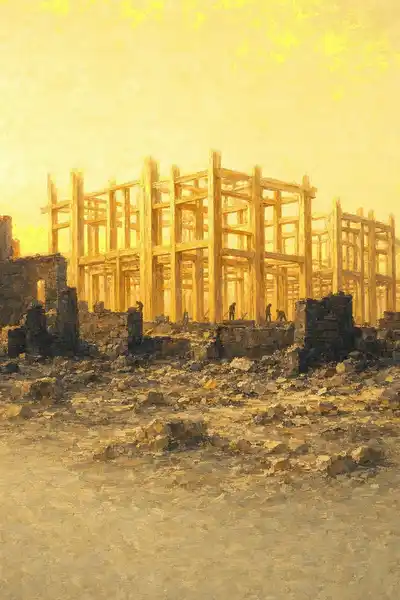
In September 1666, the Great Fire of London burned for four days and took roughly thirteen thousand houses with it. When the smoke cleared, the city faced a question that was less about grief than about mortar: who would rebuild, how fast, and on whose terms. Into that opening stepped a man named Nicholas Barbon — trained as a physician, temperamentally a speculator — who bought up ruined lots, threw up terraces, and became one of the first large-scale property developers London had ever seen. He also picked up a pen. In 1685 he published a short pamphlet with a defensive-sounding title, An Apology for the Builder, and set out to argue that the men everyone loved to blame were, in fact, quietly making the country richer.
The complaint Barbon was answering is one we would recognize. The builders, critics said, were spoiling the city — throwing up too many houses, cramming in too many people, draining the countryside of good families and honest rents. Building was seen as a kind of vanity, or worse, a public nuisance. Barbon disagreed, and not politely. He treated the objections one by one and turned each into evidence for the opposite conclusion: that the growth of houses was the growth of trade, and that a growing city was a sign of national health, not decay.
What makes the pamphlet worth reading now is not only that a seventeenth-century developer defended his own line of work. It is that in doing so, he sketched arguments about population, rent, and demand that economists would not name for another century — and that the little document itself, long buried in library microfilm collections, has come back into circulation as a printed volume one can actually hold.
The question we’re asking : Why would a physician-turned-property-speculator write a defense of building, and what did he end up proving in the process?What we’ll see : A rebuilt London, a builder's self-defense, an accidental theory of money and demand, and what it means to hold an early industrial document in print again.
Table of contents
01Chapter 1 — London burning, and a doctor turned developer
Nicholas Barbon was born around 1640, the son of Praise-God Barebone, a leather-seller and fervent Puritan preacher whose name gave the Barebone's Parliament its nickname. The son took a very different road. He studied medicine at Leiden and Utrecht, was admitted as an honorary fellow of the College of Physicians, and then, more or less, put the profession down. Medicine was not where the money was. The rebuilding of London was.
When the fire cleared the old timber city, it created something rare: enormous demand for new construction, and a legal framework — the Rebuilding Acts — that standardized what could go up and where. Barbon moved into that space with an appetite that unsettled his contemporaries. He acquired leases, financed terraces, and developed whole stretches of the West End, laying out streets around Red Lion Square and the Temple. He built at a scale that treated houses less as dwellings than as units of a business.

02Chapter 2 — The case for the builder
The heart of the pamphlet is a running rebuttal. Barbon lists the objections to building and answers each. The most persistent complaint was that new houses drew people out of the countryside into the capital, thinning the provinces and swelling London beyond reason. To this he answered that people follow trade, not the other way around; the houses did not empty the country, the opportunities did, and those opportunities were themselves a form of wealth being created.
He pressed the point further. A great city, he argued, is not a drain but an engine. The concentration of people creates markets, and markets create employment — for masons, carpenters, brickmakers, glaziers, carters, and the countless trades that feed a building site and then feed the household inside it. One house, in Barbon's accounting, sets a long chain of labor in motion. To forbid building in the name of protecting the country was to strangle the very activity that made the country prosperous.
03Chapter 3 — A pamphlet with a theory of money underneath
Underneath the self-justification, Barbon was reaching for ideas that had no settled vocabulary yet. His central intuition was that value comes from demand — from what people want and are willing to pay for — rather than from any fixed, intrinsic worth in a thing. A house, a bolt of cloth, a bushel of salt is worth what the market will give for it, and the market is the sum of human wants. This sounds obvious now. In 1685 it cut against a long tradition that located value in labor, in land, or in the metal a coin was made of.
From that seed grew the arguments Barbon developed more fully a few years later, in his Discourse of Trade of 1690. There he argued that money's value was not inherent in gold or silver but rested on its use as a medium of exchange — a strikingly modern position that put him at odds with contemporaries like John Locke, who defended the intrinsic worth of precious metal. Barbon thought like a man who had spent his life watching prices move: value was relational, restless, made by people rather than found in nature.
04Chapter 4 — When a rare pamphlet becomes a printed volume again
For most of the last century, reading Barbon's pamphlet meant one of two things: tracking down a fragile original in a special collection, or squinting at a microfilm reel. The document survived as a record — catalogued, preserved, digitized into the Early English Books Online archive that gathered thousands of texts printed between 1475 and 1700. It was safe, and it was almost unreachable, the way a thing behind glass is both protected and out of hands.
What has changed is quiet but real: this material is now issued as single print editions, high-quality reproductions delivered as individual volumes rather than consulted through an institution. An Apology for the Builder stops being a library holding and becomes a book again — one you can set on a table, mark up, and read the way its first buyers did. The shift from archive entry to object in the hand is not cosmetic. It changes who the text belongs to.
05Conclusion
Barbon spent the rest of his life as he had lived it — building, borrowing, and litigating. He died in 1698 heavily in debt, having instructed in his will that none of his creditors be paid, a final gesture entirely in character. His reputation as a developer was mixed, then and now: he scarred as much of London as he improved. But the pamphlet outlasted the buildings. The terraces have been replaced many times over; the argument has not.