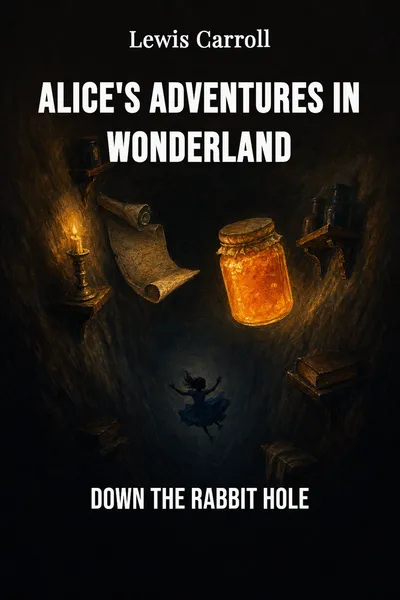
Alice's Adventures in Wonderland
Down the rabbit hole
Description
On a warm afternoon in July 1862, a mathematics lecturer at Oxford named Charles Dodgson took three young sisters out on the river near the city. To keep them entertained between the oars, he began improvising a story about a bored little girl who follows a rabbit underground. One of the sisters, Alice Liddell, asked him to write it down. He did, and three years later, under the name Lewis Carroll, the story reached the public as Alice's Adventures in Wonderland. It has never been out of print since.
The book opens with almost nothing happening. Alice is sitting on a riverbank, drowsy, glancing at her sister's book, which has no pictures or conversations in it and therefore, in her judgment, no point. Then a White Rabbit trots past, fully dressed, muttering that he is late, and pulls a watch out of his waistcoat pocket. She has never seen a rabbit with a pocket to keep a watch in. So she gets up and follows him, straight down the hole, and the fall goes on so long she has time to wonder aloud about it. That is the whole engine of the thing: curiosity, and a refusal to be surprised at the right moments.
Wonderland is often remembered as a parade of characters — the Cheshire Cat, the Mad Hatter, the Queen who wants everyone beheaded. But the earliest chapters, before any of them appear, are the ones that set the rules by which the rest will run. A child falls into a world where size is negotiable, where doors don't fit, where crying can flood a room. What that world is doing, underneath the whimsy, is worth following from the top.
The question we’re asking : What actually happens in the first descent into Wonderland, and why does a story built on pure nonsense hold together?What we’ll see : A single afternoon on a river, a girl who eats and drinks whatever is labelled, and the quiet argument a Victorian mathematician was making about how to tell a child a story.
Table of contents
01Chapter 1 — A rabbit with a pocket watch
The story begins with boredom, which is its own kind of honesty. Alice is on the bank with her sister on a hot day, too sleepy to do much, peering into a book that offers her nothing she can use. Carroll doesn't rush this. He lets her sit in the ordinary tedium of a long afternoon, because the whole point of what follows is that it interrupts something perfectly dull. Wonderland doesn't arrive as a promise; it arrives as a distraction from the absence of one.
Then the White Rabbit. On its own, a rabbit is nothing remarkable. What makes Alice move is a sequence of small wrongnesses she processes almost too calmly: the rabbit is talking to itself, it is fretting about being late, and then it produces a watch from a waistcoat pocket. Carroll's narrator notes that when she thought it over afterwards, she realised she ought to have wondered at all this, but at the time it seemed quite natural. That single observation is the key to the entire book — Wonderland works because Alice keeps not being astonished until it's too late to matter.

02Chapter 2 — The hallway of doors and the trouble with size
At the bottom, Alice finds herself in a long, low hall lined with locked doors. She tries them all; none will open. Then, on a little three-legged glass table, she finds a tiny golden key. It fits none of the big doors, but behind a curtain she discovers a door about fifteen inches high, and the key turns in it. Beyond is a garden — bright flowers, cool fountains, exactly the sort of place a child stuck indoors longs to reach. And she cannot get through, because she is far too large. She can barely fit her head into the passage.
This is where Wonderland shows its actual mechanism. The obstacle is not a monster or a villain. It is a mismatch of scale, a purely physical problem that no amount of courage solves. Alice's difficulties from here on are almost all logistical: she is the wrong size for the space she is in, and the space will not change to suit her. Carroll, a mathematician by trade, seems quietly delighted by this. The drama is geometric.
03Chapter 3 — A sea of one's own tears
Enormous, stranded, and unable to reach either the garden or the key, Alice does what a small child overwhelmed by an impossible situation does. She cries. And because this is Wonderland, where consequences are as oversized as she is, she cries on a scale to match her body. Great pools of tears gather around her, four inches deep, spreading across half the hall. She weeps as a nine-foot girl weeps, and the room begins to flood with the result.
There is a joke here, but it's a tender one. Carroll never mocks her for crying; he simply takes the tears as seriously as she does, and lets them behave like real water. She scolds herself for it — a person of her size, crying like that, ought to be ashamed — but she goes on anyway, and the flood keeps rising. It is one of the book's most quietly true moments: a child's distress treated as a genuine force in the world, large enough to change the landscape, rather than something to be hushed.
04Chapter 4 — The logic of a book that refuses to behave
Step back from the rabbit and the tears, and the striking thing about these opening chapters is how much Carroll trusts nonsense to carry weight. Nothing in Wonderland is symbolic in the tidy way Victorian children's books usually demanded. There is no moral pinned to the shrinking, no lesson about greed attached to the cake. Alice eats and drinks what is labelled because a curious child would, and the story simply follows what happens next. Carroll had grown up inside a literary culture that treated stories for children as delivery systems for instruction, and Wonderland is, from its first page, a quiet refusal of that whole arrangement.
What he offered instead was a world governed by its own consistent absurdity. Wonderland has rules — they are just not our rules. Size can be adjusted by eating; consequences are literal; a fall can take an hour; tears can flood a hall. Once you accept the premises, everything proceeds with a kind of dream-logic that never cheats. This is where the mathematician shows through. Carroll wasn't writing chaos; he was writing a system, playful but rigorous, in which the impossible follows reliably from itself.
05Conclusion
By the time Alice swims ashore among the dripping birds, the shape of Wonderland is fully set. A dull afternoon, a dressed rabbit, a long fall, a hallway of doors that won't cooperate, a body that keeps outgrowing or undershooting the space it's in, and a flood of tears that becomes a sea to swim through. She has arrived nowhere she planned and everywhere she was curious about, and the garden she glimpsed is still out of reach — which is exactly why she'll keep going.
Related books