

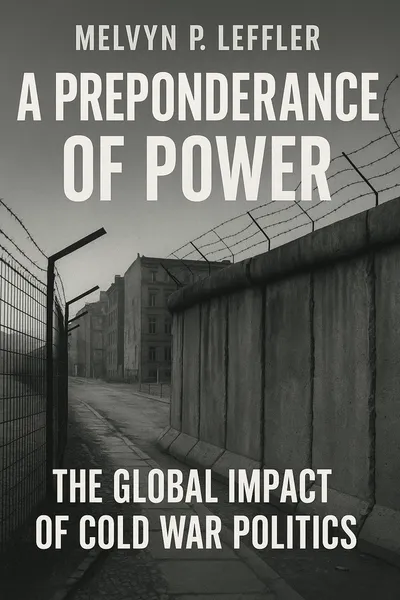
A Preponderance of Power
The global impact of Cold War politics
Description
"A Preponderance of Power" by Melvyn P. Leffler presents a fundamental reframing of American Cold War strategy, arguing that American policymakers deliberately pursued a strategy of preponderant power to reshape the international system according to their vision of security and economic interests, fundamentally transforming global geopolitics during the early Cold War period. The work demonstrates that American leaders consciously pursued overwhelming military, economic, and political dominance not merely as defensive response to Soviet actions, but as proactive strategy to create favorable global conditions for American values and interests.
Leffler examines American foreign policy formation during the crucial early Cold War years, focusing on the Truman administration's strategic calculations and their global ramifications. Drawing upon extensive archival research, the work situates American decision-making within broader contexts of economic reconstruction, security imperatives, and ideological competition. The analysis transcends traditional diplomatic history by incorporating insights from political economy and strategic studies, offering a comprehensive assessment of how American leaders conceptualized and implemented their vision of international order.
The central research question explores how and why American policymakers constructed a grand strategy based on maintaining preponderant power in the post-World War II international system. The main stake is to demonstrate that American Cold War policy represented calculated imperial design rather than reactive containment, fundamentally reshaping our understanding of Cold War origins and American global hegemony.
Leffler's comprehensive analysis fundamentally reframes understanding of American Cold War strategy by demonstrating its proactive, hegemonic character rather than reactive, defensive nature. The work reveals sophisticated integration of military, economic, and ideological instruments in service of global dominance, showing how American leaders consciously constructed international systems favorable to their interests and values. This synthesis illuminates the revolutionary transformation of American foreign policy from isolationist traditions toward permanent global engagement based on preponderant power. The intellectual contribution lies in demonstrating how security concepts expanded to justify unprecedented peacetime mobilization and intervention, creating institutional frameworks that would shape international relations throughout the Cold War period and beyond.
Table of contents
01The Architecture of American Hegemony
Leffler's analysis reveals how American policymakers conceptualized security through the lens of global dominance rather than traditional balance-of-power mechanisms. The theoretical framework employed draws heavily from realist international relations theory while incorporating elements of economic structuralism. American leaders perceived security as requiring not merely deterrence of potential threats, but active reshaping of international economic and political structures to preclude challenges to American interests.

02Economic Reconstruction and Strategic Control
The second major analytical axis examines how economic reconstruction programs served dual purposes of humanitarian assistance and strategic positioning. Leffler demonstrates that Marshall Plan initiatives and related economic policies were designed not merely to restore European prosperity, but to integrate Western economies into American-dominated systems of production and exchange. This economic architecture created dependencies that reinforced American political influence while marginalizing Soviet alternative models.
03Military Strategy and Global Positioning
Leffler's examination of military policy reveals profound tensions between declared defensive objectives and actual strategic deployments. The analysis demonstrates how American military planning consistently exceeded requirements for homeland defense or even alliance protection, instead emphasizing capabilities for global intervention and power projection. This military architecture reflected fundamental assumptions about American responsibilities and prerogatives in international affairs, creating institutional momentum toward interventionism.
04Democratic Values and Imperial Practice
The final analytical dimension addresses fundamental contradictions between American democratic ideals and hegemonic practices. Leffler explores how policymakers reconciled commitments to self-determination and democratic governance with support for authoritarian allies and intervention in sovereign nations. This tension generated elaborate ideological justifications that portrayed American dominance as benevolent leadership serving universal values.
05Critical Assessment and Contemporary Relevance
Despite its archival rigor, the work exhibits certain limitations in theoretical sophistication and comparative perspective. Leffler's analysis remains largely state-centric, underemphasizing transnational forces and non-governmental actors that influenced policy formation. The framework also displays insufficient attention to domestic political constraints and public opinion dynamics that shaped strategic options. Furthermore, the work's focus on American decision-making provides limited insight into Soviet perspectives and motivations, potentially reinforcing Western-centric interpretations of Cold War origins.