
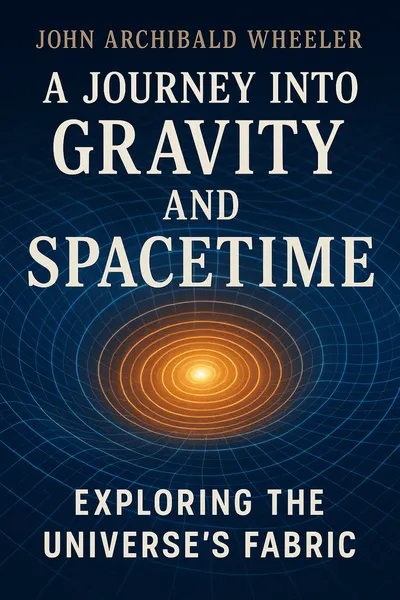
A Journey into Gravity and Spacetime
Exploring the universe's fabric
Description
Wheeler's pedagogical treatise emerges from decades of research in gravitational physics and represents his attempt to democratize Einstein's general relativity for undergraduate audiences. Writing as both a practicing physicist and experienced educator, Wheeler confronts the challenge of rendering one of physics' most abstract theories accessible without sacrificing conceptual rigor. The work situates itself within the broader tradition of popular science writing, yet maintains the analytical depth expected from a leading theoretician.
Wheeler argues that gravity and spacetime constitute a unified geometric framework where matter and energy determine the curvature of spacetime, which in turn governs the motion of matter. His central research question focuses on how the geometric nature of gravity and spacetime can be understood intuitively without advanced mathematical formalism. The defended thesis maintains that spacetime curvature provides the fundamental mechanism through which gravity operates, replacing Newtonian force-based explanations. The main stake involves transforming student comprehension of gravitational phenomena through geometric visualization and conceptual clarity.
Wheeler's achievement lies in successfully bridging the gap between mathematical formalism and conceptual understanding without sacrificing the essential insights of general relativity. His geometric interpretation provides students with intuitive tools for comprehending phenomena that previously required advanced mathematical training. The work demonstrates that pedagogical innovation can render seemingly inaccessible theories comprehensible to undergraduate audiences. The intellectual coherence of Wheeler's approach emerges from his deep understanding of both the mathematical structure of general relativity and the psychological barriers facing students. His systematic deconstruction of Newtonian assumptions, coupled with careful construction of geometric intuitions, creates a viable pathway for conceptual transformation.
Table of contents
01The Geometric Revolution in Physical Thinking
Wheeler's fundamental contribution lies in his systematic deconstruction of Newtonian gravitational intuitions. Rather than treating gravity as a mysterious force acting at a distance, he reconstructs our understanding through geometric principles. This paradigmatic shift requires abandoning deeply ingrained notions of absolute space and time, replacing them with a dynamic, curved manifold where matter and energy create deformations.
The theoretical framework Wheeler employs draws heavily from differential geometry, yet he translates these mathematical abstractions into accessible analogies. His famous rubber sheet metaphor, while imperfect, successfully conveys how massive objects warp spacetime fabric. This pedagogical strategy reveals Wheeler's deep understanding that physical intuition must precede mathematical formalization.

02Experimental Validation and Empirical Consequences
The societal implications of Wheeler's geometric interpretation extend far beyond academic physics. By emphasizing experimental confirmation of general relativity's predictions, Wheeler situates theoretical physics within broader scientific methodology debates. His treatment of phenomena like gravitational time dilation and light deflection demonstrates how abstract mathematical relationships manifest in measurable physical effects.
03Ethical and Societal Dimensions of Scientific Understanding
Wheeler's democratization of general relativity carries profound ethical implications regarding scientific literacy and public engagement with complex ideas. His commitment to accessible exposition reflects a belief that advanced scientific insights should not remain confined to narrow specialist communities. This democratic impulse challenges elitist tendencies within academic physics.
The work raises important questions about the responsibilities of scientific experts in communicating with broader audiences. Wheeler's success in translating mathematical abstractions into comprehensible concepts demonstrates that apparent incomprehensibility often reflects inadequate pedagogical effort rather than inherent conceptual impossibility. This suggests ethical obligations for scientists to engage in public education.
04Critical Assessment and Future Directions
Wheeler's approach suffers from inevitable limitations inherent in any popularization of advanced theoretical physics. His geometric analogies, while pedagogically useful, can mislead students into overly mechanistic thinking about spacetime curvature. The rubber sheet metaphor, in particular, suggests that spacetime deformation requires embedding in higher-dimensional space, obscuring the intrinsic nature of geometric curvature.
The work also exhibits certain theoretical biases reflecting Wheeler's classical general relativity background. His treatment largely ignores quantum gravitational considerations that have become increasingly important in contemporary physics. This omission, while understandable given the pedagogical focus, limits the work's relevance for students seeking comprehensive understanding of modern gravitational physics.