Yves Saint Laurent
Couture meets the street
Description
In August 1957, a twenty-one-year-old assistant found himself running the most famous fashion house in the world. Christian Dior had died of a heart attack in Italy, and the man he had quietly groomed as his successor was Yves Saint Laurent, a shy, bespectacled Algerian-born designer who had joined the house three years earlier. His first collection for Dior, shown in January 1958, was called the Trapeze line, and it made him, overnight, the great hope of Paris couture. The salons that had built their reputation on cinched waists and rigid silhouettes were suddenly betting everything on a very young man with a soft voice and unusual ideas about what a woman's body should be allowed to do inside a dress.
What followed was a career of steady insubordination against the very tradition that had crowned him. Couture in the 1950s was a closed world: a few hundred private clients, hand-sewn garments, prices that excluded almost everyone, and an unspoken agreement about what elegance looked like. Saint Laurent kept the craft and dismantled the agreement. He borrowed from the male wardrobe, from the street, from workwear and art, and put it all on the bodies of women who had never before been dressed that way in a couture house. Each rupture drew criticism; most of them became, within a few years, simply the way people dressed.
The through-line of his work is a quiet argument about who fashion is for. He kept asking whether the thing that made couture beautiful had to stay locked behind a private appointment on the Avenue Montaigne, or whether it could travel. That question, more than any single garment, is what makes him worth returning to.
The question we’re asking : How did one couturier keep breaking the rules of his own trade — and where did that leave the closed world of haute couture?What we’ll see : A series of ruptures, from a house heir to a shop on the Left Bank, that pulled elegance out of the private salon and into everyday life.
Table of contents
01Chapter 1 — The boy who inherited Dior
Yves Saint Laurent was born in Oran, in French Algeria, in 1936, into a comfortable family that indulged his early obsession with dressing the women around him. He made paper dolls, designed clothes for his mother and sisters, and by his teens was sketching with a fluency that startled the professionals he showed his work to. In 1954 he won a prize from the International Wool Secretariat for a cocktail dress; a young Karl Lagerfeld won in another category the same year. The drawings reached Michel de Brunhoff, the editor of French Vogue, who introduced the boy to Christian Dior himself.
Dior hired him almost immediately. For three years Saint Laurent worked closely under the most powerful couturier alive, absorbing the discipline of the house — the toiles, the fittings, the exacting hierarchy of the atelier. When Dior died suddenly in 1957, the house needed a successor fast, and the commercial stakes were enormous: Dior alone accounted for a substantial share of France's fashion exports. Naming a twenty-one-year-old was a gamble the house made because it had few other options and because Dior had signaled his confidence.

02Chapter 2 — The tuxedo made for a woman
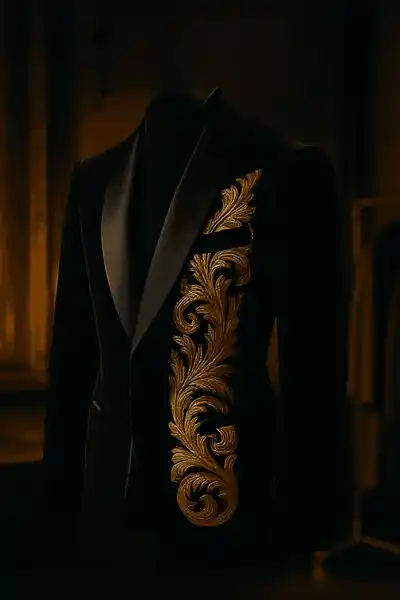
In 1966, Saint Laurent showed a garment that would become his signature and, in a sense, his manifesto: Le Smoking, a tuxedo cut for a woman. A dinner jacket, trousers, a crisp shirt — the whole grammar of male formalwear, tailored to a female body. It sounds unremarkable now, which is precisely the measure of how completely the idea won. In 1966 it was closer to scandal. Restaurants were known to turn away women in trousers, and a woman in a tuxedo read as a deliberate transgression rather than a fashion choice.
The provocation was not novelty for its own sake. Saint Laurent understood something about the male wardrobe that couture had ignored: its garments were built for authority, comfort and movement, qualities that women's evening clothes systematically withheld. Le Smoking offered a woman the same armor a man wore to command a room. The photographer Helmut Newton would later shoot it on a Paris street at night, and the image — androgynous, self-possessed, faintly dangerous — fixed the garment in the culture more firmly than any runway could.
03Chapter 3 — Rive Gauche opens its doors
In 1966, the same year as Le Smoking, Saint Laurent opened a boutique on the rue de Tournon on the Left Bank of Paris and called the line Saint Laurent Rive Gauche. It was not a couture salon. It sold ready-to-wear — clothes made in standard sizes, in series, at prices a working professional could contemplate. For a couturier at the top of the trade, this was close to heresy. Couture defined itself by its opposite: the unique garment, hand-finished, fitted to one body over many appointments.
The economics behind the decision were real. Haute couture was becoming a beautiful liability — enormously expensive to produce, dependent on a shrinking pool of very rich clients, and increasingly a prestige loss-leader rather than a business. Saint Laurent and Bergé saw that the future revenue lay elsewhere: in ready-to-wear, in licensing, and eventually in the perfume that would fund everything else. Rive Gauche was a commercial bet as much as a creative one.
04Chapter 4 — When the runway loses its monopoly
Saint Laurent was not the first designer to sell ready-to-wear, and he did not invent the idea that clothes could be made in series. What his career marks is the moment the balance of authority tipped. For most of the twentieth century, haute couture had been the place where fashion was decided. The couturier proposed, the salons showed, and the styles filtered downward and outward through copies, patterns and cheaper imitations. Ready-to-wear existed, but it followed. When a couturier of Saint Laurent's stature put his own name and his own designs directly into a boutique, he collapsed the distance between the source and the street.
The consequence was structural. If the same taste and the same silhouette could be bought ready-made, the private appointment stopped being the only way to be well dressed — and stopped being the only place a designer's reputation was built. Prestige still lived in the couture show, but money and cultural reach migrated to the ready-to-wear line and the licensed products that hung off the name. The perfume, the sunglasses, the logo on a scarf: these came to carry the house as much as the hand-sewn gown, and other houses followed the same path because the arithmetic left them little choice.
05Conclusion
The boy who took over Dior in 1957 spent the next four decades pulling at the seams of the trade that had made him. He kept the craft — the toiles, the ateliers, the fittings he learned under Dior — and turned it against the tradition's assumptions about who couture was for and what a woman was allowed to wear. The tuxedo, the safari jacket, the trouser suit and the shop on the Left Bank were all versions of the same move: take something that had been out of reach or off-limits, and hand it over.
Related books