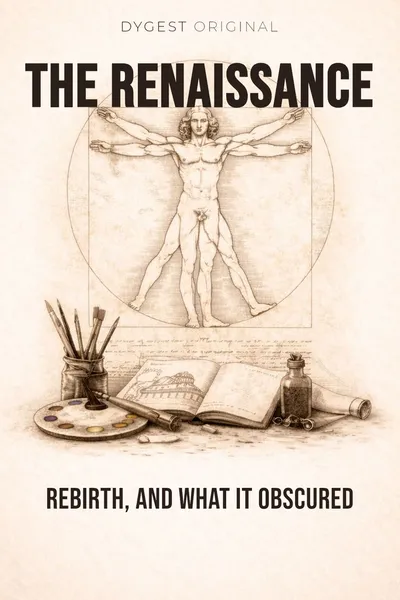
The Renaissance
Rebirth, and what it obscured
Description
Nobody living in fifteenth-century Florence woke up and told a friend they were having a Renaissance. The word we use for the whole period wasn't coined until 1855, when the French historian Jules Michelet used "la Renaissance" as the title of a volume in his history of France. The Swiss scholar Jacob Burckhardt gave the idea its lasting shape in 1860, in a book that described the era as the moment Europe woke up, rediscovered the individual, and stepped out of the long shadow of the medieval Church. A painter like Botticelli would have had no idea he was living in something so tidy.
The label stuck because it flattered everyone who inherited it. "Rebirth" implies that something had died, and by naming the middle ages as the corpse, the Renaissance got to cast itself as the return of life, light, and reason. It's a beautiful story, and like most beautiful stories about ourselves, it does some quiet editing along the way. The paintings are real. The engineering is real. Michelangelo really did carve the David out of a botched block of marble that two other sculptors had already given up on. But the frame around all of it was built centuries afterward, by people who needed a hinge on which to hang the whole idea of the modern West.
So it's worth sitting with the gap between what happened and what we later decided it meant. The achievements don't need defending; they defend themselves. What's harder to see is the machinery underneath — who paid, what was quietly borrowed, and who never made it into the group portrait at all.
The question we’re asking : How did a period nobody named at the time become the story of how the modern world was born — and what did that story leave out?What we’ll see : Behind the marble and the perspective lines, a tangle of money, borrowed knowledge, and people kept out of the frame.
Table of contents
01Chapter 1 — The word arrived four centuries late
The people we now file under "Renaissance" did have a sense that something was shifting, but they described it differently. The poet Petrarch, back in the 1330s, wrote about the centuries before him as an age of "darkness" and imagined a future that would find its way back to the clear light of Rome. Painters and scholars talked about a rinascita, a rebirth of the good arts, and the biographer Giorgio Vasari used that word in 1550 to describe how art had climbed back from crude beginnings to the heights of his own hero, Michelangelo. So the seed of the idea was there. What wasn't there was the grand, all-encompassing period we now mean.
That larger frame is a nineteenth-century invention. Michelet and Burckhardt were writing at a moment when Europe wanted an origin story for its own confidence — for science, secular states, the free individual. The Renaissance made a perfect one. It could be set against a medieval world painted as superstitious and stagnant, and it could be pointed forward toward everything modern Europeans liked about themselves. The historians weren't lying. They were shaping, the way anyone shapes a story when they already know how they want it to end.

02Chapter 2 — The bankers who paid for beauty
Genius doesn't hang on a wall by itself. Someone commissions it, feeds the artist, and covers the cost of the pigment ground from lapis lazuli shipped in from Afghanistan. In Florence, that someone was, again and again, the Medici — a family that made its fortune not in art but in banking, and specifically in being the bankers to the papacy. Cosimo de' Medici, who effectively ran the city from behind the scenes starting in 1434, spent staggering sums on buildings, manuscripts, and artists, partly out of taste and partly to launder a fortune that the Church officially frowned on lending at interest.
This is the part the flattering version tends to soften. The soaring humanist ideal of the dignity of man was underwritten by very worldly money — trade in wool and silk, currency exchange, and loans to princes and popes. Patronage was never pure. A commissioned altarpiece was an act of devotion, an advertisement of wealth, and a bid for social standing all at once. The donor often got himself painted into the scene, kneeling in the corner of a sacred moment he had paid to have depicted.
03Chapter 3 — The classics never actually left
The core Renaissance claim is a rediscovery: that Europe recovered the lost wisdom of Greece and Rome and, dusting it off, launched itself into the modern age. There's truth in it. Scholars did hunt down forgotten manuscripts in monastery libraries, and the fall of Constantinople in 1453 sent Greek-speaking scholars west with texts and the ability to read them. Something genuinely opened up. But "rediscovery" quietly implies the knowledge had been sitting in a locked box the whole time, waiting for the right Italians to find it.
Much of it had instead been kept alive, translated, and expanded elsewhere. During the centuries Europe supposedly slept, scholars across the Islamic world — in Baghdad, Cairo, and the cities of Muslim Spain — translated Aristotle, Euclid, and Galen into Arabic, argued with them, and pushed the work forward in medicine, optics, algebra, and astronomy. The very word algebra comes from the title of a ninth-century treatise by al-Khwarizmi. When these texts flowed back into Europe, often through Spain and Sicily and rendered from Arabic into Latin, they arrived enriched rather than merely returned.
04Chapter 4 — Who was standing outside the frame
Step back from the individual masterpieces and look at the group portrait the word "Renaissance" has painted, and the striking thing is how few people are actually in it. The celebrated figures are overwhelmingly men, overwhelmingly attached to wealthy courts and cities, overwhelmingly working within a narrow band of Italy and, later, a few northern European centers. The story of a whole continent being reborn was really the story of a small elite doing extraordinary things with the resources of many.
Women were largely kept out of the workshops and academies where reputations were made, though a few — the painter Sofonisba Anguissola, the poet Vittoria Colonna — pushed through anyway, usually because birth gave them access others were denied. The vast majority of the population, the farmers and laborers and servants whose taxes and work sustained the cities, appear in the period mostly as backdrop, if at all. And the same decades we celebrate as a flowering were the decades Europe expanded outward, when the wealth pouring into some of these cities was increasingly entangled with conquest, colonization, and the beginnings of the Atlantic slave trade.
05Conclusion
The paintings are still on the walls, and they still stop people in their tracks. That was never the question. The David is astonishing, the dome over Florence is a marvel of engineering, and the men who made those things earned their place in memory. What's worth remembering alongside them is that the tidy word we use to hold it all together was fitted on much later, by people who wanted a clean beginning for the modern world and found one ready-made in Italy.
Related books