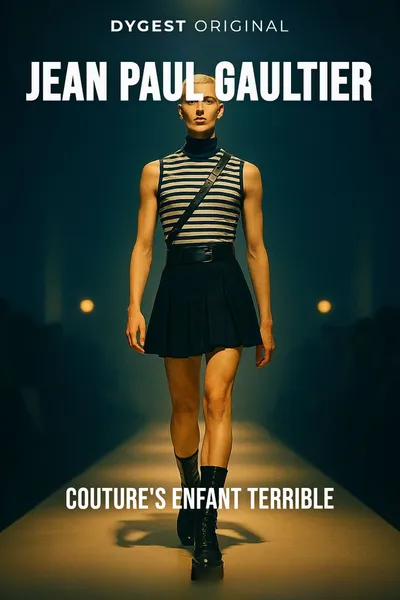
Jean Paul Gaultier
Couture's enfant terrible
Description
In January 2020, on a stage at the Théâtre du Châtelet in Paris, Jean Paul Gaultier took his final bow as a couturier. He had announced, a few days earlier, that this fiftieth-anniversary show would be his last. The runway was a party more than a farewell: two hundred looks, cameo appearances, drag performers, models of every age and body, a marching band. At sixty-seven, the man French journalists had spent four decades calling the enfant terrible of fashion was closing the house that carried his name — not in disgrace, not in bankruptcy, but at the top, on his own terms, with confetti.
He had never trained at a fashion school. He had never learned to sew a garment in the traditional sense. He sent his sketches, as a teenager, to the couturiers he admired, and Pierre Cardin hired him in 1970 on the strength of the drawings alone. From there Gaultier built a career out of doing the things couture was not supposed to do: putting men in skirts, women in corsets worn as armor, cans of food on the runway, and a conical bra on the most famous pop star alive. He treated the sacred rituals of Paris fashion as a playground.
And yet, by the time he retired, the provocations had a strange afterlife. The same gestures that once scandalized the front row had become the reliable engine of a global business — one that outlived every runway show. Gaultier's story is not simply the story of a rebel. It is the story of what happens to rebellion when the industry it teased decides it likes the joke.
The question we’re asking : How did a self-taught provocateur turn couture's taboos into his signature — and what became of that transgression once the industry embraced it?What we’ll see : A career built on breaking the rules of Paris fashion, and the quieter fate of what happens after the shock wears off.
Table of contents
01 Chapter 1 — The boy who drew corsets on his teddy bear
Gaultier grew up in Arcueil, a working-class suburb south of Paris, born in 1952. The origin story he told for decades has a single fixed point: his grandmother's corset, and the black-and-white television broadcast of the Folies Bergère music hall that his family watched. Somewhere between the two, the boy found his subject. He dressed his teddy bear, Nana, in a paper cone bra long before Madonna ever wore one. The image is almost too neat, and Gaultier knew it — he repeated it because it was true and because it explained everything that came after.
There was no art school, no apprenticeship in the couture ateliers of the rue du Faubourg Saint-Honoré. What Gaultier had instead was a habit of drawing and a nerve most teenagers lack. He posted his sketches to designers he admired, and on his eighteenth birthday, in 1970, Pierre Cardin took him on as an assistant. He passed through the studios of Cardin, then Jacques Esterel, then Jean Patou — an education by osmosis, absorbing the grammar of French fashion from the inside while never quite belonging to its institutions.

02 Chapter 2 — The cone bra and the theater of the body
The single object most people associate with Gaultier is a corset with two sharp cones for a bust — worn by Madonna on her 1990 Blond Ambition tour. She had asked him to dress the show, and he gave her lingerie as outerwear: the corset pulled out of the bedroom and onto the world's biggest stage, satin, structured, unmistakably armor. The look became one of the defining images of the decade, and it fused Gaultier's name to Madonna's in the popular imagination for good.
But the cone bra was not a stunt Gaultier invented for a pop star. He had been building corsets into his collections since the early 1980s, treating underwear as the most honest kind of clothing — the layer that actually touches the body, dragged into the light. The idea ran through his work with real consistency: the corset dress, the trench coat over a bustier, the tattoo-print bodysuits that made skin itself look like a garment. He was interested in the body as spectacle, and in refusing the line between what you show and what you hide.
03 Chapter 3 — A man in a skirt, a runway of everybody
In 1985, Gaultier staged a collection titled "Une garde-robe pour deux" — a wardrobe for two — and sent men down the runway in skirts. Not as costume, not as a gag, but as clothing proposed for actual wear. The reaction was predictable: ridicule, discomfort, headlines. A man in a skirt violated something the culture treated as settled. Gaultier kept doing it, season after season, wearing the skirts himself, and slowly the idea stopped being unthinkable and started being an argument he had simply refused to lose.
This was the deeper strain in his work, beneath the corsets and the spectacle. Gaultier used clothes to ask who was allowed to wear what. He put masculine tailoring on women and lingerie on men, mixed the codes, blurred the borders. He drew openly on gay male culture at a moment when much of the fashion establishment preferred to keep that influence unspoken, and he did it during the years the AIDS crisis was tearing through exactly those communities. The play was serious.
04 Chapter 4 — The provocation that became a perfume
The most durable object Gaultier ever made was not a garment. It was a bottle. In 1993 he launched his first fragrance, and the flacon was a torso in a corset — the cone-bra silhouette rendered in glass, sold at every airport and department store counter in the world. "Classique" for women, followed by "Le Male" for men in 1995, in a bottle shaped like a sailor's striped torso. "Le Male" became one of the best-selling men's fragrances on the planet and stayed there for decades. The provocation had been distilled, literally, into something you could buy for fifty euros.
This is the quiet ending under the loud career. The corset that once scandalized a couture audience became a shape you recognized on a shelf. The sailor stripe, borrowed from the docks and the gay bars, became a luxury signature and then a licensing asset. The runway carnivals were extravagant and mostly unprofitable; the perfume paid for everything, and eventually it was the perfume, sold through a partnership with the beauty group Puig, that carried the brand. When Gaultier stopped showing ready-to-wear in 2015, the business did not blink.
05 Conclusion
When Gaultier took his final bow at the Châtelet in 2020, the crowd was celebrating a man who had spent fifty years being told he had gone too far, and who had turned out to be right most of the time. Men wear skirts on runways now without comment. Corsets are power symbols. Casting a range of bodies is a stated corporate goal. The things that made Gaultier the enfant terrible are, in large part, simply the vocabulary of contemporary fashion — absorbed so completely that their origin is easy to forget.
Related books