
Fort Sumter
The bombardment that opened the Civil War
Description
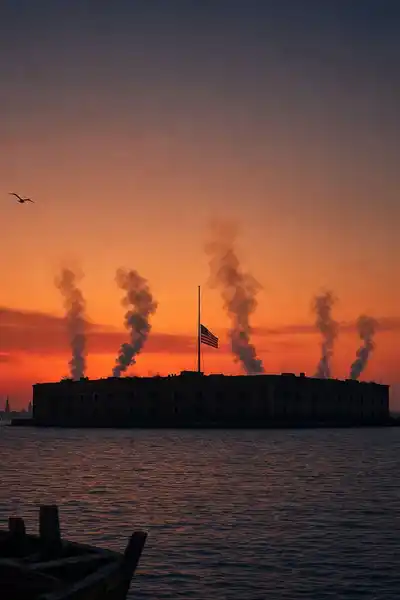
At 4:30 in the morning of April 12, 1861, in the harbor of Charleston, South Carolina, a mortar battery of the newly formed Confederate Army opened fire on the federal installation called Fort Sumter, a five-sided masonry fortification built on an artificial island at the mouth of the harbor. The fort was held by a federal garrison of approximately eighty-five men under the command of Major Robert Anderson, who had moved his force to Sumter from the more vulnerable Fort Moultrie on the mainland the previous December. The bombardment continued across the subsequent thirty-four hours, with approximately 3,000 shells being fired into the fort. The federal garrison, substantially outgunned and running out of ammunition, was unable to mount an effective defense. Anderson surrendered the fort at approximately 2:30 in the afternoon of April 13. The Confederate forces took possession of the installation, and the federal garrison was permitted to evacuate to the federal fleet that had been unable to relieve the position. No combat deaths occurred during the bombardment itself, though one Union soldier was killed by an accidental explosion during the evacuation ceremony.
The bombardment of Fort Sumter was the formal beginning of the American Civil War, which would continue across the subsequent four years and produce approximately 750,000 American military deaths substantially more than any other war in American history. The political conditions that produced the war had been accumulating across the previous four decades, with the substantial conflict over slavery, over the political balance between the slaveholding South and the increasingly industrial North, over the territorial expansion of the country across the Mexican Cession and the new western territories, and over the constitutional status of the federal versus state governments. The specific event of the Fort Sumter bombardment was substantially the product of a political crisis that had been developing across the previous four months, since the secession of South Carolina from the Union in December 1860.
The case has become one of the central reference points in American historical memory. The bombardment of Fort Sumter has been substantially treated as the moment when the political conflict that had been developing across the previous decades was substantially transformed into the military conflict that would substantially reshape the American republic. The framework that emerged from the war the constitutional resolution of the slavery question, the substantial expansion of federal authority, the substantial transformation of American political alignment has continued to operate as one of the principal frameworks of contemporary American politics. The bombardment that began at 4:30 a.m. on April 12, 1861 was the specific event that initiated this substantial transformation.
The question we’re asking: what was Fort Sumter, why did the bombardment occur when it did, and what does the case reveal about how political crises transition into military conflict?
What we’ll see: the political crisis of 1860-1861 and the secession of South Carolina, the specific events that produced the bombardment, the political consequences of the opening shots, and what survives.
Table of contents
01The political crisis of 1860-1861
The political conditions that produced the war had been developing across four decades. The Missouri Compromise of 1820 had established the framework for balancing the admission of slaveholding and free states. The Compromise of 1850 had attempted to manage the tensions produced by territorial expansion after the Mexican-American War. The Kansas-Nebraska Act of 1854 had destabilized the previous compromises by permitting territorial populations to decide on slavery through popular sovereignty. The Dred Scott decision of 1857 had declared that Congress had no constitutional authority to restrict slavery in the territories. The cumulative effect across the 1850s was the collapse of the previous framework for managing the slavery question through political compromise.
The presidential election of November 1860 produced the immediate political crisis. Abraham Lincoln, the Republican candidate, was elected with approximately 40 percent of the popular vote, having received substantial majorities in the northern states and substantially no electoral votes from the slaveholding South. The Republican Party had been substantially organized around the position that slavery should not be permitted to expand into the western territories, and the Lincoln victory substantially threatened the continued political balance between the slaveholding and free states. The southern political response was substantial. South Carolina seceded from the Union on December 20, 1860. Mississippi seceded on January 9, 1861. Florida, Alabama, Georgia, Louisiana, and Texas followed across the subsequent weeks. The seven seceded states formed the Confederate States of America at a convention in Montgomery, Alabama, in February 1861, with Jefferson Davis as president.

02The specific events that produced the bombardment
Lincoln’s inauguration on March 4, 1861, changed the political calculation. The inaugural address declared that the union was perpetual, that secession was constitutionally invalid, and that the federal government would “hold, occupy, and possess” the federal property in the seceded states. The address committed to maintaining Fort Sumter while avoiding direct provocation. The political framework was unsustainable: Anderson’s garrison was running out of food and would have to be reinforced or withdrawn within several weeks.
The decision Lincoln made in early April was substantially carefully calibrated. He decided to resupply the fort with food but not with weapons or additional troops. He notified the South Carolina governor in advance that a relief expedition was coming and that it would not be reinforced if the resupply was permitted to proceed. The framework substantially placed the political responsibility for any armed conflict on the Confederate authorities: if they permitted the resupply, the fort would remain in federal hands; if they fired on the resupply expedition, they would be the substantial initiators of armed conflict.
03The political consequences of the opening shots
The political consequences of the bombardment were substantial and immediate. Lincoln’s response on April 15 was a substantial call for 75,000 volunteers to suppress the rebellion. The framework substantially declared that the federal government would militarily resist the secession. The political reception in the northern states was substantially overwhelming, with substantial volunteer enlistment occurring across the subsequent weeks. The political reception in the four remaining slaveholding states that had not yet seceded Virginia, North Carolina, Tennessee, and Arkansas was substantially the opposite, with all four states seceding in the subsequent weeks in response to Lincoln’s call for volunteers. The Confederate forces grew from seven states to eleven, with substantial expansion of the military and economic capacity available to the secessionist cause.
04What survives, and what the case shows
Fort Sumter has continued to exist as a substantial physical monument to the events of April 1861. The fort was substantially damaged during the subsequent war by Union bombardment of Confederate-held Charleston, with the structure being substantially reduced to ruins by 1865. The federal government acquired the fort after the war and substantially preserved it as a national monument. Fort Sumter National Monument, established in 1948, has continued to operate as one of the substantial sites of American historical memory.
The deeper lesson the case offers is about how political crises transition into military conflict. The Fort Sumter bombardment was substantially the product of a political situation in which both sides had developed positions that were substantially incompatible. The federal government could not constitutionally accept the secession; the Confederate government could not politically accept the continued federal presence in its claimed territory. The specific event that produced the transition from political crisis to military conflict was substantially the result of the careful political calculation that Lincoln had made — to place the responsibility for the first shots on the Confederate authorities combined with the Confederate decision to accept that responsibility rather than permit the federal resupply.
05Conclusion
Major Robert Anderson, the federal commander at Fort Sumter, returned to the fort in April 1865, four years after his surrender, to substantially raise the federal flag over the recaptured installation. The ceremony, conducted on April 14, 1865, was substantially symbolic of the federal victory in the war that the bombardment had initiated. Anderson died several years later, having lived to see the substantial federal restoration that the war had produced.