
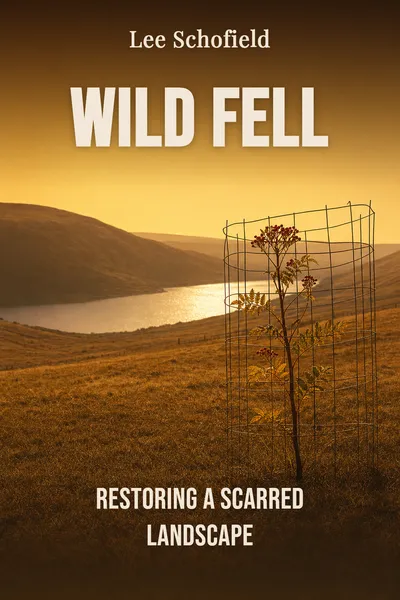
Wild Fell
Restoring a scarred landscape
Description
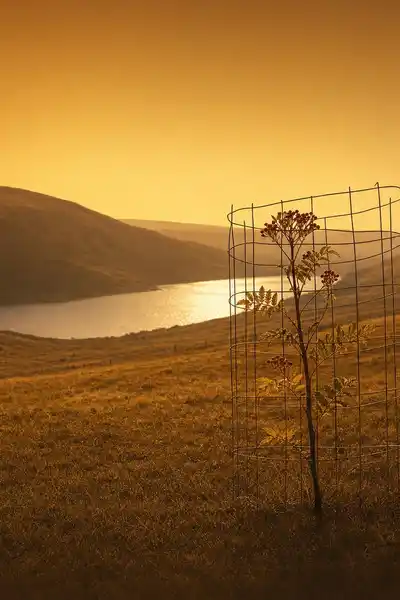
Haweswater sits in the eastern corner of the Lake District, a reservoir ringed by fells that draw walkers and photographers by the thousand. It looks like the postcard everyone has of upland England: sheep dotting close-cropped grass, dry-stone walls climbing impossible slopes, a silvery lake below. In 2012, an ecologist named Lee Schofield took over the running of two hill farms here, Naddle and Swindale, on land owned by United Utilities and managed with the RSPB. His brief, roughly, was to bring the place back to life. The problem was that most visitors could not see it was dying.
Because the beauty is real, but it is also the look of exhaustion. Centuries of intensive grazing had eaten the fells down to a stubble. The rivers had been straightened into drainage ditches. Woodland had retreated to a few gorges too steep for sheep. What reads as timeless wilderness is, in ecological terms, closer to a lawn — quiet, uniform, emptied of the birds, trees and insects that once filled it. Schofield's task was to reverse that on a working farm, in a valley where farming is not just an economy but an identity going back generations.
Wild Fell is the book he wrote about the attempt: part memoir, part nature diary, part honest ledger of what worked and what didn't. It is not a triumphant story. Rivers were re-wiggled, trees planted, meadows coaxed back — and some of it flooded, failed, or ran into a wall of local resistance. What the book offers instead is something rarer than success: a close, patient account of what it actually takes to mend a piece of ground.
The question we’re asking : What does it really take to restore a scarred upland landscape — and who gets to decide what it should look like?What we’ll see : One valley in the Lake District, the slow work of bringing back water, trees and wildlife, and the harder work of doing it among people who love the land as it is.
Table of contents
01Chapter 1 — The postcard that hides a wound
Schofield opens by asking us to look again at what we think we're admiring. The Lake District that Wordsworth walked and that UNESCO later crowned a World Heritage Site is celebrated as sublime nature. But the bare green slopes are not what nature would build if left alone. They are the product of relentless sheep grazing, drainage and burning stretched over hundreds of years — a landscape sculpted down to its bones. Ecologists have a blunt name for terrain like this: sheep-wrecked. The grass is short because nothing is allowed to grow taller.
At Haweswater the symptoms were everywhere once he learned to read them. Bird species that should have been common were scarce or gone. The soils were thin and leaking carbon. Streams that ought to have braided and wandered had been forced into straight, fast channels that flushed water and gravel off the hills as quickly as possible. In heavy rain the valley shed its water like a tin roof, which is part of why places downstream flood. A healthy upland holds water; this one threw it away.

02Chapter 2 — Letting the water find its way back
The most striking single act in Wild Fell is what the team did to the beck at Swindale. A century or more earlier, the stream had been straightened and embanked to reclaim grazing land, turned into a fast, dead channel running arrow-like down the valley floor. Schofield and his colleagues decided to put the wiggle back. Using old maps and the ghost lines of the original course still faintly visible in the ground, they carved a new-old channel with meanders, riffles and pools, then diverted the water into it and let the straight cut heal over.
It sounds simple written down; it was not. The work meant machinery in a river, careful engineering, and a nerve-wracking wait to see whether the reshaped stream would behave. Rivers do not always cooperate. But this one did. Within a remarkably short time the meandering beck slowed, spread and started doing what rivers do — depositing gravel where salmon and trout spawn, creating varied habitat along its banks, holding water in the landscape instead of racing it away. Fish returned to reaches they had abandoned. The valley began, quietly, to breathe.
03Chapter 3 — The neighbours who watch from the fence line
The rivers were the easy part. The harder terrain in Wild Fell is human. Hill farming in the Lakes is more than a livelihood; it is a culture, bound up with distinctive breeds of sheep, with families who have worked the same land for generations, and with a fierce pride in a way of life that feels under siege from every direction. Into this, Schofield arrives representing a conservation charity, reducing sheep numbers and letting the grass grow — doing, in effect, the opposite of everything the community understands as good husbandry.
The tension is not abstract. Fewer sheep, long grass and regenerating scrub read, to a neighbouring farmer, as neglect. There is real grief here too. When the word 'rewilding' entered the debate, it landed as a threat: an outsider's fantasy that would erase people from the land and turn working farms into wilderness theme parks. Schofield is careful with that word, and careful with the people. He records the awkward conversations, the suspicion at meetings, the sense of being watched from the fence line, and he does not pretend to have charmed everyone round.
04Chapter 4 — What a healed valley asks of us
Step back from Haweswater and Wild Fell becomes a book about a national blind spot. Britain treasures its uplands as the very image of unspoilt nature, yet those bare, beautiful hills are among the most ecologically depleted landscapes in Europe — a green desert dressed as wilderness. Schofield's quiet, radical point is that we have mistaken the symptom for the scenery. We have learned to love the wound. Restoration, then, is not just an engineering problem; it is a problem of perception, of teaching ourselves to see absence where we were trained to see beauty.
This reframes what 'natural' even means. If the fells we cherish are a human artefact, then there is no pristine past to snap back to — only choices about what kind of nature we want to make room for next. That is a more unsettling idea than it first sounds. It removes the comfortable notion that conservation means leaving things alone, and replaces it with a harder one: that the land is already so shaped by us that healing it requires active, ongoing, contestable intervention. Someone has to decide. Someone has to act.
05Conclusion
By the end, the postcard has changed, if you know how to look. The beck at Swindale meanders again, fish in its pools. Trees are climbing back up the gorges. In some fields the grass grows long and loud with insects, and birds that had thinned to rumour are nesting once more. None of it is finished, and Schofield is scrupulous about the failures folded in among the gains — the plantings that died, the arguments that never resolved, the pace that tests a person's faith. This is what restoration actually looks like, stripped of the triumphant music.