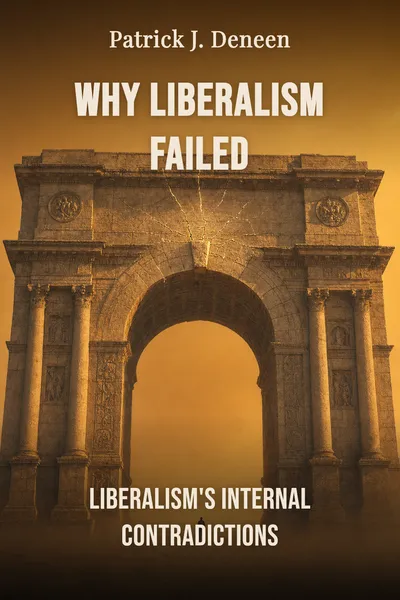
Why Liberalism Failed
Liberalism's internal contradictions
Description
By the early 1990s, the argument seemed settled. Fascism had died in a bunker in 1945; communism had folded almost bloodlessly when the Berlin Wall came down in 1989 and the Soviet Union dissolved two years later. Of the three great ideologies that had fought over the twentieth century, only one was left standing. Liberalism — not the American partisan label, but the broader project of individual rights, free markets, consent, and limited government that runs from John Locke through the American founding — had outlasted its rivals. Francis Fukuyama famously called it the end of history. The winner, it seemed, needed no defense, because there was nothing left to defend against.
Patrick Deneen, a political theorist at Notre Dame, published a book in 2018 that took that victory and turned it inside out. His title was blunt: Why Liberalism Failed. Not why it might fail, or why its enemies wanted it to. His claim was stranger and harder to shake — that liberalism is failing precisely because it has succeeded. The loneliness, the inequality, the distrust of institutions, the sense that something in modern life has come loose: these, he argues, are not malfunctions in an otherwise sound machine. They are the machine working as designed, arriving finally at its destination.
That reframing is what makes the book worth sitting with, whether or not we end up agreeing. Most critiques of liberal societies ask how to fix them with more liberalism — more rights, more markets, more choice. Deneen asks whether the medicine is the disease. If the very things liberalism promised have produced their opposites, then the crisis cannot be patched. It has to be understood at the root.
The question we’re asking : What if liberalism is unraveling not despite its triumph, but because of it?What we’ll see : How a single surviving ideology turned its own founding promises against the people who inherited them.
Table of contents
01Chapter 1 — The last ideology standing
Deneen begins with a diagnosis of victory itself. When an ideology defeats all its rivals, it stops looking like an ideology. It starts to look like reality — the natural, neutral background against which everything else happens. This, he argues, is exactly what happened to liberalism after 1989. Because fascism and communism had lost so completely, liberalism was free to present itself not as one contestable vision of the good life among others, but as the inevitable end-point of human political maturity. To question it was to sound nostalgic, or dangerous, or simply confused about how the world works.
But an ideology it remains, with a specific origin and specific commitments. Deneen traces it to the seventeenth and eighteenth centuries, to thinkers who made a deliberate break with the older classical and Christian understanding of freedom. For the ancients and for the medieval tradition, liberty meant self-mastery — the disciplined capacity to govern one's own appetites, cultivated through habit, community, and law. Freedom was something you achieved. The liberal revolution redefined it. Freedom became the absence of external constraint: the individual, imagined as prior to any community, free to choose whatever ends he liked so long as he harmed no one.

02Chapter 2 — The two revolutions that undid the self
The engine of the book is a claim about anthropology — about what liberalism assumes people are. If the free self is imagined as standing apart from nature and from community, then two things must be transformed to make that self real. The first is the natural world, which becomes raw material for human mastery rather than a given order we belong to. The second is human relationships, which become voluntary and revocable rather than binding. Deneen calls these the two revolutions, and he argues they run deeper than the usual left-right divide suggests.
On one side sits the revolution against nature, most visible in the economy. Classical and Christian thought had treated unlimited acquisition as a vice; liberalism, following Locke and later the free-market tradition, reframed the conquest of scarcity as the central human project. Nature exists to be transformed into wealth. This produced staggering material gains — and, Deneen argues, a habit of mind that treats every limit, ecological or bodily, as an obstacle to be engineered away rather than a boundary to be respected.
03Chapter 3 — The freedom that built the biggest state
Here Deneen turns to the contradiction he finds most revealing, because it inverts what liberalism believes about itself. Liberalism describes itself as the enemy of centralized power, the philosophy of limited government and individual autonomy. Yet the liberal era has produced the largest, most pervasive, most administratively intrusive state apparatus in human history. This is not an accident or a betrayal of the creed. Deneen argues it follows directly from the creed's success.
The logic is uncomfortable but clean. As liberalism strips away the intermediate institutions that once held people together — the extended family, the church, the guild, the tight local community, what earlier thinkers called the little platoons — individuals are left standing alone before two vast forces: the market and the state. The old buffers are gone. So the functions those institutions used to perform, from caring for the old to schooling the young to catching people when they fall, migrate outward to the only bodies large enough to absorb them. The isolated individual and the expanding state are not opposites. They grow together.
04Chapter 4 — The debt liberalism never repaid
Step back from the specific contradictions, and Deneen's larger argument comes into focus. Liberalism, he contends, has always lived off inherited capital it did not create and could not replace. It presumed a citizenry already shaped by older traditions — religious, familial, civic — that taught self-restraint, obligation, and trust. On those pre-liberal virtues, liberal institutions depended: consent means little among people incapable of keeping promises; markets collapse without honesty; self-government fails without citizens formed to govern themselves. Liberalism drew on this reservoir while quietly draining it, and for a long time the drawdown was invisible because the reservoir was so full.
What we are witnessing now, in his reading, is the reservoir running low. The declining trust in institutions, the atrophy of civic participation, the retreat into private life and screens — these are the symptoms of a culture that has spent down its inheritance. Liberalism generates freedom and prosperity, but it does not generate the human beings capable of sustaining freedom and prosperity. It assumes they will simply keep appearing, formed by forces it has spent three centuries dismantling.
05Conclusion
The book closes where the argument began — with the discomfort of a winner. Liberalism defeated its enemies so thoroughly that it forgot it was ever one contestable idea among others, and that forgetting, Deneen argues, is now its deepest vulnerability. A system that cannot see itself as a choice cannot correct itself, because every problem it encounters looks like a call for more of the same. The loneliness and distrust it produces get treated as accidents to be fixed with another dose of the medicine that caused them.
Related books