

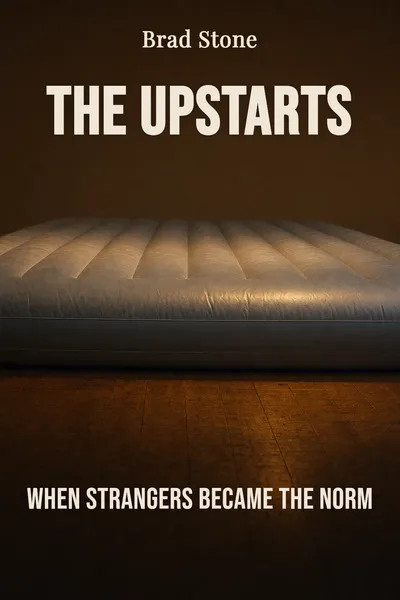
The UpStarts
When strangers became the norm
Description
In the winter of 2008, two designers in San Francisco couldn't make rent. Brian Chesky and Joe Gebbia bought a few air mattresses, threw up a bare-bones website, and offered strangers a place to sleep on their living-room floor during a sold-out design conference. They called it AirBed & Breakfast. Around the same time, Travis Kalanick and Garrett Camp were stuck in the cold outside a tech conference, unable to hail a cab, kicking around an idea that would let them summon a black car from a phone. Neither project looked like a business anyone should take seriously. Both looked, frankly, a little unhinged.
A decade later, the arithmetic had flipped. Uber and Airbnb were among the most valuable private companies on earth, moving millions of people into cars driven by people they'd never met and beds owned by people they'd never meet. The two firms had rewritten how cities move, how people travel, and how regulators think about the difference between a company and a platform. What had seemed reckless in 2009 — climbing into a stranger's sedan, letting a stranger sleep in your spare room — had become so ordinary that pausing to notice it felt quaint.
In The UpStarts, journalist Brad Stone tells the intertwined story of how these two companies grew up in parallel, chasing the same generational shift and running into the same wall of taxi commissioners, hotel lobbies, and city attorneys. It is a story about ambition and timing, about founders who bent rules until the rules bent back, and about the strange thing that had to change first in all of us for any of it to work.
The question we’re asking : How did two shaky startups turn the once-unthinkable act of trusting a stranger into a daily habit for millions?What we’ll see : How Uber and Airbnb were built, how they fought their way past the rules, and what their rise reveals about trust itself.
Table of contents
01Chapter 1 — Two problems, two garages
The two companies began, Stone shows, not with grand theories about the future of work but with small, specific irritations. For Airbnb, it was rent. Chesky and Gebbia were broke, a big conference had booked out every hotel in San Francisco, and they had floor space. The first version was almost a stunt: three guests, air mattresses, breakfast in the morning. When they later tried to raise money, investors mostly waved them off. The idea of paying to sleep in a stranger's apartment struck seasoned venture capitalists as either creepy or trivial, and probably both.
Uber came from the other end of the market. Camp was frustrated by how hard it was to get a decent car in San Francisco, and he had the money to imagine a fix: press a button, a black car appears. Kalanick, already a bruised veteran of two earlier startups, joined as the harder-edged operator. Where Airbnb was two designers trying to make something feel welcoming, Uber was engineers and dealmakers trying to make something feel inevitable. The early product wasn't for everyone — it was a premium town-car service, glossy and a little exclusive.

02Chapter 2 — The playbook: grow first, apologize later
The defining tactic of both companies, in Stone's telling, was speed used as a weapon. The theory was blunt: if you can put enough drivers on the road, or enough hosts online, fast enough, a city's residents will fall in love with the service before its officials can shut it down. Once tens of thousands of people rely on something, banning it becomes politically expensive. Growth wasn't just a business goal; it was legal cover.
Uber pushed this hardest. Kalanick treated regulation as an obstacle to be out-maneuvered rather than a rule to be obeyed, and the company became famous for entering cities without permission, signing up drivers, and then daring authorities to take the service away from voters who now depended on it. When taxi commissions objected, Uber mobilized its users to flood officials with complaints. The company's aggression was a feature, not an accident, and Stone doesn't sand off its rough edges — the bullying, the price surges during emergencies, the sense that winning mattered more than being liked.
03Chapter 3 — The war for the city
The clearest battlegrounds were the cities themselves. Stone devotes much of the book to the grinding, unglamorous fights that decided whether these companies would live or die: New York, where the taxi industry and the hotel lobby were powerful and organized; Paris and London, where drivers took to the streets; and San Francisco, where both firms were headquartered and where the political blowback landed closest to home. These were not abstract policy debates. They were street fights involving protests, lawsuits, and the occasional slashed tire.
The incumbents had a real case. Taxi drivers had paid heavily for medallions that Uber was rendering worthless overnight. Hotels operated under safety, tax, and labor rules that Airbnb hosts largely ignored. Neighbors complained that apartment buildings were turning into unlicensed hotels, that rents were rising as landlords converted units to short-term rentals, that strangers with rolling suitcases were now a permanent presence in the hallway. The disruption everyone celebrated in the abstract felt very different to the people living next to it.
04Chapter 4 — Trust, engineered
Strip away the apps and the valuations, and what Uber and Airbnb actually built was a machine for manufacturing trust between strangers. This is the deeper thread running through Stone's book. For most of human history, the rule was simple: don't get into cars with people you don't know, don't sleep in the homes of people you've never met. These companies didn't just ask people to break that rule. They built the scaffolding that made breaking it feel reasonable.
The scaffolding was the phone. Every trip and every stay left a record — a name, a photo, a payment, a two-way rating. If a driver behaved badly, the passenger could report it, and if a guest trashed the place, the host could too. The technology turned an anonymous encounter into a documented, reversible transaction. The stranger was no longer entirely a stranger; they were a profile with a score, backed by a company that promised, at least in principle, to stand behind the exchange. Trust, in other words, was outsourced from personal instinct to platform design.
05Conclusion
The two founders who couldn't make rent, and the two who couldn't hail a cab, ended up running companies that reshaped how the world moves and where it sleeps. Stone's account closes with them at the peak of their power and, in Uber's case, on the edge of the reckoning that would follow — the ambition that built the company barely distinguishable from the ambition that nearly wrecked it. The UpStarts is less a celebration than a field report on what happens when a generational shift meets a pair of founders willing to run at every wall in front of them.