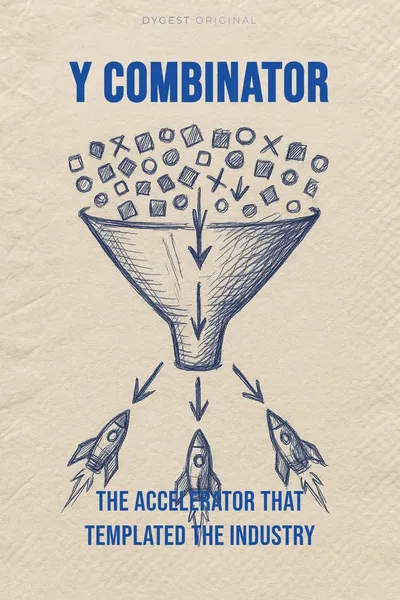
Y Combinator
The accelerator that templated the industry
Description
In 2005, Paul Graham and three co-founders started a small experiment in Cambridge, Massachusetts. They would invite a cohort of would-be founders to spend three months in residence, give them small seed funding (initially $5,000 per founder), work intensively on product and VC preparation, and end with a Demo Day pitch to investors. The first batch had eight companies. One was Reddit. Another was Twitch, then called Justin.tv. Over two decades, Y Combinator ran three batches a year and funded more than five thousand startups, including Airbnb, Stripe, Dropbox, Coinbase, Instacart, DoorDash, and Cruise.
Y Combinator is the most successful accelerator ever created. Its alumni portfolio is worth, in aggregate, more than half a trillion dollars. Its methodology — three-month batch, Demo Day, standard terms, heavy emphasis on talking to users and iterating has been copied by hundreds of accelerators globally. Its founding partners, particularly Graham and Jessica Livingston, are among the most influential figures in contemporary startup culture, their essays forming the canonical literature every aspiring founder reads. YC's influence has been more consequential than any VC firm, business school, or single founder-author.
What YC actually does, how it produces its outcomes, and why the model has been so difficult to replicate are worth working through. The specific mechanics batch dynamics, partner-founder interactions, alumni network combine in ways competitors have repeatedly underestimated. Understanding the model is also useful for understanding what has changed about startup creation more broadly, because YC's success has pushed the industry toward the conventions it pioneered.
The question we're asking: what does Y Combinator actually do, and why has the model been so consequential?
What we'll see: the origins, the batch mechanics, the alumni network that compounds value, and the industry-wide effects of the YC template.
Table of contents
01The origins
Graham had been a founder himself. He sold Viaweb to Yahoo in 1998 for roughly $49 million, then spent years writing essays on Lisp, programming, and startups. The essays built an audience of technically inclined readers who would become the founder population YC was built to serve. Graham's observation was that the standard VC path raise a seed round after having built a prototype and assembled a team was poorly matched to two or three young technical people wanting to try building a company. The early-stage funding gap, and the specific services newly-minted founders actually needed, was not being addressed.
YC's structure was designed to fill that gap. The small check size meant many companies per year without traditional fund scale. The batch format meant founders surrounded by peers in the same experience compounding benefits individual investor meetings could not produce. The short three-month length meant the program could iterate on its own methodology across cohorts. Standard terms fixed equity for the small check, minimal negotiation meant moving quickly through applications without burning energy on deal-by-deal terms.

02The batch mechanics
The core operational mechanism is the batch. Three times a year, roughly two to three hundred companies are accepted and spend three months working intensively while interacting with partners and each other. The batch produces dynamics that individual mentorship cannot replicate. Founders see many other founders going through similar problems at similar stages, which normalizes difficulty and accelerates learning. The batch creates a social and psychological context that reduces the isolation of early-stage company building often a more critical factor than the technical advice provided.
Weekly office hours with partners are the specific forcing mechanism. Each week, founders meet a partner for twenty or thirty minutes to discuss progress and get feedback. The short duration and high frequency produces a rhythm of commitment, review, and adjustment that is hard to sustain outside the program. Founders who know they must report progress each week make more progress than those without external accountability. Partners who have seen hundreds of companies identify failure modes quickly and push back on decisions history suggests will not work.
03The alumni network
YC's compound value over two decades has been substantially about the alumni network. Each batch adds founders who go on to build companies, and the accumulating population becomes a resource current batches can draw on. A 2024 founder working on fintech can reach alumni who built fintech in 2015 or 2019 and get specific advice. The alumni graph over ten thousand founders means nearly any question has already been answered by someone inside it. The value of this depth is one of the main reasons the program has sustained dominance despite competition.
The alumni network also functions as a hiring pool. YC-graduated founders who did not build successful companies often join other YC companies as early employees, producing a labor-market advantage for portfolio firms. A YC company's first senior hire pool contains candidates who understand the rhythm, have personal connections through the batch, and have been pre-filtered by YC's selection. The depth compounds with each cohort.
04The industry-wide effects
Y Combinator's success has reshaped how startups get built across the entire industry. The batch model has been copied by hundreds of accelerators, from Techstars in the US to Antler globally, each trying to replicate some element of the YC formula. The specific terms YC uses the SAFE note (Simple Agreement for Future Equity) the firm developed in 2013 have become the industry standard for early-stage financing, replacing the more cumbersome convertible notes that were dominant before. The founder playbook that YC propagated talk to users, build minimum viable products, measure retention, iterate fast, focus on growth has become the default operating manual for early-stage startups whether they went through YC or not.
The essays and writing YC partners have produced have become the canonical literature of startup practice. Paul Graham's essays, Sam Altman's lectures before he left to run OpenAI, Jessica Livingston's Founders at Work interviews, Michael Seibel's podcast appearances, the Startup School curriculum YC made freely available these materials have been read, watched, and internalized by essentially every technical founder of the past fifteen years. Whether a given founder went through YC or not, they have almost certainly absorbed YC's framing of how startups should operate. The cultural influence has been unusually concentrated for a single institution, and it has persisted across multiple leadership transitions.
05Conclusion
Y Combinator matters as a subject because it is the single most consequential institution in contemporary startup creation, and its specific mechanisms have shaped how thousands of companies have been built. Understanding how YC actually works is useful for any founder evaluating whether to apply, for any investor evaluating YC companies, and for anyone trying to understand the broader technology ecosystem's operating conventions. The program's influence is substantially invisible from outside because it operates through cultural and relational mechanisms rather than through the direct capital deployment that traditional venture investors use. Missing the YC dynamics means missing a large part of how the contemporary startup industry functions.
Related books