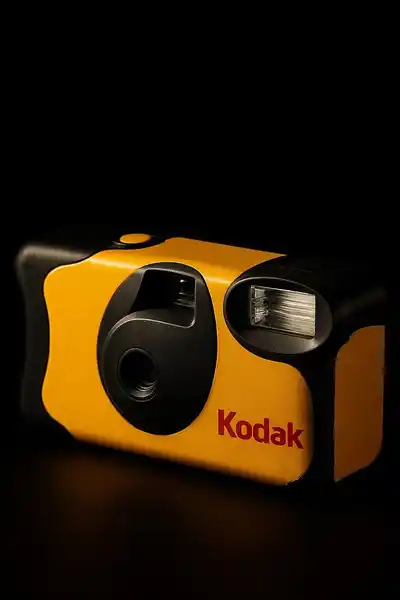
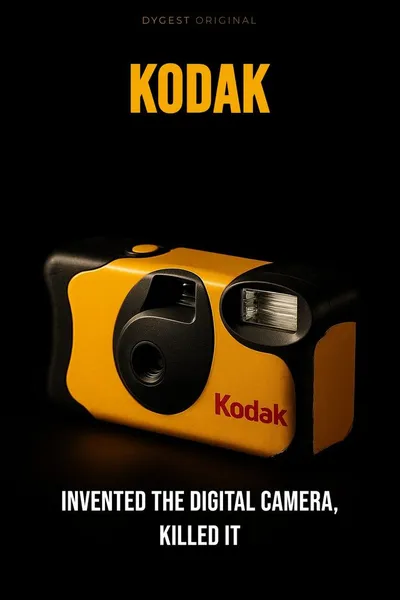
Kodak
Invented the digital camera, killed it
Description
In 1975, a young engineer at Eastman Kodak named Steven Sasson built the first digital camera. It weighed eight pounds, took twenty-three seconds to capture a single black-and-white image at a resolution of 0.01 megapixels, and stored the picture on a cassette tape. Sasson showed the prototype to Kodak's management. They listened politely, asked a few questions, and filed the patent. Then they did almost nothing with it for twenty years.
By 2012, Kodak filed for bankruptcy. The company that had invented photography as a mass-market product, that had been one of the most admired American corporations for most of the twentieth century, that owned the patent on the technology that killed it — that company was worth almost nothing. Its competitors, many of whom had licensed Kodak's digital patents to build their own cameras, had eaten it alive.
The Kodak story gets told as a fable about missing the future. But that's not quite what happened. Kodak saw the future. It saw it in 1975, then again in 1981 when a Sony prototype reminded everyone that digital was real, then again in the late 1990s when digital cameras became consumer products. What Kodak couldn't do — not wouldn't, couldn't — was act on what it was seeing. The reason is a pattern that shows up across industries, and it has a name.
● The question we're asking: how can a company invent the technology that destroys it, know the technology is coming for twenty years, and still fail to survive it?
● What we'll see: the innovator's dilemma that trapped Kodak, the film business that worked too well, the digital efforts that never got the funding they needed, and why cannibalizing yourself is almost impossible for a successful company.
Table of contents
01 The innovator's dilemma
Clayton Christensen, a Harvard Business School professor, spent the early 1990s studying why successful companies so often fail in the face of new technologies. The pattern he kept finding wasn't about stupid management or complacent culture. It was structural. Christensen called it the innovator's dilemma. Big companies can't adopt disruptive technologies because the numbers don't work for them, and the numbers don't work because the disruptive technology starts out worse than the incumbent product on the dimensions the incumbent's customers care about.
Kodak's film business in the 1990s was almost unbelievably good. Margins on photographic film ran above sixty percent. The company dominated the global market — two out of every three photos taken on the planet used Kodak film. Every wedding, every vacation, every baby's first steps went through a Kodak product at some point. The recurring revenue was enormous because film was a consumable: you bought the camera once, you bought the film forever.

02 The company tried
Kodak did try. This is the part of the story that gets lost. In 1991, Kodak released the DCS 100, a digital camera built into a Nikon body for professional photojournalists. It was the first commercial digital SLR. Through the 1990s, Kodak spent billions on digital R&D and acquired a range of companies in imaging software and photo-sharing. In 2001, Kodak bought Ofoto, an online photo-sharing service, a full decade before Instagram.
The problem wasn't that Kodak ignored digital. The problem was that Kodak couldn't figure out how to make digital pay. Ofoto, for instance, was positioned as a way to get people to order prints of their digital photos — because prints were the Kodak business model. But by the mid-2000s, people weren't ordering prints. They were looking at photos on screens and sharing them over email. Ofoto was built around a workflow that digital was destroying.
03 The End
The irony of Kodak's position is that it probably had the best digital camera patents in the world. When competitors wanted to build digital cameras, many of them had to license technology from Kodak. Through the 2000s, patent licensing was a real business for the company — hundreds of millions of dollars a year. But licensing is a lagging indicator. It means you invented something that other people are using more effectively than you are.
The end came faster than anyone at Kodak had modeled. Film sales peaked in 2000 and then fell off a cliff. By 2005, consumer film was essentially gone. Professional film followed within a few years. Digital cameras themselves were then rapidly replaced by smartphones starting in 2007. The market Kodak had been trying to transition into didn't even exist as a standalone market by the time Kodak got good at it.
04 Why this keeps happening
The Kodak story is usually told as a warning: watch for disruption, cannibalize yourself before someone else does. This is correct in principle and almost useless in practice. Every CEO of a successful incumbent company has read Christensen and knows the theory. Almost none of them can actually do it, because the reasons Kodak couldn't do it are the reasons any successful incumbent can't do it.
Those reasons are about organizational identity, about the capabilities you've built and the ones you haven't, about the shareholders and employees and partners whose livelihoods depend on the business that's being disrupted. Telling a film company to become a digital company is not a strategy. It's a request to become a different company, with different people, different skills, different investors, and different customers. Companies don't do that. They die, and different companies take their place.
05 Conclusion
The first digital camera was invented inside Kodak in 1975. Thirty-seven years later, Kodak filed for bankruptcy. Between those two dates, the company saw what was coming, tried repeatedly to respond, owned the patents, and still lost. The story isn't about blindness or hubris. It's about what happens when a company has to become something fundamentally different from what it has been — and the internal physics that make that almost impossible.
Related books