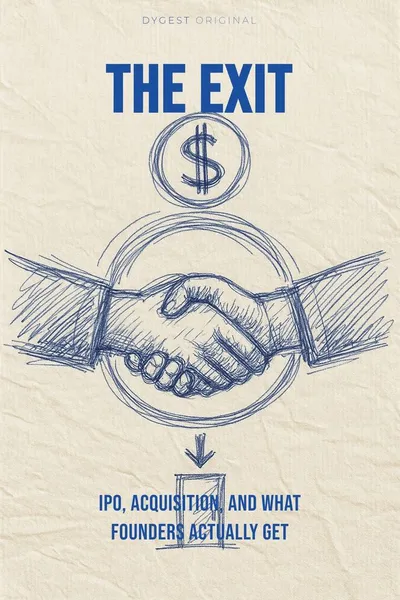
The exit
IPO, acquisition, and what founders actually get
Description
The founder story usually ends at the exit. The IPO bell rings, the acquisition announcement goes out, the founder takes the stage at the company all-hands to thank the team. Employees who held stock options wire money into their personal accounts for the first time. VCs celebrate the return that will define their fund's performance. The founder gives interviews about the journey and either starts a new company or takes a quiet year to recover. The exit is the moment the startup becomes an actual company in the legal and financial sense, and the founding team converts equity into money.
The narrative is compressed and often misleading. The exit is a specific corporate transaction with specific legal structures and distributional dynamics the story rarely dwells on. The founder's share of proceeds, after liquidation preferences, dilution across rounds, escrow holdbacks, vesting, and tax, is often a fraction of the headline. Employees' share, particularly late-stage joiners, is often even smaller. VCs capture the portion their preferred stock and contract terms allocated them, typically larger than their operational contribution would suggest. The exit is a distributional moment; the distribution depends on decisions made years earlier that most participants barely remember.
Understanding what an exit actually looks like the two main types, their mechanics, what founders and employees receive, and what happens afterward is prerequisite to reading the startup industry's outcomes clearly. The exit literature is substantially hagiographic. The ten-million-dollar check, the billionaire IPO, the acquisition that made the team wealthy these are the stories that circulate. The fifteen-million-dollar acquisition that returned nothing to common, the IPO priced below the preferred floor, the founder walking away with less than a year of his prior salary these are the stories the industry does not tell, even though they are numerically more common.
The question we're asking: what actually happens at an exit, and what does each kind of exit mean for the founders and employees who built the company?
What we'll see: the two main exit types, the mechanics of each, what founders actually receive, and what happens to them afterward.
Table of contents
01IPO and acquisition
There are essentially two ways a venture-backed startup exits. IPO the company goes public, listing shares on an exchange, allowing existing shareholders to eventually sell into the public market. Or acquisition another company buys it, with existing shareholders receiving cash or acquirer stock. Each has specific mechanics and distributional consequences. Most exits happen through acquisition, not IPO, despite IPO being more culturally celebrated. In most VC portfolios, three to five times as many exits happen through M&A.
The IPO path requires substantial scale typically hundreds of millions in revenue, clear profitability trajectory, institutional readiness including audited financials, SEC compliance, and a management team capable of running a public company. The process takes six to twelve months, involves investment banks as underwriters, and costs substantial fees. After IPO, founders and other pre-IPO shareholders are typically restricted from selling for six months (the lockup period), then can trade subject to insider rules. The founder's IPO wealth is a function of the public market's valuation, which may differ substantially from the preferred valuation the last private round implied.

02The mechanics of the money
The headline value is rarely what founders receive. A $500M acquisition is not $500M going to the founders. The acquirer transfers value to the company, which distributes it according to the capital structure. Preferred stock (investors) gets paid before common stock (founders and employees) in most structures. Within preferred, later rounds typically have priority over earlier rounds. The result is a waterfall money flows through the cap table in a specific order, and common receives whatever is left.
Liquidation preferences are the most important mechanism. A standard one-times non-participating preference means preferred holders get their money back first, then remaining proceeds distribute pro-rata. If a company raised $100M in preferred and sold for $500M, preferred takes back $100M first; the remaining $400M splits across all shares. A two-times preference means preferred takes $200M first. A participating preference means preferred takes its preference and also participates in upside pro-rata. A three-times participating preference on a $500M exit can mean common receives essentially nothing.
03What founders actually receive
The distribution across exits is heavily skewed. The median VC-backed exit is substantially smaller than the mean, because the mean is pulled up by a small number of very large outcomes. The median founder outcome is probably in the low millions per founder, spread across years of vesting and escrow, after tax. This is not a bad outcome it is better than a decade of salary in most professions but it is not the wealth-changing event the founder mythology implies. Founders with tens or hundreds of millions are a distinct minority. Founders with billions are a handful per year across the entire industry.
Tax treatment varies by jurisdiction. In the US, long-term capital gains are taxed substantially below ordinary income, favoring founders who held equity for the required period. The Qualified Small Business Stock (QSBS) provision can exclude up to $10M of gains from federal tax if requirements are met, which matters enormously for those who qualify. European founders typically face higher overall tax on exit proceeds, reducing headline-to-take-home further than American founders face. Tax rules produce substantial differences in what founders receive from structurally identical exits in different places.
04What happens afterward
Founder life after exit follows typical patterns. Some immediately start another company, drawing on capital, network, and reputation from the first success. These serial founders are the most visible post-exit pattern, the one the mythology most celebrates. Others join VC firms as investors. The YC alumni network and founder-focused funds are populated substantially by post-exit investors. Others take a quiet period a sabbatical often two or three years long, before deciding what to do next.
Psychological outcomes of exit are less documented than financial ones. Many founders report a specific post-exit depression the thing they spent years building is no longer theirs to run, the team has dispersed, the founder identity is suddenly unclear. Founder-coaching practices have emerged to address it. Acquisitions are often particularly hard because the acquirer integrates the team into its operations, dissolving the distinctive culture the founders watch something they built being disassembled. The celebration of exit is usually followed by grief, even when the financial outcome is excellent.
05Conclusion
The exit matters because it is the moment when abstract valuations become real outcomes, and because the distribution reveals how the industry's claims map onto practice. Founders who understand their exits in specific financial terms are better prepared for decisions during development which rounds to raise, what terms to accept, when to consider offers, how to structure employee equity. Founders operating on the mythology's compressed version of the exit are often surprised by what they receive, which produces regret about decisions they could have made differently.
Related books