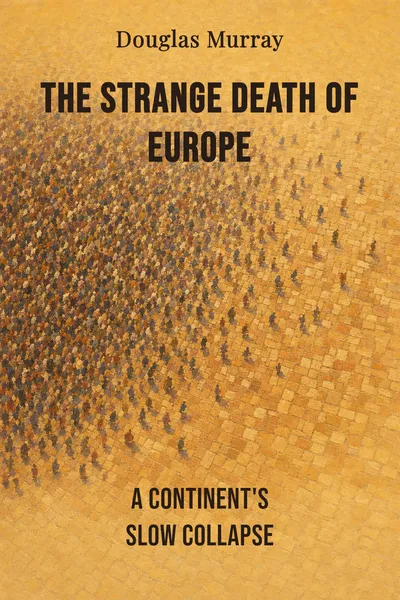
The Strange Death of Europe
A continent's slow collapse
Description
In 2017, a British writer named Douglas Murray published a book with a title borrowed from a 1935 study of Liberal England: The Strange Death of Europe. The original had described how a dominant political order dissolved almost without anyone deciding it should. Murray took the phrase and pointed it at the whole continent. His subject was not a war or a coup or an economic crash. It was something slower and harder to photograph — a sense, shared by many Europeans he spoke to, that the place they had grown up in was quietly becoming somewhere else, and that no one had ever quite agreed to it.
The book landed hard. It became an international bestseller, was translated widely, and was later reissued with new material covering the terror attacks and political upheavals that followed its first appearance. It also became a lightning rod. To admirers, Murray had said out loud what polite society preferred to leave unsaid. To critics, he had dressed anxiety and nostalgia in the language of civilizational decline. Either way, the argument travelled far beyond the usual readership for essays about European identity, and it kept coming back into the conversation with each new headline.
What makes the book worth decoding is not whether every prediction holds, but the shape of the case it builds. Murray weaves together two threads he insists are inseparable: a demographic and political story about immigration, and a deeper cultural story about exhaustion, memory and belief. He argues the two only make sense together — that Europe's discomfort with change is really discomfort with itself. That claim is where the whole book stands or falls.
The question we’re asking : What exactly does Murray mean when he says a whole continent is dying — and what is the death he claims to be describing?What we’ll see : How one book braided immigration, guilt and self-doubt into a single diagnosis of a tired civilization.
Table of contents
01Chapter 1 — The book that named a mood
Murray opens with a claim that sounds sweeping and then spends the book trying to earn it: "Europe is committing suicide." The word is deliberate. He is not saying Europe is being killed by an outside force. He is saying it is doing this to itself, half-knowingly, through decisions taken and not taken over decades. The suicide metaphor runs through everything — a civilization that has, in his telling, lost the will to insist on its own continuation.
The strength of the opening is that it names a feeling many readers recognize before they can defend it. Murray reports conversation after conversation with ordinary Europeans who describe their towns changing faster than they can absorb, who feel they were never asked, and who sense that saying so out loud has become socially dangerous. He treats that unease not as bigotry to be scolded away but as data to be explained. Whether one agrees or not, this is what gave the book its reach — it spoke to a mood that mainstream politics had mostly declined to address directly.

02Chapter 2 — Immigration without a plan
The first thread Murray pulls is the one that got the most attention: the scale and improvisation of postwar immigration into Western Europe. His argument is less about any single group of arrivals than about the absence of a decision. Successive governments, he contends, brought in labour, then families, then more, always as a temporary measure or an economic fix, and never as a considered answer to the question of what kind of society they wanted to become. The guest-worker schemes of the 1950s and 1960s assumed people would leave. They did not, and no one had planned for the possibility that they would stay.
He marshals the numbers to show a continuous transformation rather than a single event. Cities that were largely homogeneous within living memory became genuinely plural in a generation or two. Murray's point is not that this is wrong in itself, but that it happened at a pace and scale the public was rarely consulted on, and that the gap between elite comfort with the change and popular unease was papered over rather than closed. When politicians promised integration or lower numbers and delivered neither, he argues, trust drained out of the whole political class.
03Chapter 3 — Guilt, and the loss of the story
The second thread is the one Murray thinks actually explains the first. Europe, he argues, is uniquely burdened by guilt about its own past — the wars, the Holocaust, the empires — to a degree that has curdled from healthy self-criticism into something closer to self-loathing. A civilization that has taught itself to see its history mainly as a record of crimes will struggle to argue that its inheritance is worth defending, or worth asking newcomers to join. Guilt, in his telling, disarms confidence.
He treats this as the hidden engine behind the political paralysis. If you are not sure your culture has value, you cannot make demands of anyone in its name. You cannot say what integration means, because you cannot say what people are integrating into. The reluctance to set limits, the discomfort with the very idea of a European "us," the tendency to treat any preference for continuity as suspect — Murray reads all of it as the behaviour of a society that has quietly concluded it has no moral standing to prefer its own survival.
04Chapter 4 — When a civilization stops believing in itself
Step back from the specifics and the book is making a larger claim than any argument about migration numbers. Murray's real subject is confidence — the intangible thing that lets a civilization transmit itself to the next generation without apology. His wager is that Europe's crisis was never mainly about who arrived at its borders. It was about whether the people already there still believed their inheritance — the languages, the art, the freedoms, the long argument with itself — was worth passing on. Everything else, in this reading, follows from the answer to that.
The provocation is that decline here is not measured in GDP or armies. Europe is wealthier, safer and healthier than almost any society in history. Murray's point is that material success can coexist with a kind of spiritual surrender, and may even hasten it: comfort makes it easy to stop asking hard questions about meaning and continuity. A civilization can have everything and still quietly decide, without ever voting on it, that it no longer needs to reproduce itself in belief.
05Conclusion
Murray began with a borrowed title about a political order that dissolved before anyone chose to end it, and he ends more or less where he started: with a continent that has drifted into a condition it never deliberated. The updated edition, reaching into the terror attacks and political shocks that followed the first, did not soften the case so much as extend it. The two threads he braided — immigration without a plan, and a culture unsure it deserves to continue — remain, in his telling, one thread. The border trouble is the visible edge of an invisible loss of nerve.
Related books