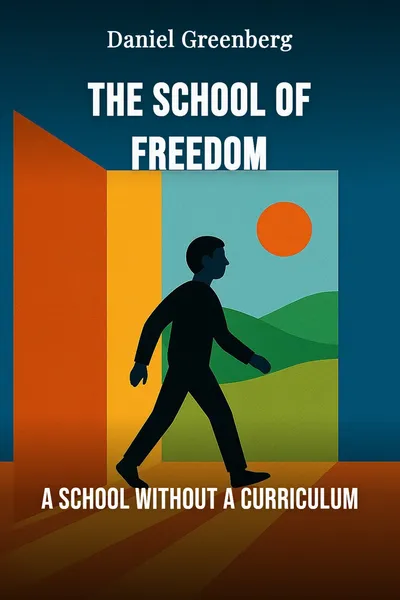
The School of Freedom
A school without a curriculum
Description
In 1968, a small group of parents and teachers opened a school in a converted stone mansion in Framingham, Massachusetts, and decided, deliberately, not to tell the children what to do. Sudbury Valley School had no classes anyone had to attend, no curriculum, no grades, no tests, no homework, and no age-grouped classrooms. Children of four shared the building with teenagers of eighteen. A child could spend the morning fishing in the pond, the afternoon reading, the next week doing nothing a visitor would recognize as learning. The adults on staff did not lecture, did not correct, did not steer. They answered questions when asked and otherwise stayed out of the way. One of the founders, Daniel Greenberg, a former university physicist, became the model's clearest voice, and the book he wrote about it, The School of Freedom, lays out the reasoning behind a place that looks, from the outside, like it should not work at all.
The intuition everyone brings to it is the same. Left alone, children will do nothing. They will play video games until their eyes give out and never touch a book. The whole edifice of modern schooling rests quietly on the opposite of trust: that learning has to be imposed, sequenced, measured, or it does not happen. Sudbury Valley was built as a standing bet against that assumption. Decades on, the school is still open, its graduates have gone on to college, trades, businesses and ordinary adult lives, and the bet has not obviously been lost.
So the model raises a harder question than it first seems to. Not simply whether children can learn without being taught, but what a school is actually for, and who it is really designed to reassure. Greenberg's answer is uncomfortable precisely because it is so plain.
The question we’re asking : What actually happens when a school removes the curriculum, the grades and the teachers' authority, and leaves children to direct themselves?What we’ll see : How Sudbury Valley works from the inside, what its students end up doing with all that freedom, and why the model asks more of the grown-ups than the kids.
Table of contents
01 Chapter 1 — A school that trusts children to run themselves
The physical setup tells you most of what you need to know. Sudbury Valley occupies a nineteenth-century mansion and a few outbuildings on ten acres, with a pond, woods and a barn. Inside, there are rooms with books, rooms with computers, a kitchen, an art space, a music room. What there isn't is a bell, a timetable, or a wall covered in the week's objectives. Children arrive, sign in, and then their day is theirs. Nobody tracks whether a given student has opened a math book this term or ever.
The age mixing is deliberate and central. Because there are no grades, a seven-year-old and a fifteen-year-old use the same spaces and talk to each other as a matter of course. Greenberg describes younger children learning enormous amounts simply by being around older ones — picking up reading, games, arguments, social codes — the way they learn to speak at home, by immersion rather than instruction. The older students, for their part, often find that explaining something to a younger child is where their own understanding firms up.

02 Chapter 2 — What happens when nobody assigns anything
The first surprise, for most people, is reading. In a conventional school, reading is taught on a fixed timetable, and a child who hasn't cracked it by a certain age is flagged as behind. At Sudbury, children learn to read at wildly different ages — some at four, some not until nine or ten — and Greenberg reports that it makes essentially no difference to where they end up. The late readers catch up fast once they decide they want to, because the motivation is theirs. There is no stigma attached to the timing, so there is no anxiety quietly sabotaging the process.
The same pattern shows up with subjects everyone assumes have to be force-fed. Greenberg tells of students learning years of arithmetic in a matter of weeks, once they had a reason to want it — a game, a job, a plan. The claim is not that children are secretly geniuses. It's that the slow, dragged-out pace of conventional instruction exists partly to fill a timetable, and that a motivated person moving at their own speed covers ground startlingly fast. Learning compresses when it is wanted.
03 Chapter 3 — The School Meeting and the price of a vote
Sudbury Valley is run as a direct democracy, and this is not a decorative add-on — it's the spine of the place. The governing body is the School Meeting, where every student and every staff member has exactly one vote. A five-year-old's vote weighs the same as the founder's. The Meeting sets the budget, writes the rules, hires and fires staff, and decides how the school spends its money. Greenberg is blunt that this is real power, not a classroom exercise in pretend citizenship.
The rules the community lives by are made and amended by this Meeting, and enforced through a judicial system the students run themselves. When someone breaks a rule, the matter goes to a committee of peers who investigate, weigh the complaint, and hand down consequences. Being on the receiving end of a judgment you helped design, delivered by people your own age, is a very different experience from being sent to a principal's office. The authority is horizontal, and because of that, it is taken seriously.
04 Chapter 4 — Trusting the child is the hard part
Step back from the pond and the School Meeting, and the striking thing about Sudbury Valley is how little of its difficulty lies with the children. Greenberg's whole account suggests that the kids take to self-direction with surprising ease. The resistance, the anxiety, the near-impossibility of the thing — all of it lives in the adults. Self-direction, it turns out, is less a demand on the person being trusted than on the people who have to do the trusting.
That's the uncomfortable center of the book. To let a child spend a year fishing and talking and apparently doing nothing, you have to override almost everything schooling has taught you to fear. You have to believe that the drive to learn is native, not installed — that a person left genuinely free will, in their own time, turn toward the world rather than away from it. Most of the apparatus of conventional education exists not because children can't be trusted, but because adults can't quite bring themselves to find out. The curriculum, the grades, the constant measuring: Greenberg reads these less as tools for learning than as instruments of reassurance for the grown-ups.
05 Conclusion
The stone mansion in Framingham is still a school, still run by its own students, still refusing to tell them what to learn. The children who fished in that pond are grown now, with careers and families and the ordinary unremarkable lives that were, in a sense, the whole argument. Greenberg set out to prove that a school could trust children completely and not collapse, and the simplest measure of the experiment is that it is still standing, and that the people it produced are fine.
Related books