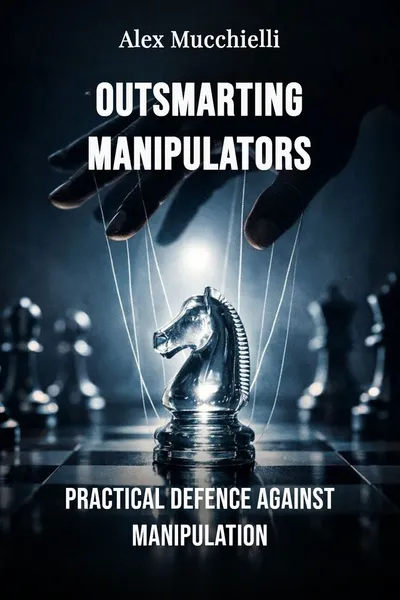
Outsmarting Manipulators
Practical defence against manipulation
Description
A conversation ends and we can't quite say what happened. We agreed to something we didn't want, or we apologized for a wrong we didn't commit, or we walked away vaguely ashamed of a feeling that seemed reasonable an hour earlier. Nothing was shouted. No one lied outright, at least not in a way we could prove. And yet we've been moved — gently, precisely — to a place we would never have chosen. That faint after-taste is the subject Alex Mucchielli takes up in Outsmarting Manipulators, and it is the clue he tells us to trust.
Mucchielli spent his career studying communication, and his wager in this book is almost disarming. Manipulation, he argues, is not mysterious. It isn't a dark gift some people are born with and the rest of us can only suffer. It's a technique — a set of repeatable moves that work on the situation around us rather than on us directly. Change what the situation seems to be, and you change what we'll agree to without ever touching our will head-on. Which means a technique can be learned from the other side too. What one person does to arrange a scene, another can learn to read.
The hard part isn't believing manipulation exists. We've all felt it. The hard part is that it works precisely because we're inside it while it happens, too busy answering to notice the question has been rigged. Mucchielli's book is less a catalogue of villains than a manual for stepping back far enough to see the arrangement — and for doing something about it in the moment, not three days later in the shower.
The question we’re asking : When someone bends us without ever openly forcing us, what exactly are they doing — and how do we take back the room?What we’ll see : How a manipulator builds the scene, why slowing down breaks the spell, and what changes the instant the move has a name.
Table of contents
01 Chapter 1 — The move you feel before you can name it
Mucchielli starts where we actually experience manipulation: in the body, before the mind catches up. Something tightens. We feel cornered, rushed, obscurely guilty, suddenly in debt. The feeling arrives ahead of any argument we could make for it, and that gap is the first symptom. In an honest exchange, our reactions track what's being said. In a manipulated one, the reaction runs ahead of the content — we're anxious to please, or to defend ourselves, over something that, written on paper, wouldn't warrant it.
His claim is that these sensations are data, not weakness. The discomfort is us registering, below the level of words, that the terms of the conversation have been quietly reset. A colleague drops that "everyone's already on board," and we feel the pull to conform before we've examined whether everyone is, or whether it matters. A partner sighs that they "always end up doing everything," and we feel the guilt before we've checked the ledger. The emotion is the fingerprint the technique leaves behind.

02 Chapter 2 — Manipulation is a work of staging
The heart of Mucchielli's analysis is that a manipulator doesn't really work on us. They work on the scene we're standing in. His background is in the study of how meaning gets constructed in communication, and he carries that lens straight into everyday conflict: what we agree to depends less on the raw facts than on how the situation is framed — who we seem to be in it, what's supposedly at stake, what the normal thing to do appears to be. Shift the frame and you shift the decision, without laying a finger on the decision itself.
He maps the common levers. There's the staging of the relationship — positioning themselves as the generous one so that refusing them feels petty, or as the victim so that any pushback looks like cruelty. There's the staging of norms — invoking what "people do," what's "obvious," what "any reasonable person" would accept, so that disagreeing means stepping outside the sane and the decent. There's the staging of identity — casting us as the loyal friend, the serious professional, the good parent, roles we then feel obliged to live up to by doing exactly what they want.
03 Chapter 3 — The counter-move is slowness
If the technique lives on momentum and compression, Mucchielli's central countermeasure is the opposite: deliberate slowness. Almost every manipulative frame is designed to make us respond fast, inside the terms we've been handed. The single most powerful thing we can do is refuse the tempo. Not refuse the person — refuse the speed. "I need to think about it." "I'll get back to you tomorrow." "Let me sit with that." These sentences sound like nothing, and they dismantle a great deal, because the staging rarely survives a night of calm examination.
He pairs slowness with a second habit: separating the request from the wrapping. When we feel pulled, the useful question is not "am I a good person?" but "what, concretely, is being asked of me, and do I want to do it?" Strip away the role we've been cast in, the urgency, the appeal to what everyone supposedly does, and look at the bare demand. Often it shrinks dramatically once undressed. The guilt was doing the work the request couldn't do on its own.
04 Chapter 4 — What a tactic stops being once it's seen
Step back from any single trick and Mucchielli's deeper point comes into view: manipulation is a particular kind of communication, one whose entire power rests on the target not seeing how the situation has been arranged. That's the structural fact that organizes the whole book. Honest persuasion can survive being named — you can say "you're trying to convince me" and the argument carries on undamaged. Manipulation can't. It's built to stay below awareness. The frame only holds while it's taken for the plain truth of the situation rather than one party's construction of it.
This is why awareness isn't a soft, feel-good remedy but the actual mechanism of defence. The manipulator and the target are, in a sense, collaborating on the scene — one builds it, the other agrees to live inside it. The moment the target stops treating the frame as given and starts seeing it as a made thing, the collaboration breaks. The sigh is still a sigh, the "everyone agrees" is still said, but it no longer lands, because it's been recognized as a move rather than a fact. The technique doesn't get defeated so much as it stops functioning.
05 Conclusion
We began with that faint after-taste — the sense of having been moved somewhere we didn't choose, with no sentence we could point to as the culprit. Mucchielli's book turns that vague unease into something usable. The discomfort was accurate. It was us noticing a staging we couldn't yet describe. And because manipulation is a technique rather than a curse, what the unease registers can be brought all the way into the light: the role we were cast in, the urgency that was invented, the choice that was rigged, the norm that was conjured.
Related books