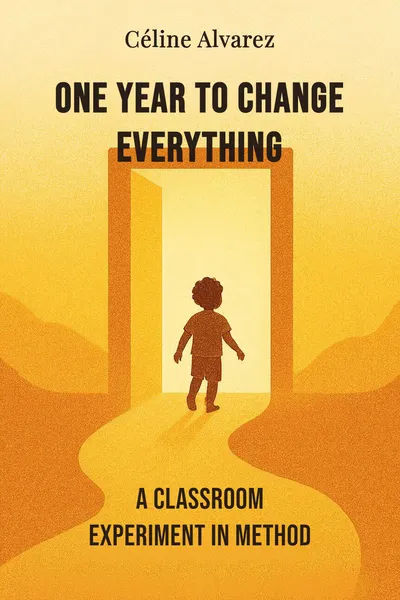
One Year to Change Everything
A classroom experiment in method
Description
In September 2011, a former linguistics student named Céline Alvarez walked into a nursery school in Gennevilliers, a working-class suburb north of Paris, with an unusual arrangement in her pocket. The French education ministry had agreed to let her run a single preschool classroom her own way for three years, measured each year by cognitive scientists, and then to see what happened. The children were three to five years old, many from immigrant families, several arriving with almost no French. On paper it was a modest pilot. In practice Alvarez had set out to test a conviction she had been building for years: that the ordinary classroom works against the way young brains actually learn, and that a room designed around the child's own activity would produce results the system assumed were impossible for kids like these.
Three years later she left the school, resigned from the ministry, and published what she had seen. The book, One Year to Change Everything, reports a classroom where four-year-olds were reading, where children regulated their own conflicts, where the gap between the fastest and slowest learners narrowed instead of widening. The annual tests, run by a lab in Grenoble, showed jumps that Alvarez presented as a vindication. Then the experiment ended — not because it failed, but because the administration declined to extend it, and the measurements stopped before anyone could repeat them.
That abrupt ending is the part worth sitting with. A teacher reports something remarkable in one room, with one set of children, over three years, and then the conditions that produced it dissolve. What are we actually looking at — a method anyone could carry into any school, or a single gifted teacher and a lucky room?
The question we’re asking : Can a classroom redesigned around the child's own activity really close the gaps the system treats as permanent — and how would we ever know for sure?What we’ll see : A three-year experiment in a Paris suburb, the principles it ran on, the results it reported, and the argument it set off about what counts as proof in education.
Table of contents
01Chapter 1 — A nursery school in Gennevilliers
The setting mattered as much as the method. Gennevilliers sits in the Hauts-de-Seine, a department of sharp contrasts, and the school Alvarez chose served a neighborhood classified as a priority education zone — the French label for areas where children arrive with the heaviest odds against them. These are the schools where the achievement gap tends to open earliest and widest. Alvarez did not pick an easy room to make her point; she picked a hard one, because the whole argument depended on showing results where the system expected the least.
Her path to that classroom was unusual. She had studied linguistics, not education, and she had passed the teaching exam deliberately, as a way to get inside a public school and try something. Her reading ran through two sources that rarely sit together: Maria Montessori, the Italian physician who a century earlier had designed classrooms around the child's self-directed activity, and contemporary cognitive neuroscience, the research on how attention, memory and language actually develop in the first years of life. Alvarez's wager was that Montessori had intuited, without the instruments, what the brain scientists were now able to measure.

02Chapter 2 — Letting the child do the work
The core principle was simple to state and hard to practice: the adult's job is to make activity possible, then get out of the way. In a conventional preschool, the teacher decides what the whole group does and when. In Alvarez's room, the child decided — within a prepared environment where every available activity had been chosen to build a specific skill. A tray for pouring water trained the hand and the eye. A set of rough letters to trace with a finger connected sound to shape before a pencil was ever involved. The freedom was real but bounded, and the boundaries did the teaching.
Behind the trays sat a claim drawn straight from the neuroscience Alvarez had read. Young children learn fastest when they are intrinsically engaged — when the activity itself, not a reward or an instruction, holds their attention. Concentration, on this view, is not something you impose on a three-year-old; it is something that appears on its own when the task matches the child and nobody interrupts it. The adult who breaks a child's focus to move everyone to the next scheduled activity, Alvarez argued, is destroying exactly the thing the system claims to want.
03Chapter 3 — What the numbers said, and what they didn't
The results Alvarez reported were striking, and she did not understate them. By the end of the first year, the Grenoble tests showed large gains across the group in the areas measured — working memory, the control of attention and impulse, early reading and number sense. Children who had started behind were catching up; several four-year-olds were reading fluently, well ahead of the age at which French schools formally teach it. In a priority education zone, where results usually run below the national average, a room of children scoring at or above it was the kind of outcome the system treated as out of reach.
Just as important to Alvarez was what the numbers did not capture directly but the daily life of the room made visible. The children, she reported, grew calmer and more autonomous. Conflicts got settled between children rather than refereed by adults. The spread between the strongest and the weakest learners seemed to shrink over the year — the opposite of the usual pattern, where early gaps widen into permanent ones. For Alvarez this social and emotional change was not a side effect of the academic gains but their root: a child who can concentrate and feel secure is a child who can learn anything.
04Chapter 4 — The experiment that split a profession
When Alvarez published her account, the reaction divided along a fault line that runs through all of education research. For one camp, here was a working demonstration: a teacher had gone into the hardest kind of school and gotten results the system swore were impossible, and the honest response was to study it, scale it, and stop wasting children's early years. For the other camp, the enthusiasm was precisely the problem. One classroom, no control group, measured by its own designer, ended before replication — this was a compelling story, not evidence, and education had been burned before by compelling stories that evaporated when someone tried to repeat them under controlled conditions.
The disagreement is not really about Alvarez. It is about what counts as proof when the thing being measured is a child's development, which is slow, tangled with family and poverty and luck, and impossible to run as a clean laboratory trial. You cannot randomly assign children to a method and a life. The gold-standard experiment that would settle the question — many classrooms, many teachers, randomized, tracked for years — is expensive, slow, and awkward to reconcile with the urgency Alvarez felt watching three-year-olds lose time the system would never give back.
05Conclusion
Céline Alvarez left Gennevilliers in 2014 and took her argument outside the school system, publishing, training teachers, and building a following large enough that her ideas now circulate well beyond the single classroom where they were tested. The children she taught grew up; the room went back to running the ordinary way; the annual measurements that might have told us whether the gains lasted were never resumed. What remains is a book, a set of principles, and a result that was never allowed to prove or disprove itself.
Related books