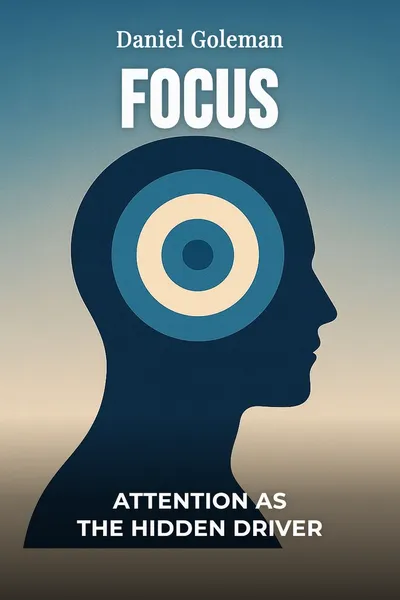
Focus
Attention as the hidden driver
Description
In 2013, the psychologist Daniel Goleman — the man who, nearly two decades earlier, had made "emotional intelligence" a household phrase — published a book with a one-word title: Focus. The timing was not an accident. By then the smartphone was five years old, the notification had become ambient, and the sense that we were all losing the thread of our own attention had started to feel less like a complaint and more like a condition. Goleman's wager was that attention deserved the same treatment he had once given emotion: to be pulled out of the realm of vague self-help and examined as a real, structured, measurable human capacity.
His starting claim is deceptively plain. Attention, he argues, behaves less like a fixed trait and more like a muscle — something that fatigues, that can be depleted by the wrong demands, and, crucially, that can be strengthened by the right kind of practice. We tend to talk about focus as if some people simply have it and others don't. Goleman draws on cognitive science, neuroscience, and the study of expert performers to make a different case: the ability to direct and hold attention is a skill, unevenly distributed partly because it is unevenly trained.
What makes the book more than a productivity manual is where Goleman takes this. He is not only interested in the kind of focus that lets us finish a report without checking a screen. He is interested in the attention we pay to ourselves, the attention we pay to other people, and the attention we pay to the larger systems we live inside — and in the quiet argument that these three are connected, and that a culture distracted in one is likely to be distracted in all three.
The question we’re asking : If attention is a capacity that can be trained rather than a trait we're simply born with, what exactly are we training, and toward what?What we’ll see : How Goleman reframes focus as a strengthenable skill with an inner, social, and outward reach — and why that distinction matters more than the usual war on distraction.
Table of contents
01 Chapter 1 — The muscle nobody trains
Goleman opens by dismantling a flattering illusion: that attention is a stable possession, something we either have or lack. The science he assembles says otherwise. Attention is a limited resource that gets spent, and spending it has a cost. Psychologists call it cognitive load — the mind can only hold and process so much at once, and when it's overloaded, performance drops in ways we rarely notice from the inside. The person answering email during a meeting isn't doing two things well. They're doing two things badly and feeling productive about it.
The useful reframe is that attention works like a muscle. It tires with use, which is why willpower and concentration tend to fray as the day goes on — a phenomenon researchers have described as a kind of depletion. But the same metaphor carries a hopeful flip side: a muscle responds to training. Goleman leans on work showing that focused practices, including simple attention exercises and forms of mindfulness, measurably improve the brain's ability to notice when the mind has wandered and to steer it back. That return trip — catching the drift and redirecting — is the repetition that builds the capacity.

02 Chapter 2 — Inner, other, outer
The spine of Focus is a simple taxonomy: three kinds of attention, pointed in three directions. There is inner focus — attention turned on ourselves. There is other focus — attention turned toward the people around us. And there is outer focus — attention turned toward the wider world and the systems that shape it. Goleman's argument is that a full life, and good judgment, require all three, and that most of us are lopsided.
Inner focus is self-awareness in a practical sense: the capacity to notice our own feelings, read our gut sense, and resist the impulses that hijack a good plan. Goleman connects this to self-control, and reaches back to one of psychology's famous findings — Walter Mischel's marshmallow experiments at Stanford, begun in the late 1960s, in which young children were offered one treat now or two if they could wait. The children who could wait tended, in follow-up studies, to fare better years later. Goleman reads this not as a verdict on character but as evidence that the ability to hold attention away from a tempting cue is foundational, and trainable.
03 Chapter 3 — The high road and the low road
To explain why attention can feel like a fight, Goleman borrows a distinction between two systems in the brain, often sketched as a high road and a low road. The low road is fast, automatic, emotional — it reacts before we've thought, pulling attention toward whatever is loud, threatening, or rewarding. The high road is slower, deliberate, effortful — it's the system we use to plan, to concentrate, to override an impulse. The two are always negotiating, and the low road has the home advantage, because it's older and quicker.
This is the architecture that modern distraction exploits with almost unfair precision. A notification is a low-road trigger: novel, socially charged, impossible to ignore for free. Every time it pulls us, the high road has to spend energy climbing back to the task. Goleman's point is that we are not weak for losing these skirmishes; we are outgunned by design, and the cost compounds. Each interruption carries a recovery tax, the minutes it takes to reload what we were doing. A day of such interruptions is a day of mental friction that never shows up on any ledger.
04 Chapter 4 — Attention as a civic resource
Step back from the individual, and Goleman's argument takes on a larger stake. If attention is trainable, it is also erodable — and a culture that erodes it does not just produce distracted individuals. It produces thinner relationships, poorer leadership, and a collective blind spot toward exactly the slow, systemic problems that outer focus is built to see. Attention, in this reading, is less a private resource than a shared one, and the way a society treats it has public consequences.
Consider what Goleman calls the great lost art of paying attention to one another. Children raised amid distracted adults, he worries, may be getting less of the sustained face-to-face attention through which empathy is learned in the first place. Leaders who cannot hold other focus misread their teams; organizations that reward only short-term metrics starve the outer focus that would let them see where they're actually heading. The deficit in one direction tends to leak into the others, because they draw on the same underlying faculty.
05 Conclusion
Goleman's wager, in the end, is that we have been fighting the wrong battle. The war on distraction treats attention as something to defend, a fragile stock to be guarded from thieves. Focus proposes the opposite posture: attention as a capacity to build, the way we'd build strength or stamina, through the unglamorous repetition of noticing a drift and coming back. The screen in our pocket is a worthy adversary, but it is an adversary that a trained faculty can meet.
Related books