
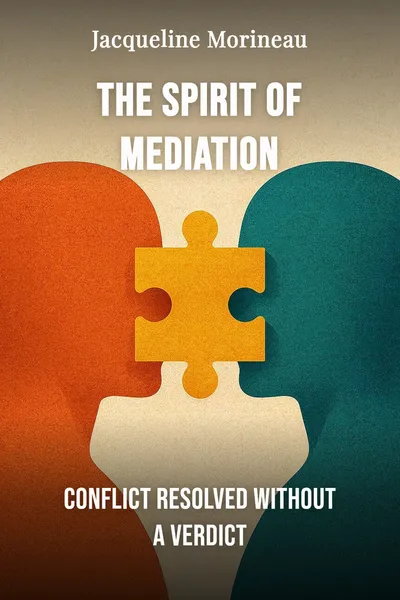
The Spirit of Mediation
Conflict resolved without a verdict
Description
In the 1980s, a woman named Jacqueline Morineau was working inside the French justice system, assigned to help victims and offenders in the margins of the criminal courts. She watched, day after day, the same procedure play out: two people brought before a third who would weigh their accounts, assign fault, and hand down a verdict. The machinery was efficient. It produced decisions. And yet she kept noticing something the decisions never touched — the people left the room with a judgment in hand and the actual quarrel still lodged inside them, unspoken, unresolved, sometimes hardened.
Out of that observation she built something she called criminal mediation, and later set down in a book, The Spirit of Mediation. Her proposal was strange for a legal professional: a space where two parties in conflict meet, in the presence of a mediator who holds no power to rule. No sentence, no winner, no file closed by authority. The mediator's job is almost the opposite of a judge's — not to settle the matter from above, but to let the two people, slowly and often painfully, find their own words again.
It sounds soft, almost naïve, next to the solid architecture of the law. But Morineau drew her model from an unexpected place — the structure of ancient Greek tragedy — and insisted that conflict handled this way does something a verdict cannot. The wager at the center of her work is that resolution and judgment are not the same thing, and that we have confused them for a very long time.
The question we’re asking : Can a conflict actually be resolved when no one is appointed to decide who is right?What we’ll see : How a practitioner inside the courts built a form of mediation modeled on tragedy, and what it asks of everyone who enters the room.
Table of contents
01 Chapter 1 — A courtroom that wasn't working
Morineau's starting point was not a theory but a frustration she lived from the inside. She had spent years close to the penal system, in the awkward zone where victims and offenders are processed, and she grew convinced that the court does one thing well and another thing not at all. It establishes facts and attributes responsibility. What it cannot do is reach the knot of emotion, resentment, humiliation and fear that usually sits underneath the facts. The law speaks the language of acts; conflict lives in the language of feeling.
The problem, as she saw it, is that a verdict closes a file without closing a wound. A victim can win and still feel unseen. An offender can be sentenced and understand nothing of what their act did to another person. The two parties never truly speak to each other — they speak to the judge, through lawyers, in a vocabulary scrubbed of everything personal. Each leaves with a decision imposed from outside, and the human relationship that the conflict damaged remains exactly as damaged as before.

02 Chapter 2 — The theater of the Greeks, borrowed for a modern room
To give her practice a shape, Morineau reached back to Greek tragedy, which strikes most people as an odd source for a conflict-resolution method. Her reasoning was that tragedy was never mere entertainment for the Greeks; it was a civic ritual in which a whole city gathered to watch human beings torn apart by forces larger than themselves, and left the theater changed. Tragedy stages suffering so that it can be looked at, felt collectively, and in some sense purified. That purification — catharsis — was exactly what she thought conflict needed.
From the architecture of tragedy she drew a three-part movement that structures a mediation session. First comes what she called the theory, the moment of exposition: each party lays out their version, their account of the facts, the surface of the dispute. Then the crisis — the pressure rises, the real emotions break through the controlled narrative, the anger and pain that the facts were covering finally surface. The session is allowed to become difficult; the mediator does not rush to calm it, because the storm is where the truth lives.
03 Chapter 3 — What happens when nobody judges
The hardest thing to accept about Morineau's model is the absence at its center. No one in the room is going to tell the two parties who was right. For people raised on courts and arbitration, this feels like leaving a task undone. But she argued that the absence is the whole point. The moment a third party decides, the two people are relieved of the work of facing each other, and that work is where the actual repair happens. A judgment lifts the conflict out of their hands. Mediation leaves it there, deliberately.
What the mediator offers instead of a verdict is attention. The practice depends on a quality of listening that most ordinary conversation lacks — listening that does not interrupt, does not correct, does not quietly prepare a rebuttal. In that kind of silence, people say things they have never managed to say, including to themselves. Morineau observed again and again that when someone finally feels genuinely heard, their need to attack softens. Aggression is often a demand for recognition that has found no other outlet.
04 Chapter 4 — The practice that refuses to decide
Stepping back, what Morineau was really proposing is a different anthropology of conflict. The dominant assumption of modern societies is that disputes are problems to be solved, ideally by an expert who applies a rule and issues an outcome. Mediation, in her sense, treats conflict not as a problem but as a passage — a crisis that human beings go through, and that, if accompanied rather than cut short, can leave them more whole than it found them. The goal is not to eliminate the conflict but to transform the people who were caught in it.
This reframes what we even mean by resolution. We tend to equate it with closure: the file stamped, the matter settled, the quarrel declared over. Morineau's practice suggests a resolution measured differently — by whether speech has been restored between the parties. A conflict, in her account, is above all a breakdown of speech, a point where two people can no longer address each other and so address a judge instead. To resolve it is to give them back the capacity to speak, and to be heard, directly.
05 Conclusion
Morineau began inside the courts, watching people leave with decisions and without peace, and ended by building a room where no decision is handed down at all. The Spirit of Mediation is her account of why that absence matters — why a conflict passed through, with its crisis fully felt and its two parties truly heard, can close in a way that no verdict reaches. Borrowing the shape of Greek tragedy, she made of the mediation session a small ritual of exposition, rupture and release, with the mediator standing where the chorus once stood: present, attentive, and deliberately powerless to rule.
Related books