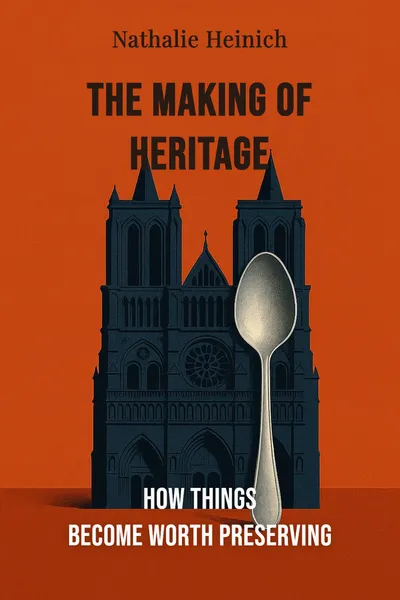
The Making of Heritage
How things become worth preserving
Description
In the 1990s, a French sociologist spent months inside the Inventaire général, the state body that catalogues France's built patrimony, watching civil servants decide whether an old barn, a factory chimney, a village washhouse deserved to be recorded and protected. Nathalie Heinich went into the field the way an anthropologist studies a remote village: notebook open, questions naive, attention fixed not on the monuments but on the people arguing about them. What she found became the material for her book "La fabrique du patrimoine", translated as The Making of Heritage — a close study of how ordinary objects get promoted into the sacred category of things we must not lose.
The word heritage carries an air of obviousness. A cathedral, a castle, a Roman wall — surely these things are simply valuable, and our job is only to notice and maintain them. Heinich's whole point is that this obviousness is manufactured. Value is not lodged in the stone waiting to be discovered; it is produced, negotiated, argued over, written down. Somebody has to decide that this washhouse matters and that one down the road does not. And the people who decide follow criteria that are far stranger, far more emotional, and far more revealing than the neutral language of official protection lets on.
That gap — between heritage as a self-evident treasure and heritage as the outcome of a working day in a provincial office — is where the interesting questions live. Following the inspectors on their rounds, Heinich turns a bureaucratic routine into a mirror of how a whole society decides what deserves to outlast it.
The question we’re asking : How does an ordinary object stop being ordinary and become something a society decides it must preserve?What we’ll see : A trip inside the offices, the field visits and the quiet judgments through which a culture sorts what it keeps from what it lets go.
Table of contents
01Chapter 1 — Inside the office where things become monuments
Heinich did something French sociology rarely does with heritage: instead of theorizing about memory and the nation from a desk, she went to watch the machinery run. Her field was the Inventaire général des monuments et des richesses artistiques de la France, a body created in 1964 under André Malraux with a deceptively simple mission — to survey and record everything of artistic interest across the country, region by region, house by house. Its agents are researchers and photographers who fan out across a territory, note what they find, and produce files. Those files are not protection in themselves, but they are the first sorting, the moment a thing enters the record or stays outside it.
What struck her first was how much of heritage is administrative labor. There are forms to fill, categories to assign, photographs to take from the correct angle, measurements to record. The romance of the ruin dissolves into a workflow. An inspector arrives in a village, is shown around by a proud local, walks the streets, and decides — often on the spot, often on intuition sharpened by years of practice — whether a given doorway, roof, or fountain is worth documenting. The decision then travels up through descriptions and dossiers until it hardens into official standing.

02Chapter 2 — The moment a thing turns into heritage
The central puzzle is the transition itself. How does a house stop being just a house and become patrimony? Heinich noticed that the shift almost never happens because an object suddenly becomes beautiful or old. Age and beauty help, but they are not the trigger. The trigger is a change of regard — a moment when someone looks at the ordinary thing and sees, instead of a functional object, a trace of something worth holding onto. A barn stops being a place for hay and becomes a witness to a vanished rural economy. A factory stops being industry and becomes memory.
This shift often rides on a feeling she treats with unusual seriousness: the sense of loss, or the fear of it. Things tend to become heritage at the moment they are threatened or already gone — when the last of a kind is about to be demolished, when a trade is dying, when a way of life is slipping. Absence, or imminent absence, is a powerful maker of value. What we barely noticed while it was abundant becomes precious once it is rare. Heritage, in this light, is less about the past than about anxiety over the present's tendency to erase.
03Chapter 3 — The feelings that make a stone worth keeping
One of Heinich's sharpest moves is to insist that heritage runs on emotion, not just expertise. Beneath the technical vocabulary of typologies and periods, the inspectors are guided by a handful of affects — admiration, attachment, indignation at destruction, tenderness for the humble and the everyday. She borrows from her earlier work on value and singularity to argue that these feelings are not noise interfering with rational judgment; they are the judgment. What gets preserved is, in the end, what somebody has come to love or to fear losing.
She maps a spectrum of these values. There is the aesthetic — the object is admired for its form. There is the historical — it testifies to an event or an era. There is the memorial — it anchors a community's sense of itself. And increasingly there is what she calls a value of the ordinary: the washhouse, the workers' housing, the modest and anonymous, which the twentieth century learned to cherish precisely because it was humble. Heritage has drifted downward, from kings' palaces to peasants' tools, and that drift is one of the quiet revolutions her fieldwork records.
04Chapter 4 — Heritage as a way of choosing what counts
Step back from the dossiers and the field visits, and Heinich's study becomes an argument about how any society decides what deserves to outlast it. Every act of preservation is also an act of selection. To classify this and not that, to record the washhouse but not the parking lot, to save the industrial chimney and demolish the shed beside it — each choice draws a line between what counts as worth transmitting and what is allowed to disappear. Heritage is not a neutral inventory of the valuable. It is the machinery by which a culture authors its own image of itself.
This is where the sociology bites hardest. The criteria that feel like pure perception to the inspectors are the residue of a particular history — of who has held cultural authority, of which tastes have been legitimated, of what a nation has wanted to remember and what it has preferred to forget. The expansion of heritage to the humble and everyday looks like democratization, and partly it is. But it is still a selection made by trained agents applying a sensibility they did not invent and rarely question, converting their situated judgments into the durable form of official value.
05Conclusion
Back in the provincial offices where Heinich spent her months, the work goes on as if none of this were mysterious. An inspector drives to a village, is shown a house, feels something, opens a file. The gesture is small, routine, sincere. What her patient watching reveals is how much rides on it — how a whole apparatus of value, protection and memory grows out of these ordinary judgments, each one converting a private feeling into a public fact that will shape what our grandchildren find still standing.
Related books