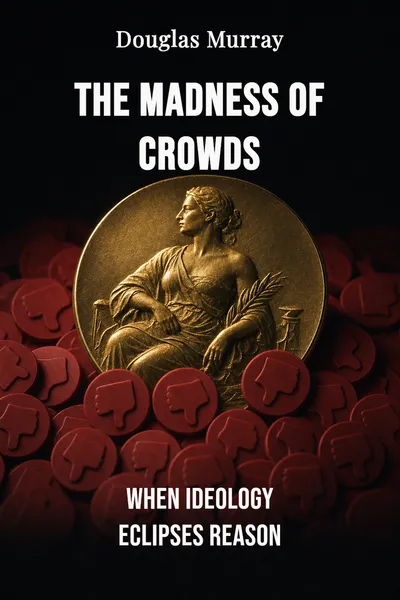
The Madness of Crowds
When ideology eclipses reason
Description
In 2015, a marine biologist named Tim Hunt made a clumsy joke at a science conference in Seoul about women crying in laboratories. Within days the seventy-two-year-old Nobel laureate had resigned his honorary post at University College London, been dropped by the Royal Society, and become a global shorthand for sexism. The remark was foolish. The response, when the fuller context of the speech emerged, looked to some observers wildly out of proportion to a bad quip made by an ageing scientist who by most accounts had spent his career promoting women. Murray uses the episode as one of many exhibits.
The British writer Douglas Murray built his 2019 book The Madness of Crowds around dozens of such flashpoints — small incidents that detonated far beyond their size, careers ended over a sentence, campuses convulsed by a speaker, entire debates that seemed to shut down the moment they began. His claim is that something had shifted in how societies in the West argue about themselves. New moral orthodoxies had settled over questions of gay rights, women, race, and identity, and these orthodoxies were being enforced with an intensity that left little room for doubt, nuance, or ordinary disagreement.
Murray writes as an avowed partisan, not a neutral referee, and the book is a polemic that has been praised and attacked in roughly equal measure. But beneath the individual cases sits a broader argument about what happens to public reason when contested political claims are treated as settled moral facts, and when the machinery of outrage runs faster than the capacity to think.
The question we’re asking : What did Murray think had gone wrong with the way Western societies argue about identity — and why did the disputes feel so charged?What we’ll see : A tour through his chosen flashpoints, the machinery that amplified them, the contradictions he claims the new orthodoxies demand, and the deeper diagnosis underneath.
Table of contents
01Chapter 1 — Four battlegrounds, one pattern
Murray organises the book around four subjects he treats as the front lines of a wider conflict: gay identity, women, race, and what he groups under the heading of trans questions, with a series of shorter interludes threaded between them. His method is accumulation. He gathers case after case — a fired executive, a shouted-down lecture, a viral pile-on, a policy reversal — and lets the volume do the arguing. The individual stories vary, but he wants us to notice the shape they share.
On gay rights, his angle is deliberately counterintuitive. Murray, who is gay himself, argues that a movement which had largely won its central battles for legal equality did not then declare victory and stand down. Instead, he suggests, activism kept escalating, moving from a demand for tolerance toward a demand for celebration, and treating any residual hesitation as bigotry. The question of whether sexuality is fixed at birth or partly fluid, he notes, gets answered differently depending on which answer is politically useful at a given moment.

02Chapter 2 — The technology that rewired the argument
Murray is clear that none of this could operate at scale without the platforms. Twitter, Facebook, and their kin did not invent human self-righteousness, but they built an apparatus that rewards it instantly and punishes deviation just as fast. A remark that once died in the room now travels the world before its author has finished the sentence, stripped of tone, context, and the ordinary charity of face-to-face exchange.
The mechanics matter to his argument. Outrage is unusually engaging — it spreads faster and further than agreement or nuance — so the systems that monetise attention are, in effect, tuned to amplify the angriest reading of any event. Murray describes a dynamic in which a single screenshot, sometimes years old, can be exhumed and recirculated as fresh evidence of villainy, with the accused given no statute of limitations and no way to age out of a bad moment.
03Chapter 3 — When contradictions become mandatory
The heart of Murray's complaint is that the new orthodoxies ask people to affirm propositions that cannot all be true at once. He lays these out as internal contradictions that are not merely tolerated but required, and that anyone can see once they look, but which it has become dangerous to name aloud.
Sexuality, in one register, is presented as innate and immutable — people are born a certain way and cannot change. In another, it is celebrated as fluid, chosen, a spectrum one moves along freely. Both claims are advanced with equal confidence, and the appropriate one is deployed according to the needs of the argument. The same, he says, happens with gender: it is at once a rigid biological reality when a category needs defending and a pure social construct when a category needs dissolving.
04Chapter 4 — The tyranny of the unforgiving present
Step back from the individual quarrels and Murray is really describing something older wearing new clothes. The impulse behind the pile-ons — the certainty of righteousness, the hunger to identify heretics, the refusal to forgive — looks to him like a religious energy that has lost its object and attached itself to politics instead. The West, he argues, has not become less religious so much as differently religious, transferring the apparatus of sin, confession, and unpardonable transgression from the church to the timeline.
What that transfer costs is mercy. A religious tradition at its best offered a route back: repentance, penance, absolution, the possibility that a person could be more than their worst act. The secular version Murray sketches keeps the sin and abolishes the forgiveness. The offender is defined permanently by the offence, and no amount of contrition restores them, because the system has no mechanism for restoration. This, he suggests, is why the disputes feel so pitiless — they are structured to punish, not to reconcile.
05Conclusion
The book closes where Murray's larger anxiety lives: not in any single verdict about gender or race, but in the atmosphere around all of them. Tim Hunt's resignation, the shouted-down lecturers, the exhumed tweets — these were never really about the offences themselves. They were about a way of arguing that had lost its brakes, in which speed replaced reflection and loyalty replaced thought. Murray's wager is that a culture can survive fierce disagreement far more easily than it can survive the inability to disagree.
Related books