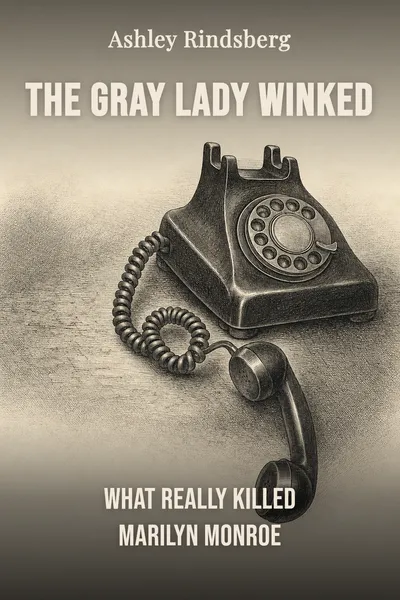
The Gray Lady Winked
What really killed Marilyn Monroe
Description
On the morning of August 5, 1962, the world learned that Marilyn Monroe had been found dead in her Brentwood bungalow the night before, a bottle of Nembutal beside the bed. She was thirty-six. Within hours the story had a shape: a fragile star, a lifetime of pills, a lonely end that looked a lot like the ending everyone had half-expected. The Los Angeles County coroner would call it a probable suicide. The most powerful newspaper in the country, the New York Times, reported it in roughly those terms, and the terms stuck. For sixty years, that has been the version most of us carry around without ever having examined it.
Ashley Rindsberg's book "The Gray Lady Winked" refuses to let the version sit undisturbed. His subject is not really the pharmacology of a barbiturate overdose, and he does not pretend to have solved a murder. What he has done is reopen the file — the timeline, the phone records, the housekeeper's shifting account, the missing hours, the names that kept surfacing and kept getting brushed off — and ask why so much of it never made it into the record that mattered. Around Monroe's last night orbit two of the most powerful forces in American life at the time: the Kennedys and organized crime. Rindsberg is careful. He raises questions rather than closing them.
The book belongs to a larger argument Rindsberg makes about the New York Times itself — the "Gray Lady" of the title. His interest is in how a newspaper's choices about what to chase and what to let lie can quietly decide what a whole society treats as settled.
The question we’re asking : What did the record leave out about Marilyn Monroe's final night, and who decided it could stay out?What we’ll see : How a reopened file turns a familiar death into a story about power, and about who gets to say what happened.
Table of contents
01Chapter 1 — The word that never made it into print
Rindsberg starts with the gap between what was known and what was published. By August 1962, Monroe was not a fading recluse; she had just been fired from a film, rehired, and was fielding magazine covers. She was also, by many accounts, tangled up with the two most powerful brothers in Washington. That last part is the thing the record handled gingerly. The name Kennedy sat close to the center of her final months, and yet in the coverage that shaped the public memory, it barely appears.
This is the move that gives the book its title. To "wink" is to see something and choose, deliberately, not to say it out loud — to signal to the people who already know while keeping the rest of us in the dark. Rindsberg argues that the paper of record did exactly that around Monroe: it had the pieces, or could easily have gotten them, and it declined to assemble them into the obvious question. A wink is not a lie. It is something subtler and harder to prosecute — an agreement, unspoken, about what will not be printed.

02Chapter 2 — The night the timeline fell apart
The heart of the book is the timeline, because the timeline is where the official account gets shaky. The broad strokes are simple. On the evening of August 4, Monroe was in her home in Brentwood. At some point she died. In the early hours of August 5, the police were called. But the space between those points, Rindsberg shows, is a mess of contradictions that never got resolved, and the mess was there for anyone who cared to look.
The housekeeper, Eunice Murray, gave accounts that changed over the years, including about when she first noticed something wrong and what she did next. The hours between the discovery and the call to police stretched, in some tellings, well past what an innocent explanation comfortably covers. Phone calls were made in that window; who was called, and who came to the house, has never been fully nailed down. Monroe's psychiatrist and her doctor were both on the scene, and their movements complicate rather than clarify things.
03Chapter 3 — When the paper decides what a story is
Here the book widens from Monroe to the machinery around her. Two shadows fall across the final months: the Kennedy brothers, and the mob figures whose worlds overlapped with theirs. Rindsberg lays out what has been reported over the decades — the surveillance, the whispered connections, the men who had reasons to want Monroe's confidences contained. He treats all of it as hypothesis, not verdict, and keeps insisting on the distinction even where the temptation to close the loop is strongest.
But his real argument is about the newspaper's role in what happened next. A death of this magnitude, touching figures of this power, was exactly the kind of story a great investigative paper exists to chase. The choice not to chase it, Rindsberg contends, was itself a form of authorship. By declining to connect Monroe to the Kennedys in print, by treating the timeline's holes as clerical rather than suspicious, the paper did not merely fail to investigate. It wrote a conclusion.
04Chapter 4 — The reporter who kept the receipts
Step back from Brentwood and the Monroe case becomes, in Rindsberg's hands, a single exhibit in a larger case about the New York Times. His broader claim is that the paper of record does not simply report what happened; through the accumulation of its choices, it decides what a society is allowed to consider real. When the most trusted outlet leaves a thread unpulled, the thread stops existing for almost everyone. The authority that makes a paper worth reading is the same authority that makes its silences invisible.
That is a different and more unsettling kind of power than the one usually attributed to the press. We tend to picture censorship as something loud — a story spiked, a fact denied. Rindsberg's version is quieter. It works through emphasis and omission, through the calm authority of a byline that treats a contested account as obvious. Monroe's death is his showcase precisely because the official version was so smooth, so free of the friction the facts should have produced. The smoothness is the tell.
05Conclusion
Sixty years on, we still reach for the same three words to explain Marilyn Monroe's last night: pills, loneliness, suicide. Rindsberg does not replace them with three other words. He shows that the tidy version was tidy because someone let it be — the messy hours, the powerful names, the physical questions all present at the time, all quietly set aside. The Nembutal bottle by the bed is still there in his account. What has changed is the confidence with which we can call it the end of the story.
Related books