

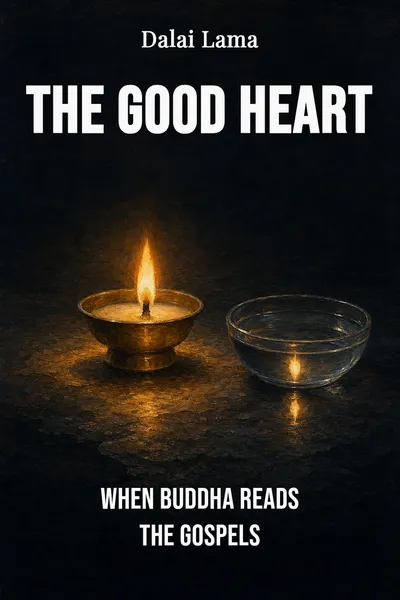
The Good Heart
When Buddha reads the Gospels
Description
In September 1994, in a hall in London, a Tibetan Buddhist monk sat down with the four Christian Gospels open in front of him and began to read them aloud, one passage at a time, to a room full of Christian contemplatives. The occasion was the tenth John Main Seminar, organized by the World Community for Christian Meditation, and the reader was the Dalai Lama. He had agreed to do something he had never done before: comment, in public, verse by verse, on the Sermon on the Mount, the Beatitudes, the parable of the mustard seed, the Transfiguration, the Resurrection. He kept apologizing, warmly, for how little he knew of the text.
What came out of those days became a book, The Good Heart, and it is a strange one. It is not a Buddhist trying to convert Christians, and not a diplomat smoothing everything into a single bland faith. It is a monk from one tradition sitting inside the sacred words of another, saying honestly where he recognizes his own path and, just as honestly, where he does not. The Christians in the room, led by the Benedictine monk Laurence Freeman and the memory of John Main, were not there to be persuaded either. They were there to see what happens when reverence meets difference in the same room.
That is the odd promise of the whole thing. We tend to assume that dialogue between religions means finding the lowest common denominator — we're all climbing the same mountain, more or less. The Good Heart does something less comfortable and more interesting than that.
The question we’re asking : What does a Buddhist monk actually see when he reads the Christian Gospels with care — and what does he refuse to pretend he sees?What we’ll see : A famous teacher reading someone else's scripture out loud, and what that unusual exercise reveals about how two whole traditions can meet without dissolving into one.
Table of contents
01Chapter 1 — A monk reads a book he was never trained to read
The setup was deliberate. Laurence Freeman, the Benedictine who led the World Community for Christian Meditation after John Main's death, did not ask the Dalai Lama for a lecture on Buddhism. He asked him to read the Gospels — the community's own scripture — and respond as a Buddhist. The reversal matters. Usually the host tradition explains itself and the guest listens politely. Here the guest was handed the host's most intimate texts and invited to say what he made of them, in front of the people who live by them.
The Dalai Lama's first move, throughout the seminar, was to disarm the very idea of authority. He repeatedly reminded the room that he was a poor reader of the Gospels, that he might misunderstand, that his Christian friends should correct him. This was not false modesty. It was method. By refusing the posture of the expert commenting from above, he made the reading a conversation rather than a verdict. When he stumbled over a theological term or admitted a passage puzzled him, the puzzlement itself became part of the exchange.

02Chapter 2 — Where the two traditions actually meet
The overlaps he found were real, and he named them without inflating them. The Sermon on the Mount, with its call to turn the other cheek, landed close to the Buddhist practice of patience and the refusal of retaliation. The Beatitudes' blessing of the meek and the merciful echoed teachings he had recited all his life. When Jesus tells his followers not to judge, or to love those who hate them, the Dalai Lama recognized the same difficult work that Buddhist training calls the cultivation of compassion toward the enemy — perhaps the hardest thing either path asks.
The center of gravity, for him, was compassion itself. Both traditions, he argued, place the transformation of the heart at their core, and both insist that this transformation shows up in how one treats other people, especially those one has no reason to help. The title of the book comes from here. A good heart — a mind turned genuinely toward the welfare of others — is, in his reading, the thing Jesus and the Buddha are both pointing at, however differently they describe the journey and its destination.
03Chapter 3 — What the Buddhist eye notices in the Gospel
The differences were where the reading became sharpest, and he did not soften them. The Resurrection was the clearest case. A Christian reads it as the singular, historical act of a God who enters death and defeats it. The Dalai Lama, reading as a Buddhist, could honor the passage's power without accepting its metaphysics. In his framework there is no creator God, and the significance of a spiritual event lies in what it does for the practitioner's mind, not in a unique divine intervention in history. He said so plainly, and then said the disagreement was fine — better than a polite blur.
This is where his method earned its keep. Rather than translate the Christian idea of a personal God into some Buddhist near-equivalent, he let it stand as genuinely other. A faith organized around a loving creator who saves is not the same as a path organized around awakening from ignorance through one's own effort across many lives. To treat them as secretly identical, he warned, insults both. The respect he showed the Gospel was precisely his willingness to let it disagree with him.
04Chapter 4 — The problem the seminar refused to solve
Step back from the individual passages and the John Main Seminar looks like an argument about what dialogue between religions is even for. The comfortable answer, the one that circulates most easily, is that dialogue should discover unity — peel back the doctrines and find the same universal spirituality underneath. The Good Heart quietly refuses that answer. Its whole design assumes the opposite: that the traditions are not the same, that their differences are real and worth keeping, and that this is not an obstacle to friendship but the condition of an honest one.
The Dalai Lama's repeated warning against spiritual hybrids is the key to this. He was protecting something. A tradition earns its depth over centuries by holding its practices, its philosophy, and its community together, and a person is usually served best by going deep into one rather than sampling several. His advice to the Christians was to become better Christians — to let the encounter with Buddhism send them back into their own tradition with fresh attention, not out of it. That is a surprisingly demanding thing to say to admirers, and it is the ethical core of the book.
05Conclusion
The monk who kept apologizing for reading the Gospels badly turned out to read them with unusual care. Over those days in London he moved through the Sermon on the Mount, the Beatitudes, the mustard seed and the Resurrection, recognizing his own path where it truly overlapped and naming the divergence where it truly diverged. What emerged was not a synthesis but a demonstration — that two people can revere each other's holiest words without pretending those words say the same thing.