Confession
An institution that produced the self
Description
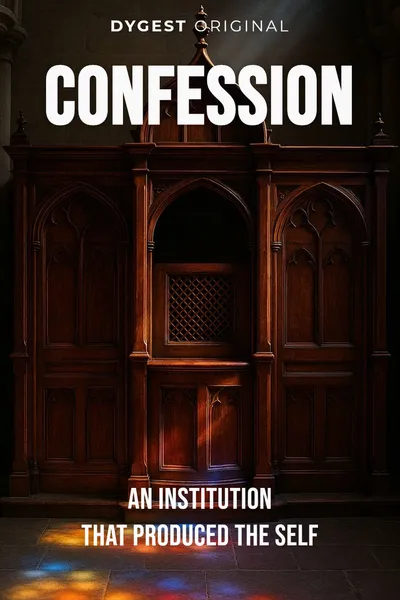
In November 1215, several hundred bishops, abbots and envoys gathered in Rome for the Fourth Lateran Council, the largest Church assembly of the medieval West. Among the dozens of canons they issued was one that would quietly reorganize the inner life of Europe. Canon 21, known by its opening words Omnis utriusque sexus, required every Christian who had reached the age of reason to confess their sins to their own priest at least once a year, privately, and to perform the penance assigned. It sounds administrative. In practice it installed an annual appointment with one's own conscience, enforced across an entire civilization, binding on everyone.
Before 1215, confession existed but was irregular, often public, sometimes a once-in-a-lifetime affair. After 1215, it became a recurring private duty: kneel, examine your memory, put your faults into words, and speak them to a listener trained to question and absolve. Over the following centuries the practice grew a whole technology around itself — manuals for priests, catalogues of sins, techniques for probing the reluctant penitent. To confess well, one had to first become a careful observer of one's own desires and motives. The obligation to speak produced a new habit of looking inward.
That habit did not stay inside the church walls. The scene recurs with the furniture changed: the booth becomes a couch, the priest becomes a therapist, the examination of conscience becomes a status update at two in the morning. The listener and the vocabulary shift, but the underlying move holds — that something true about us is lodged inside, and that saying it out loud sets something right. We treat this as human nature. It has a history, and the history has a start date.
The question we’re asking : How did a yearly church duty turn into the deep conviction that speaking our secrets is how we become ourselves?What we’ll see : How one medieval rule built the inward-looking self, and how that self kept its habit long after it stopped kneeling.
Table of contents
01 Chapter 1 — The year the Church made everyone talk
The Fourth Lateran Council met under Pope Innocent III, at the height of papal ambition, and its canons touched everything from Crusade logistics to the rules for marriage. Canon 21 was short, but its reach was total. Every believer of discerning age was to confess all their sins faithfully, once a year at minimum, to their parish priest, and the priest in turn was bound to discretion — the seal of confession, breaking which brought severe penalty. A duty on one side, a guarantee of secrecy on the other. That pairing is what made honest speech thinkable.
What the rule demanded was harder than it looked. You cannot confess sins you have not identified, and you cannot identify them without surveying your own conduct, thoughts, intentions. So the Church built the tools. Summae confessorum — handbooks for confessors — multiplied through the thirteenth and fourteenth centuries, instructing priests on how to interrogate, which questions to ask, how to distinguish a mortal fault from a venial one. Sins were sorted, often around the seven deadly ones, each with its branches and sub-branches, a grid laid over the whole of a life.

02 Chapter 2 — From the confessional to the clinic
For centuries confession's monopoly on secret speech held. If you had something hidden and heavy, the priest was the one person obliged to hear it and forbidden to repeat it. Then, in the nineteenth century, the medical world began to take an interest in what people would not say. Doctors treating what they called nervous disorders — hysteria above all — noticed that symptoms often eased when patients were induced to talk about things they had buried. The cure, strikingly, ran through speech.
In Vienna in the 1880s and 1890s, Josef Breuer and then Sigmund Freud pushed this further. Breuer's patient Bertha Pappenheim, remembered as Anna O., called the process the talking cure, and the phrase stuck because it named something real. Freud eventually abandoned hypnosis for free association: the patient was to say whatever came to mind, without editing, however shameful or trivial. The analyst listened, questioned, interpreted. What surfaced, Freud argued, was material the patient had pushed out of awareness — and bringing it into words was itself part of the healing.
03 Chapter 3 — The couch inherits the kneeler
Psychoanalysis was never going to reach most people — it was slow, expensive, and confined to a few cities. But its core wager, that talking about yourself to a skilled listener could set you right, escaped the consulting room and spread far beyond Freud's specific theories, most of which later therapy quietly dropped. Over the twentieth century, counseling, group therapy, and later cognitive and humanistic approaches turned the talking cure from an elite treatment into a mass expectation. Speaking about one's feelings became a general competence, something a well-adjusted adult was supposed to be able to do.
The American philosopher and the French historian Michel Foucault watched this spread and read it against the grain. In the first volume of his history of sexuality, published in 1976, Foucault argued that the West had become, in his phrase, a singularly confessing society. We confess our crimes, our loves, our illnesses, our thoughts; we confess to doctors, teachers, employers, lovers, and we have come to experience this telling not as submission but as liberation. The more we are required to speak the truth about ourselves, the more we feel that in speaking it we are finally being free.
04 Chapter 4 — A culture that believes the truth is spoken
Step back from the particular settings — the booth, the couch, the group circle, the comment thread — and a single assumption runs through all of them: that the truth of a person is something lodged inside, and that it becomes real, and the person becomes whole, by being put into words for another to receive. Confession, in this broad sense, is not one practice among many in the culture. It is close to the culture's default idea of what a self is and how one is supposed to tend it.
This is worth holding against alternatives, because it is not the only way a civilization has imagined the person. Traditions that locate virtue in action, in bearing, in what one does rather than what one discloses, produce a very different ideal — the self proven by conduct, not revealed by speech. The confessing model instead makes disclosure the master key. We judge sincerity by willingness to open up. We suspect the reserved. We treat the unspoken as the unresolved, as though anything genuinely important must eventually be said.
05 Conclusion
Omnis utriusque sexus was one canon among seventy issued by a council that was mostly thinking about Crusades, heresy and clerical reform. Its drafters cannot have imagined that the small print of annual confession would outlast the theology that justified it, migrate into medicine, and end up shaping how a secular, scrolling civilization understands its own interior. Yet the line from the parish priest to the analyst to the midnight post is continuous: the same protected act of telling, the same faith that saying the hidden thing does something, the same inward gaze that confession first trained people to turn on themselves.
Related books