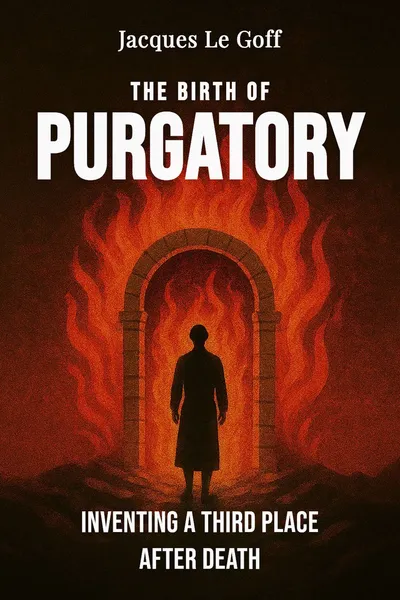
The Birth of Purgatory
Inventing a third place after death
Description
For most of Christianity's first millennium, the geography of the afterlife had two addresses. There was heaven for the saved and hell for the damned, and between them, nothing you could name. A soul was sorted at death and that was that. Then, at some point in the late twelfth century, a French Cistercian or a Paris theologian began using a strange new noun. Not the adjective people had leaned on for centuries — a purging fire, a place of purgation — but a thing, a location: purgatorium. The historian Jacques Le Goff, in his 1981 book The Birth of Purgatory, put a rough date on the shift and asked a question that sounds almost impertinent. When exactly did the third place after death come into existence?
His answer is disconcertingly precise. The noun, he argues, appears in the surviving record only in the years around 1170 to 1180 — not in Scripture, not in the Church Fathers, but in the sermons and treatises of a particular generation, in a particular corner of Europe. Before that, Christians had prayed for their dead and imagined a cleansing after death, but they had no fixed room to put those souls in. The idea floated. What Le Goff traces is the moment the idea acquired walls.
That is a peculiar thing to be able to date. Doctrines usually feel timeless, handed down whole. This one has a birth certificate, or close to it, and the birth happened at a very specific moment in medieval history — the same decades that gave Europe universities, Gothic cathedrals, a money economy, and a new appetite for sorting the world into categories. Purgatory, in Le Goff's telling, was not found in the sources. It was built.
The question we’re asking : How does a place that supposedly always existed turn out to have a datable birth in the twelfth century?What we’ll see : How a floating intuition about the dead slowly hardened, over a thousand years, into a named location on the map of the afterlife — and what that new address changed.
Table of contents
01 Chapter 1 — A word that did not exist yet
Le Goff's method is almost forensic, and it starts with grammar. For centuries, Latin Christianity spoke of purgation as an action or a quality — ignis purgatorius, a purgatorial fire, purgatorial punishments. The adjective did the work. What it never did was name a place. There was no noun, no purgatorium, no room you could point to between the gates of heaven and the mouth of hell. And in Le Goff's reading, a place that has no name in a culture's vocabulary does not yet fully exist in that culture's imagination. The absence of the word is not a footnote. It is the evidence.
This matters because the scriptural foundation for the idea was always thin. There is a much-cited verse in the second book of Maccabees about praying and making offerings for the dead, and a line in Paul's first letter to the Corinthians about a person being saved "as through fire." Early theologians read these as hints. But hints are not architecture. Augustine, writing around the turn of the fifth century, allowed cautiously that some souls might undergo a cleansing after death, yet he refused to draw a map. He hedged, he qualified, he left it uncertain. That uncertainty lasted the better part of eight hundred years.

02 Chapter 2 — The slow work of imagining a middle place
The assembly did not happen overnight, and Le Goff is careful not to make it look like a lightning strike. What he describes across the eleventh and twelfth centuries is a slow reorganization of how Europeans pictured the beyond. The old binary — saved or damned, up or down — began to feel too crude for the moral life people actually recognized. Most human beings were neither saints nor monsters. They were middling: decent, flawed, forgivable. A two-room afterlife had no place for the vast, ordinary middle of humanity, and that pressure had to go somewhere.
The monasteries did much of the imaginative labor. Cluny, the great Burgundian abbey, had by the eleventh century made prayer for the dead a central occupation, and around the year 1030 it established the commemoration of all the departed — the feast we know as All Souls' Day, fixed on November 2. An entire institution now devoted itself, on a calendar, to souls who were being helped somewhere. To pray systematically for the dead is already to assume they exist in some state that prayer can reach. The practice was quietly outrunning the doctrine.
03 Chapter 3 — 1170, and the noun appears
The nailing-down is what Le Goff dates, and it is here his argument becomes concrete. Sifting the manuscripts, he places the first secure appearances of purgatorium as a noun — a place, not merely a quality — in the years around 1170 to 1180. He points to the intellectual milieu of Paris and to Cistercian circles, environments where the new logical rigor met the older monastic obsession with the dead. Somewhere in that overlap, the adjective hardened into a substantive. Purgation stopped being something that happened to you and became somewhere you went.
Grammar, in Le Goff's hands, carries enormous weight. The shift from "a purging fire" to "Purgatory" is the shift from a process to a territory, and a territory has properties. It has a location on the cosmic map — between hell and heaven. It has entrances and exits, since souls arrive and eventually leave. It has, crucially, a duration: time is served there, and time can be measured, shortened, negotiated. A named place is a place with a clock, and the clock changes everything.
04 Chapter 4 — The stakes of a third place
What did the invention actually do? Adding a third room to the afterlife sounds like a tidy theological adjustment, but Le Goff's larger claim is that it reorganized the relationship between the living and the dead, and with it a good deal of medieval society. Because purgatory ran on time, and time could be reduced, the fate of a soul was no longer sealed at the grave. It stayed open. The dead were now reachable, their suffering shortenable, and that gave the living an ongoing, active stake in people who had died. Grief acquired a task.
That task had an economy. If prayers, masses, and alms could shorten a soul's sentence, then the living had every reason to fund them — and the Church had a vast new territory of pastoral and financial activity. Bequests for masses, endowments for chantries, gifts made with the dead in mind: an entire circuit of obligation and expenditure grew up around the third place. Le Goff is not cynical about this, but he is clear-eyed. Purgatory redistributed spiritual and material resources on a large scale. It gave the institution a lever that reached beyond the grave, and centuries later the sale of indulgences pegged to purgatorial time would help detonate the Reformation.
05 Conclusion
A soul that once stood at a fork — heaven or hell, nothing between — found, sometime around 1170, a third road opening in the middle. Le Goff's achievement is to make that opening visible as an event, with a rough date, a location, and a human context, rather than as a timeless truth simply revealed. He tracks the noun, watches it appear, and shows a millennium of scattered intuition finally hardening into a place with a name, a map position, and a clock. The materials were old; the assembly was medieval.
Related books