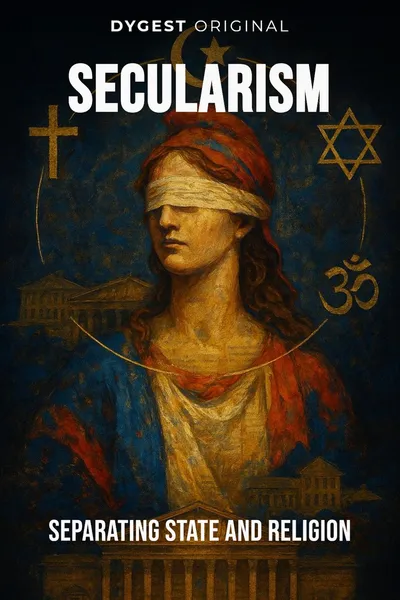
Secularism
Separating state and religion
Description
In December 2004, a French law took effect banning conspicuous religious symbols in public schools — headscarves, large crosses, skullcaps, turbans. The debate that produced it had run for fifteen years, kicked off in 1989 when three teenage girls were expelled from a middle school north of Paris for refusing to remove their headscarves. The affair split the country. Teachers, intellectuals, politicians and families argued about what a secular school owed its pupils, and what it was allowed to forbid them. To many observers outside France, the whole thing looked baffling: a liberal democracy telling schoolgirls what they could wear on their own heads, in the name of freedom.
The word at the center of it all was laïcité — usually translated as secularism, though the translation does a lot of quiet damage. Because the thing France was defending that year was not the thing an American means by separation of church and state, nor the thing a British or German or Indian citizen would recognize under the same label. They all share a family resemblance. They all claim to keep the state and religion apart. But they draw the line in strikingly different places, and for strikingly different reasons.
We tend to assume there is one modern settlement here, arrived at once and shared by every secular democracy. There isn't. Separation is a word that hides a cluster of rival models, each shaped by the particular fight its country had with its own churches. France's version is the one that keeps surprising everyone else — and the reason it surprises them turns out to be the most revealing part of the story.
The question we’re asking : What does it actually mean to separate state and religion — and why does that separation look so different from one democracy to the next?What we’ll see : How rival models of church-state separation took shape, and what makes the French version the odd and illuminating one out.
Table of contents
01 Chapter 1 — The word that means different things in different places
Start with the fact that secularism is not one idea with local accents. It is several distinct arrangements that happen to share a name. The common thread is modest: in a secular state, religious authority and political authority are institutionally distinct. No church runs the government, no government is formally an arm of a church. Beyond that minimum, the models diverge sharply, and the divergence is about what the state does with religion once it has unhooked itself from any single one.
The American arrangement, written into the First Amendment in 1791, does two things at once: the state may not establish a religion, and it may not prohibit anyone from freely exercising theirs. The emphasis falls heavily on that second clause. Religion is meant to flourish in public life; the state simply stays neutral between faiths. An American president is sworn in on a Bible, Congress opens with a chaplain's prayer, and none of this is felt to breach the wall. The wall keeps the state out of the church, more than it keeps the church out of the public square.

02 Chapter 2 — The American wall and the French fence
Put the American and French models side by side and the contrast sharpens into something almost architectural. Thomas Jefferson's famous phrase, from an 1802 letter to a Baptist congregation in Connecticut, was a "wall of separation between church and state." The point of the wall, for Jefferson and the Baptists he was reassuring, was to protect religion from the state. Dissenting congregations had been taxed and harassed by established colonial churches; the wall guaranteed they would be left alone to worship as they pleased. Separation, in the American imagination, is a shield around conscience.
The French model inverts the logic. Where the American wall protects religion from the state, the French arrangement is built at least as much to protect the state — and public life, and the individual citizen — from religion. Laïcité does not simply ask the government to be neutral. It asks the public sphere itself to be kept clear of religious markers, so that in the spaces the Republic directly controls — above all the school and the civil service — citizens meet as citizens and nothing else, stripped of the badges of faith that might otherwise divide them.
03 Chapter 3 — Where the French model came from
France did not arrive at laïcité through calm constitutional design. It fought its way there, against a single, enormous, entrenched adversary: the Catholic Church. For centuries the Church was not one religious option among many but the throne's partner — owning vast land, controlling education, registering births and deaths, and sanctifying the monarchy itself. There was no pluralism to balance. There was one dominant institution fused with political power, and the fight over secularism was, from the start, a power struggle with that institution.
The Revolution of 1789 opened it. Revolutionaries seized church property, tried to bring clergy under state control, and briefly attempted to replace Catholicism outright with civic cults of Reason and the Supreme Being. Napoleon then struck a truce, the Concordat of 1801, that re-regulated the relationship without dissolving it: the state recognized and salaried the clergy, and in return gained a say over the Church. For most of the nineteenth century, France lurched between regimes that leaned clerical and regimes that leaned anti-clerical, the question never settled.
04 Chapter 4 — The problem every modern state has to solve
Step back from France and the deeper issue comes into view. Every modern state governs people who hold incompatible convictions about the most important things — the nature of the good life, the source of moral authority, what happens after death. These are not disagreements that argument settles. A state that wants to hold such people together as equal citizens has to find some arrangement for living with that permanent plurality. Secularism, in all its forms, is one family of answers to that problem. It is less a doctrine about God than a technique of coexistence.
Seen this way, the rival models stop looking like different degrees of the same thing and start looking like different bets. The American bet is that you keep the peace by letting every conviction flourish openly while the state referees from a position of neutrality. The British bet is that an established but toothless church causes nobody much trouble, so why disturb it. The Indian bet is that even-handed state involvement in every faith keeps the largest from dominating the rest. Each is a wager about which arrangement best lets deeply divided people share a country.
05 Conclusion
Go back to those schoolgirls expelled in 1989, and the law that eventually answered their case in 2004. The reaction abroad — that France was being illiberal, even authoritarian, toward a scrap of cloth — missed what was actually in play. France was not improvising a new intolerance. It was reaching for a settlement forged more than a century earlier, in a fight with a Church that had once held the whole of public life in its grip, and applying that settlement to a presence its authors never foresaw. Whether the fit was right is exactly what the French have been arguing about ever since.
Related books