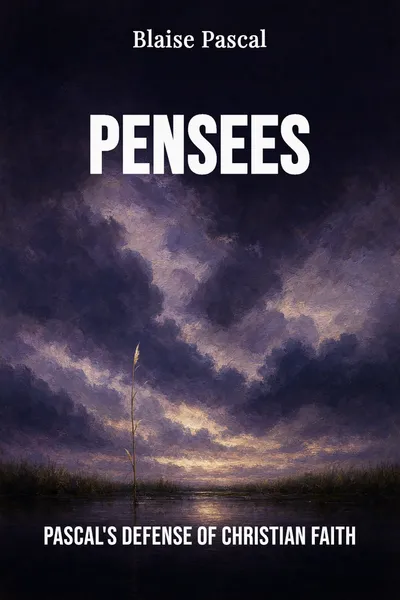
Pensees
Pascal's defense of Christian faith
Description
When Blaise Pascal died in Paris in August 1662, at thirty-nine, he left behind a mathematician's reputation, a religious life of unusual intensity, and a mass of paper. Scholars would later count hundreds of fragments — some a single line, some running to several pages — many written on large sheets that Pascal had cut into strips and threaded onto string, grouped by theme. He was building something. The plan, as far as anyone could reconstruct it, was a full-scale defense of the Christian religion, an Apology meant to persuade the cultivated, skeptical readers of his century. He never finished it. What we call the Pensées is the wreckage of that project, published by his family and friends in 1670, eight years after his death.
The oddity is that the wreckage became a classic where the finished book might not have. Pascal wrote in flashes — sharp, aphoristic, sometimes brutal about the human condition, sometimes tender. He was arguing with an imaginary interlocutor, the worldly Frenchman who thought religion was for the weak-minded, and he refused the tools that interlocutor expected. No proofs of God's existence from the order of nature. No comfortable theology. Instead, a relentless portrait of what it feels like to be human, followed by the claim that only one account of the world makes sense of that feeling.
For more than three centuries the Pensées has been read as one of the great works of Christian thought — and, just as often, by readers with no faith at all, who find in it the most honest description of restlessness they have ever encountered. It is a book that meets you where you are uneasy.
The question we’re asking : How does an unfinished pile of notes become one of the most enduring defenses of Christian faith ever written?What we’ll see : A fragment-by-fragment argument that runs from the wretchedness of the human condition, through a famous bet, to a kind of knowing that reason alone cannot reach.
Table of contents
01 Chapter 1 — A book that was never a book
Pascal was already famous before he turned to religion in earnest. As a teenager he had written on conic sections; in his twenties he built a mechanical calculating machine and, with Pierre de Fermat, laid the foundations of probability theory. He was a working scientist of the first rank. Then, over the course of the 1650s, a series of events — his sister's entry into the austere convent of Port-Royal, his own intense religious experience one night in November 1654, which he recorded on a scrap of paper and sewed into his coat — turned him toward the defense of the faith he now held with total seriousness.
The Apology he planned was ambitious. He wanted to convince a specific reader: not the atheist who had settled the question, but the man of the world who had never really posed it, who lived among diversions and assumed religion was a matter for temperament rather than truth. Pascal thought this reader could be moved — not by argument alone, but by being shown himself. So he gathered notes, sharpened phrases, arranged fragments into bundles he labelled by theme: wretchedness, diversion, the philosophers, the wager, the proofs of the Christian religion.

02 Chapter 2 — The misery and greatness of a thinking reed
Before Pascal offers a single reason to believe, he insists on describing the reader's situation. The picture is bleak and precise. We are, he writes, suspended between two infinities — the vastness of the cosmos and the abyss of the infinitely small — and we grasp neither. We do not know where we came from or where we go. We are certain of almost nothing that matters, and yet we cannot stop wanting to know. This is the human condition as Pascal frames it: a creature built for truth and starved of it.
His most famous image captures the paradox. Man is a reed, he writes, the weakest thing in nature — but a thinking reed. The whole universe need not arm itself to crush him; a vapor, a drop of water, is enough to kill him. But even as the universe crushes him, he is nobler than what kills him, because he knows he is dying and knows the advantage the universe has over him. The universe knows nothing. Our greatness, in Pascal's account, lies precisely in our capacity to grasp our own misery.
03 Chapter 3 — The wager, and what it really argues
The most quoted fragment of the Pensées is the wager — and also the most misread. Pascal imagines his worldly interlocutor at an impasse: reason cannot prove whether God exists or not, since God, if he exists, is infinitely beyond our comprehension. Faced with a question reason cannot decide, the man says he will simply not choose. Pascal's reply is that not choosing is itself a choice. We are already embarked; the game is already being played; we have to bet, whether we like it or not.
So he lays out the stakes like the probability theorist he was. If you wager that God exists and you are right, you gain an infinity of happy life. If you wager he exists and you are wrong, you have lost very little — a few worldly pleasures. If you wager against and you are right, you gain almost nothing. If you wager against and you are wrong, you lose everything. When one side of the ledger holds an infinite gain against a finite loss, the rational bet is obvious. Given the chance of infinite reward, betting on God is the only reasonable move.
04 Chapter 4 — Reasons of the heart
Running under everything in the Pensées is a claim about the limits of reason itself. Pascal, one of the sharpest reasoners of his age, did not trust reason to reach the things that matter most. The heart has its reasons, he writes, which reason does not know. He does not mean sentiment as opposed to logic. He means a whole other faculty of knowing — the way we grasp first principles, the way we know we are not dreaming, the way we apprehend God when we do. These are known by the heart, not proved by the mind, and reason has to lean on them even to begin its work.
This is why Pascal has so little patience with the philosophers who tried to argue their way to God through the design of nature. Such proofs, he thought, are feeble and convince almost no one who was not already convinced; and worse, they lead at best to a distant clockmaker, not to the God who speaks and saves. It is one of the boldest moves in the book: a defense of Christianity that refuses the standard rational apologetics and stakes everything on a different kind of encounter. "The God of Abraham, Isaac, and Jacob," he wrote on that scrap sewn into his coat, "not of the philosophers and scholars."
05 Conclusion
Pascal never assembled his Apology, and it is worth remembering why. Illness dogged him for years; he died young, in pain, having given much of his last strength to charity and prayer rather than to finishing his manuscript. The great defense of the faith stayed a heap of fragments on string. And yet the incompleteness turned out to fit the argument. A book that insists reason cannot close the deepest questions could hardly end as a tidy system with every proof in place.
Related books