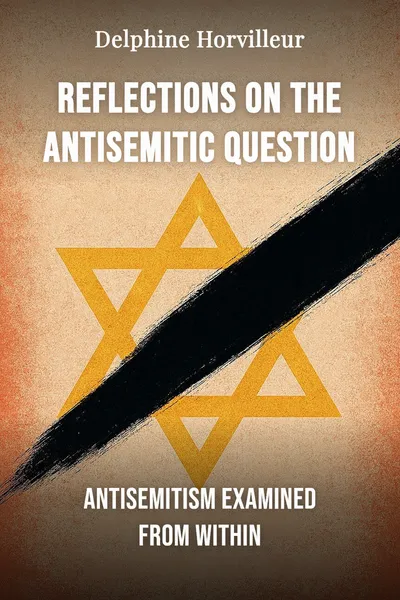
Reflections on the Antisemitic Question
Antisemitism examined from within
Description
Delphine Horvilleur is one of a handful of women rabbis in France, which already places her in an odd position: a figure of a tradition that much of the public assumes to be closed, patriarchal, turned inward. In 2019 she published a short, dense book — in French, Réflexions sur la question antisémite — written in the wake of a wave of attacks and desecrations, at a moment when the word "antisemitism" was back in the newspapers and yet, she felt, badly understood. Her move was unusual. She did not set out to catalogue the crimes or count the graffiti. She set out to ask what the antisemite actually sees when he looks at a Jew.
The title echoes, deliberately, the old "Jewish question" of the nineteenth century, and Jean-Paul Sartre's famous postwar essay that flipped it — arguing that it is the antisemite who creates the Jew, not the other way around. Horvilleur takes that insight and carries it further, as a rabbi rather than a philosopher. She reads the hatred the way she reads a text: looking for its structure, its recurring images, the fantasy it keeps returning to across centuries that otherwise have nothing in common. Plague, poison, money, conspiracy, contamination — the accusations change, the grammar does not.
What makes the book unusual is the vantage point. This is antisemitism examined from inside the thing it targets, by someone whose job is to interpret, to sit with grief, to officiate at funerals including those of the murdered. The result is less an indictment than a diagnosis — and, in the end, something closer to a proposal about how to live with an identity that others are forever trying to fix in place.
The question we’re asking : What does the antisemite actually see when he looks at a Jew — and what does that fantasy reveal about the one who holds it?What we’ll see : How a rabbi reads an ancient hatred from the inside, the fantasy underneath its changing accusations, and the kind of answer she proposes.
Table of contents
01 Chapter 1 — The hatred that keeps changing costume
Horvilleur begins with a problem of definition. Antisemitism is routinely described as a prejudice, a form of racism among others, and treated as though understanding it were a matter of listing its victims and its violence. But she notices something that resists that framing: the accusations contradict each other. The Jew is denounced as a rootless cosmopolitan and as a narrow tribalist; as a grasping capitalist and as a subversive communist; as weak and degenerate, and as a hidden master pulling the world's strings. No single real group could be all of these at once. The coherence, she argues, is not in the target. It is in the function.
This is where she leans on Sartre's wartime insight, that the antisemite does not hate Jews because of who they are but needs the figure of the Jew in order to explain his own disappointments and fears. Horvilleur extends it across history. Reading the medieval libels — the accusation that Jews poisoned wells during the Black Death, that they desecrated the host, that they killed children for their blood — she finds the same scaffolding reappearing under each new story. The content is interchangeable. What stays constant is a structure that assigns to the Jew the role of the one responsible for a disorder the rest of society cannot otherwise name.

02 Chapter 2 — What the Jew is made to represent
If antisemitism is a container, the next question is what, exactly, gets poured into it. Horvilleur's answer draws on her reading of Jewish texts and of the long history of how the Jew has been positioned in Christian and then secular Europe. The Jew, she argues, is repeatedly cast as the one who refuses to dissolve — who will not convert, will not fully assimilate, will not disappear into the majority. He is the remainder, the leftover that a project of total unity cannot absorb. And projects of total unity, religious or national or ideological, tend to experience their own remainder as an insult.
This is why, across very different regimes, the Jew ends up occupying the place of the witness to limits. He is a reminder that the whole is not whole, that the one is not fully one, that there is an outside. For a theology that claims to have superseded the old covenant, the persistence of Jews who did not accept the new one is a standing contradiction. For a nation that imagines itself as pure and seamless, the Jew who belongs and yet remains distinct is a scandal. The hatred, in Horvilleur's reading, is often directed less at a people than at what that people is made to symbolize: the impossibility of closure.
03 Chapter 3 — A fantasy about bodies and borders
Horvilleur, attentive as a reader to the body in religious texts, notices that antisemitism is saturated with bodily images. The Jew is imagined as diseased, as a source of contagion, as vermin, as poison in the blood or the water. Nazi propaganda made the metaphor literal, filming Jews as rats; but the vocabulary of infection runs back through centuries of Christian Europe and forward into contemporary conspiracy talk about contamination and replacement. This is not decorative language. It is the heart of the fantasy.
Her claim is that antisemitism is, at bottom, an obsession with purity and with borders — the border of the body, of the people, of the nation. The Jew is intolerable because he is figured as the one who crosses: who passes between inside and outside, who mixes, who blurs the line that was supposed to keep the pure separate from the impure. In a worldview organized around clean separations, the border-crosser is the ultimate threat, because he exposes the border as porous, as something made rather than given.
04 Chapter 4 — The courage of an unfinished identity
Having diagnosed the hatred as a panic about purity and closure, Horvilleur does not answer it with a counter-wall. This is the step her book takes that distinguishes it from the standard genre of alarm and denunciation. If antisemitism is a demand that identities be sealed and pure, then the temptation — for Jews as for anyone under attack — is to respond in kind: to harden, to retreat into a defensive, fixed identity, to meet the fantasy of purity with a purity of one's own. She regards that as a trap, because it accepts the enemy's grammar.
Her proposal is the opposite. She reads Jewish tradition as, precisely, a refusal of the sealed self — a long practice of commentary, argument, exile, and reinterpretation in which identity is never finished, never a possession, always in conversation with what it is not. To be a Jew, in her account, is partly to carry the knowledge that one is not whole, that belonging and strangeness coexist, that the story is still open. The best response to a hatred built on the fantasy of closure is to live, visibly and without shame, as evidence that a human being can hold an identity that stays unfinished.
05 Conclusion
Horvilleur set out to understand what the antisemite sees, and came back with a portrait of the one who looks rather than the one looked at. The accusations — poison, money, conspiracy, contamination — turn out to say almost nothing about Jews and almost everything about a mind that cannot bear its own permeability, its own lack of wholeness. The Jew is drafted to play the remainder, the border-crosser, the living proof that no unity is complete. The hatred is a way of punishing someone for a condition that belongs to everyone.
Related books