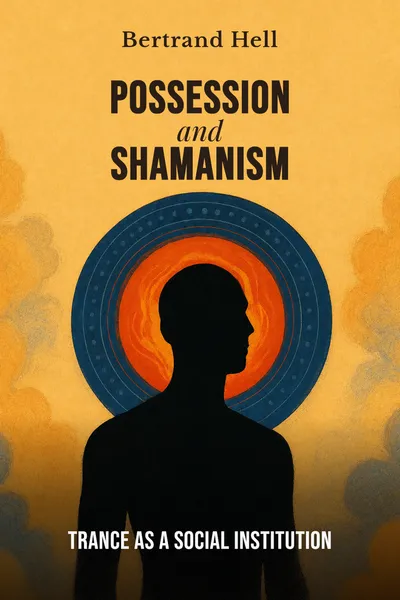
Possession and Shamanism
Trance as a social institution
Description
A woman collapses in a courtyard in northern Benin, shaking, her voice no longer her own. Around her, nobody panics. An older man steps forward, calls the spirit by name, asks it what it wants. Musicians adjust their rhythm. What looks, to an outside eye, like a medical emergency or a private breakdown is in fact a scene everyone present has seen before, knows the steps of, and knows how to end. The anthropologist Bertrand Hell spent years among such scenes — in West Africa, in Morocco, in the hunting societies of eastern France — and the puzzle that organized his work was this ordinariness. The spectacular loss of self was, for the people living it, a managed event.
Western thought has long treated trance as something that happens to a person: a fit, a pathology, a nervous storm to be calmed. Hell's book turns that intuition over. Across the societies he compares, possession is not an accident that befalls the weak. It is a relationship — often a lifelong one — between a human being and an invisible power, and it comes with rules, specialists, apprenticeships, and obligations on both sides. The spirit is not an intruder to be expelled but a partner to be negotiated with, fed, honored, and, when necessary, silenced.
Hell also refuses a border that anthropology had long patrolled: the one between the shaman who masters spirits and the possessed who are mastered by them. Looked at closely, the two keep bleeding into each other. The question is what holds all of this together — why societies as distant as Haitian vodou, the Moroccan Gnawa, and Siberian shamanism keep inventing structures to house the same wild phenomenon.
The question we’re asking : If trance is a collapse of the self, why do whole societies build careful, durable institutions to produce and govern it?What we’ll see : How possession works as a negotiated bond with the invisible, and what happens when we stop reading it as illness.
Table of contents
01 Chapter 1 — Two ways of handling the spirits
For most of the twentieth century, anthropology kept possession and shamanism in separate boxes. The shaman, in the classic picture drawn by Mircea Eliade, was the active one: he left his body, traveled to other worlds, commanded the spirits, and came back with knowledge. The possessed person was the passive one: a spirit entered, took over, spoke through a body that had become a vessel. One rode the horse; the other was the horse. The border felt clean, and it carried a quiet hierarchy — mastery on one side, surrender on the other.
Hell's comparative work takes that tidy border apart. When we look at actual practices rather than at ideal types, the two keep overlapping. The Siberian shaman is often seized, shaken, and chosen against his will before he ever learns to control anything; his first encounter with the spirits looks a lot like an illness. The African medium, supposedly passive, spends years learning which spirit speaks through her, how to invite it, how to dismiss it. In both cases there is a crisis, then a long schooling, then a working relationship. The difference is one of emphasis, not of nature.

02 Chapter 2 — The cult that domesticates what it can't expel
The decisive move in Hell's analysis concerns what societies actually do with the spirits that seize people. There are, broadly, two options. One is exorcism: name the intruder, fight it, drive it out, restore the person to a clean, single self. The other is adorcism — a term Hell borrows and sharpens — which does the opposite. Instead of expelling the spirit, the group identifies it, welcomes it, and folds it into an ongoing relationship. The spirit is not an enemy to be defeated but a companion to be housed.
Most of the great possession cults are built on this second logic. In the Moroccan Gnawa ceremonies, in the bori cults of the Hausa, in Haitian vodou, in the zar of the Horn of Africa, the aim is not to be rid of the spirit forever. It is to turn a destructive, anonymous affliction into a named, manageable presence that visits on schedule, during the ritual, in exchange for music, colors, foods, and attentions it has come to expect. The uninvited storm becomes a recurring guest with a place setting.
03 Chapter 3 — Masters of disorder, not victims of it
If possession were simply submission, it would be hard to explain why so many of the possessed end up with power. Across the cults Hell examines, the adept who learns to host her spirits well does not stay at the bottom. She becomes a diagnostician, a healer, an authority consulted in crisis — someone others come to when a spirit troubles them. The affliction, properly cultivated, converts into a vocation. The weak link becomes the specialist.
Hell is attentive to who tends to be chosen. Possession cults recruit heavily among those placed at the margins of a social order: women in patriarchal societies, slaves and their descendants, the poor, the dispossessed. This has led some anthropologists to read possession purely as a weapon of the weak — a sideways way of voicing complaints, extracting attention, or inverting a hierarchy for an afternoon. Hell takes that insight seriously without reducing everything to it. Yes, the trance grants a licensed space where ordinary rules bend. But to read it only as disguised protest is to miss that the practitioners genuinely believe in their spirits and genuinely acquire competence.
04 Chapter 4 — Trance as a thing societies build and keep
Step back from the particular cults and a larger claim comes into focus, the one that runs through Hell's whole comparison. Trance is not a private psychological event that cultures happen to decorate differently. It is, first and last, a social institution. The capacity to be possessed exists, but what a society does with it — how it is triggered, recognized, directed, ended, and passed on — is built, maintained, and inherited like any other institution, with its specialists, its rules, its apprenticeships and its sanctions.
This reframes the whole phenomenon. Left to itself, the raw crisis is formless and frightening; it could become madness, isolation, death. The institution is what stands between the individual and that formlessness. It supplies a name for what is happening, a script for living it, a community that recognizes it, and a way back. The spirit does not simply arrive and depart; it is summoned at the right moment and dismissed at the right moment, by people trained to do exactly that. Regulation is not a varnish on top of trance. It is the condition that makes trance survivable and transmissible.
05 Conclusion
Return to the courtyard in Benin, to the woman shaking and the old man calling the spirit by name. Nothing about the scene was out of control, though everything about it looked that way. The crisis had a name, the name had a song, the song had a specialist who knew when to raise it and when to let it fall. What appeared to be a self coming apart was, in truth, a society holding something together — a bond with the invisible that it had learned, over generations, to house rather than to banish.
Related books