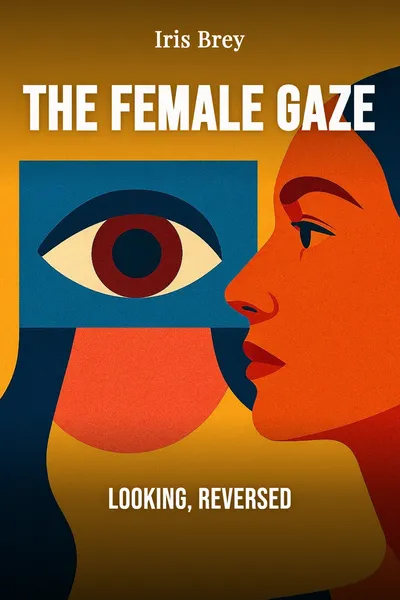
The Female Gaze
Looking, reversed
Description
In 1975, the British critic Laura Mulvey published an essay that would haunt film studies for the next half-century. Her claim was blunt: mainstream cinema had been built, shot by shot, around a male spectator. The camera lingered on women the way a man might look at them; the plot advanced through men who acted while women waited to be looked at. Mulvey called it the male gaze, and once the phrase existed, it was hard to un-see. You could watch almost any film from the studio era and feel the machinery — the slow pan up a body, the reaction shot given to the man, the woman lit to be admired rather than understood.
For decades the male gaze was the diagnosis without a cure. Critics could name what was wrong, but the counter-model stayed vague — as if the only alternative to a man looking was a man looking less. Iris Brey, a French film scholar and critic, took the problem head-on in her book on the female gaze. Her wager is precise and slightly provocative: the female gaze is not about who directed the film, nor about how many women are on screen, nor even about the gender of the character we follow. It is a matter of form — of where the camera stands, whose sensation it shares, and what it refuses to show.
That distinction matters because it turns a vague aspiration into something you can actually watch for. Brey is not asking cinema to flatter women or to swap one set of clichés for another. She is asking a harder question about the grammar of images themselves — the cuts, the framing, the duration of a shot — and whether that grammar can put us inside an experience rather than in front of a spectacle.
The question we’re asking : If the male gaze is a way of filming, what would its reversal actually look like on screen?What we’ll see : How a single reframing of who the camera serves rewrites what a film can feel like.
Table of contents
01Chapter 1 — A word that named what was missing
Before Brey, the female gaze floated around as a hopeful slogan. People used it to praise any film with a strong heroine, or one signed by a woman, as if authorship guaranteed a different way of seeing. Brey clears the table early. A woman can direct a film soaked in the male gaze, and a man can, in principle, film against it. The gaze is not a biography. It is a position the camera takes, and positions can be learned, borrowed, betrayed.
So she starts by sharpening what the male gaze really is, because the reversal only makes sense against its counterpart. Mulvey's point, which Brey carries forward, was that classical cinema splits the labor of looking: the man on screen looks, the woman is looked at, and the spectator is quietly slotted into the man's seat. The pleasure offered is the pleasure of possessing an image. The woman becomes surface — beautiful, threatening, consoling — but rarely a center of consciousness the film asks us to inhabit.

02Chapter 2 — The camera that owns the room
To feel the reversal, it helps to sit with what it reverses. Brey returns often to the ordinary mechanics of the male gaze, the ones so common we barely register them. A woman enters a scene and the camera introduces her in pieces — legs, then torso, then a face that arrives last, almost as an afterthought. The cut gives the reaction to the man watching her, so that her appearance exists mainly as the effect it produces on him.
What organizes all of this, Brey argues, is a certain ownership of space. The male gaze assumes the world belongs to the looking man, and the woman is one of the things arranged within it. Even her desire, when the film grants her any, tends to be filmed as a performance for someone else — a seduction staged for a viewer rather than an experience lived by a subject. Pleasure is shown from the outside, as spectacle, never from the inside, as feeling.
03Chapter 3 — When the frame changes sides
So what does the reversal actually look like? Brey's answer is concrete, almost technical. The female gaze happens when the film builds its images around a woman's experience rather than her appearance — when the camera shares her sensation instead of surveying her body. The shift is small on paper and enormous on screen: we are no longer watching a woman feel something, we are placed inside the feeling with her.
This changes how a scene is cut. Instead of handing the reaction shot to a man observing her, the film holds on her face, her hands, the texture of what she perceives. Duration becomes a tool. A shot held longer than comfort allows can turn a moment of desire or fear into something we undergo rather than consume. The camera stops being a spectator in the room and becomes a nervous system, registering heat, hesitation, discomfort, want.
04Chapter 4 — A grammar, not a checklist
Step back and the deepest claim of Brey's book comes into focus: the female gaze is a matter of language, not of subject matter. It lives in the grammar of cinema — framing, editing, point of view, duration — the same place the male gaze always lived. This is why it resists the checklists it keeps getting reduced to. A film does not become female-gaze because it passes a test for strong women, or because a woman signed it, or because it takes a feminist theme. Those things can coexist perfectly with a camera that still owns the room.
Treating the gaze as form rather than content also protects it from being turned into a marketing label. Brey is wary of the way the phrase gets flattened into praise, slapped onto anything with a female lead. If it means everything, it means nothing. Her insistence on the technical — where the camera stands, what the cut privileges, how long a shot lasts — is what keeps the concept sharp enough to actually watch for, and sharp enough to argue about honestly.
05Conclusion
We began with a phrase that let critics name a discomfort they had felt for decades without a vocabulary for it. Brey's contribution is to complete the sentence the male gaze left hanging. Its reversal was never a matter of counting women on screen or crediting them behind the camera; it was a question of where the camera chooses to stand and whose sensation it agrees to carry. Filmed from inside a woman's experience rather than in front of her body, the same story becomes a different film — not because it shows different things, but because it looks from a different place.
Related books