
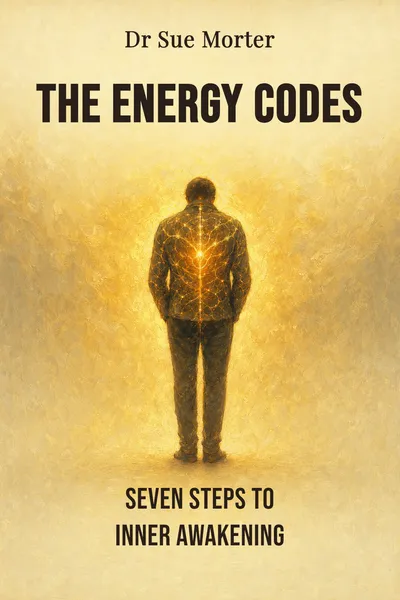
The Energy Codes
Seven steps to inner awakening
Description
In her forties, Dr Sue Morter was already a successful chiropractor running a busy clinic her family had built in Indiana. She had grown up inside a particular kind of American healing culture — her father developed a bioenergetic technique, and the household treated the body as a system of electrical circuits long before that was fashionable. By most measures she had arrived. And yet, by her own account, something kept surfacing: a sense that the relief she gave patients was real but partial, that pain kept returning because they were addressing the wrong layer of the problem.
The turn, as she tells it, came through her own practice rather than a patient's. During years of deep meditation she describes moving through waves of physical sensation, buried emotion, and eventually a kind of dissolving of the ordinary self — the experience that later organized the whole book. Out of it came a claim that sits at the center of The Energy Codes, published in 2019: that most of us live almost entirely in our heads, managing life from a frightened, protective mind, while the body carries an intelligence we have been trained to ignore.
The book proposes seven steps — the codes — meant to move us back into the body and, from there, into what Morter calls awakening. It braids together energy medicine, readings of neuroscience, breath, yoga, and a frankly spiritual vocabulary, and it is unabashedly a self-transformation program rather than a neutral survey. The interesting thing is less whether every mechanism holds up than what kind of shift it is actually asking for.
The question we’re asking : What are the seven Energy Codes actually trying to change, and what has to be true for the program to work?What we’ll see : How a personal breakdown became a method, what the codes ask of the body, and the reframing of the self underneath it all.
Table of contents
01Chapter 1 — A collapse on a stage, and a question about pain
Morter's origin story is deliberately unglamorous before it becomes dramatic. She spent years as a practitioner who could relieve symptoms reliably but watched them come back, and she came to suspect that the recurrence was information, not failure. The pattern, she argues, is that we treat pain as a mechanical fault to be repaired while ignoring the emotional and energetic charge stored alongside it. Fix the mechanics, leave the charge, and the body eventually reproduces the problem.
The pivot she keeps returning to is a moment on a meditation retreat when, after long practice, she experienced what she describes as a total energetic opening — light, heat, a loss of the usual boundaries of self. Whatever one makes of the phenomenology, its function in the book is clear: it convinced her that the ordinary waking mind is not the whole of us, and that there is a more expansive intelligence available if we stop routing everything through the anxious, protective part of the brain.

02Chapter 2 — The circuitry we forgot we had
The word energy does a lot of work in this book, and Morter leans hard on the idea that the body is fundamentally electrical. She points to the measurable facts that nerves fire electrically, that the heart and brain generate fields, and that we are, at some level, a system of currents rather than a static machine of parts. From there she extends into the language of chakras and energy centers, treating them as places where that current tends to concentrate, stall, or flow freely.
This is where the book asks for its first real leap. Morter reads neuroscience selectively but not carelessly: she draws on ideas about neuroplasticity — that the brain rewires with repeated experience — and about the nervous system's shift between defensive and restful states, to argue that changing how energy moves through the body can retrain the mind. The scientific vocabulary is used to make the energetic claims feel grounded. Whether the bridge fully holds is a fair question, and the book is more interested in results than in defending every join.
03Chapter 3 — Seven codes, one repeated move
The seven codes are the spine of the book, and each is offered as both a concept and an exercise. The Bioenergetic Code opens the sequence with breathwork — a central-channel breathing pattern meant to draw energy up and down the spine and pull attention out of the head. The Feeling Code follows, insisting that emotions are energy in motion and that the habit of suppressing them is what leaves charge stuck in the tissue. The instruction is counterintuitive: feel the sensation fully in the body rather than analyzing the story attached to it.
The Clearing Code addresses old wounds directly, working with the idea that early experiences leave protective patterns that keep firing long after they are useful. The Heart Code turns toward gratitude and love as active states, not sentiments — cultivated deliberately because, in Morter's model, they open the flow that fear closes. The Breath Code deepens the first, using specific breathing to circulate energy and settle the nervous system into a less defended state.
04Chapter 4 — The self that was never broken
Step back from the exercises and a bolder claim comes into view. Most healing frameworks assume something is broken and needs repair. Morter's does the opposite. Her wager is that the essential self was never damaged — that underneath the defensive mind and the stored pain there is an intact, wiser intelligence, and that the whole point of the codes is not to fix a flawed person but to relocate identity out of the frightened head and into that deeper ground. Healing, in this reading, is less construction than remembering.
That reframing is the book's real engine, and it is what separates it from a straightforward wellness manual. If the problem is a broken part, you need a specialist to mend it. If the problem is that you have been living as the wrong version of yourself — small, defended, mind-bound — then the work is available to you directly, through breath and attention, without permission from anyone. It is an empowering move, and a deeply spiritual one, closer to contemplative traditions that speak of waking from illusion than to clinical medicine.
05Conclusion
The book closes roughly where the personal story opened: with the conviction that the life we actually live is decided less by circumstance than by whether we inhabit our bodies or hover, anxious, above them. The seven Energy Codes are all variations on getting back down into the body and letting stuck charge move, and Morter's promise is that doing this daily changes not just how we feel but who we take ourselves to be. From a practitioner who once only relieved symptoms, it is a striking reversal — the pain was never only the point.