The Emotion Code
How emotions lock the body
Description
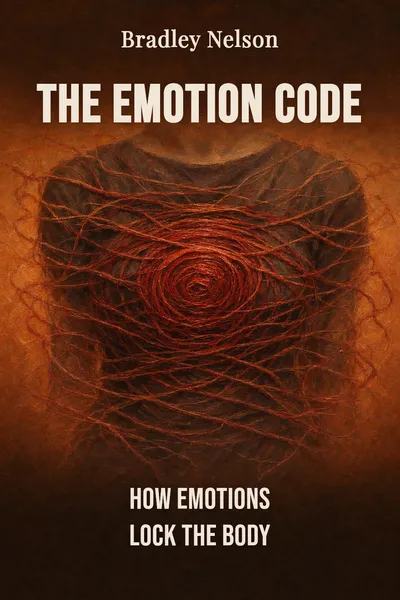
Somewhere in the early 2000s, a chiropractor in the American Southwest named Bradley Nelson started telling his patients something most doctors never would. The back pain, the migraines, the low mood that wouldn't lift — a lot of it, he said, wasn't mechanical or chemical. It was emotional. Not emotional in the loose way we say a bad week left us drained, but literally: an emotion from years ago, felt intensely and never fully processed, had gotten stuck in the body as a small ball of trapped energy, still sitting there, distorting the tissue around it. Fear from a childhood accident. Grief no one let you finish. Anger you swallowed in a marriage. Lodged, physical, waiting.
Nelson turned this idea into a method and, in 2007, a book: The Emotion Code. The pitch is unusually concrete for something so intangible. Every trapped emotion, he argues, can be found, named, and released — and once it's gone, the pain or pattern it was driving tends to ease. The tool isn't a scan or a questionnaire but muscle testing, borrowed from applied kinesiology, in which the body is asked yes-or-no questions and answers through the strength of an arm. It sounds strange stated plainly. It has also sold widely, been practiced by thousands of certified practitioners, and reached people who felt conventional care had run out of answers.
That gap — between how odd the method sounds and how many people it has reached — is the interesting part. The Emotion Code speaks to an intuition many of us carry without examining: that what we feel and never resolve doesn't simply evaporate, that it settles somewhere. Nelson takes that hunch and builds a whole architecture on it, complete with a chart of emotions, a way to interrogate the subconscious, and a barrier around the heart he says most of us are walking around with.
The question we’re asking : What exactly does Bradley Nelson claim gets trapped in the body, and how does he say we can find and release it?What we’ll see : How a chiropractor turned a familiar intuition about buried feeling into a full method — the trapped emotion, the muscle test, the wall around the heart — and why the idea travels so far.
Table of contents
01 Chapter 1 — Emotions that never left
Nelson starts from a premise he treats as physical fact: an emotion is energy. When we feel something strongly, the body generates a specific vibrational frequency — one for fear, another for grief, another for resentment. Usually we feel the emotion, it moves through us, and it clears. But sometimes, he argues, the process gets interrupted. The feeling is too big, the moment too overwhelming, or we're too young to process it, and instead of passing through, a portion of that energy stays behind. It condenses into what he calls a trapped emotion: a small sphere of stuck feeling, roughly the size of an orange in his description, lodged somewhere in the body.
The consequences, in his telling, are twofold. There's the emotional layer — the trapped fear keeps making you feel afraid in situations that don't warrant it, the trapped grief keeps a sadness alive long after its cause is gone. And there's the physical layer. Because the trapped emotion sits in a particular region of tissue and vibrates at its own frequency, it distorts the surrounding area, showing up as pain, dysfunction, or illness. A trapped emotion near the lower back becomes back pain. One near the heart interferes with the heart. The body, in this model, keeps the emotional score in a very literal, locatable way.

02 Chapter 2 — Muscle testing and the subconscious witness
If trapped emotions are invisible, how do you find them? Nelson's answer is that the conscious mind doesn't know, but the subconscious does — it has recorded every emotion we've ever trapped, when it happened, and where it sits. The whole task becomes getting the subconscious to talk. His channel for that is muscle testing, drawn from applied kinesiology developed in the 1960s. The idea is that a true statement leaves a muscle strong, while a false one makes it momentarily weak. Ask the body a yes-or-no question, press down on an outstretched arm, and read the answer in whether it holds or gives way.
From there the process is methodical, almost like twenty questions run against the body. Is there a trapped emotion? If the arm tests strong for yes, the practitioner narrows it down using a chart Nelson provides — sixty emotions arranged in a grid of columns and rows. Is it in column A or column B? Top half or bottom? Question by question, the field shrinks until a single emotion is named: abandonment, shame, or unworthiness. Then more questions to date it — did this get trapped before age ten? — and, if the person wants, to locate the event.
03 Chapter 3 — The Heart-Wall
The centerpiece of the book — the concept Nelson clearly cares most about — is what he calls the Heart-Wall. His reasoning: the heart isn't just a pump but an emotional center, the place from which we give and receive love. When life gets painful, the subconscious does something protective. It takes trapped emotions and stacks them around the heart, building an energetic barrier to shield it from further hurt. In the moment, the wall does its job. The problem is that it never comes down on its own.
A Heart-Wall, in his account, is made of layers — trapped emotions laid down over years, each with its own material, described as everything from wood to steel to cloth. And while it protects, it also insulates. The same barrier that keeps pain out keeps love and joy from getting through. People with a thick Heart-Wall often describe feeling numb, distant, unable to fully connect even with those closest to them — as if something stood between them and the world. He estimates that the vast majority of us have one.
04 Chapter 4 — The reach of an idea about the body
Step back from the magnets and the charts and The Emotion Code is offering something with real gravitational pull: the claim that suffering has a cause you can locate and remove. Most of our pain — physical and emotional — comes as a fog, without a clear origin or obvious exit. Conventional medicine often manages symptoms without curing them; therapy can take years and still leave things unnamed. Against that, a method saying your problem is a specific trapped emotion, findable in an afternoon and releasable in a few passes of the hand, answers a deep wish for the diffuse to become concrete and the concrete to become fixable.
It also lands in a culture increasingly willing to believe the body carries our emotional history. The idea that stress lives in the tissues, that trauma is stored somewhere physical, has moved from the fringes toward the mainstream. Nelson's book rides that current and pushes it to its most literal conclusion: not that emotion influences the body in vague ways, but that a discrete unit of grief is sitting at a nameable spot in your abdomen. The intuition is widely shared; what's distinctive is how solid and mechanical he makes it.
05 Conclusion
Bradley Nelson built The Emotion Code out of a hunch most of us recognize — that a feeling we never resolved doesn't just disappear, that it lodges somewhere and keeps working on us. Where he goes further than almost anyone is insisting the lodging is literal: a trapped ball of energy with a name and an address in the body, found by asking the subconscious yes-or-no questions and cleared with a few passes of a magnet. Around the heart, he says, these emotions stack into a wall that keeps out both pain and love, and taking it down is where people feel the change most.
Related books