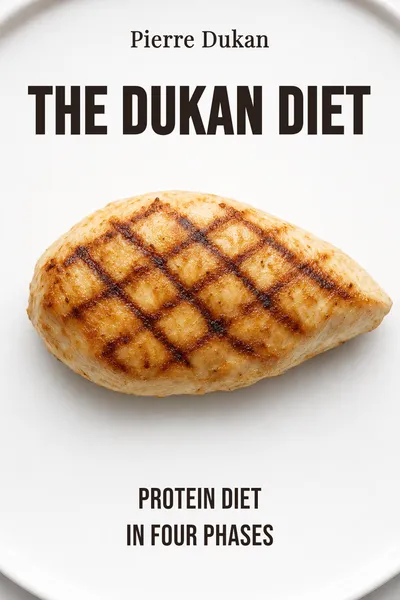
The Dukan Diet
Protein diet in four phases
Description
Sometime in the late 1970s, a Paris general practitioner named Pierre Dukan had a patient who wanted to lose weight and told him he could give up anything except meat. Dukan, so the story goes, told him to eat nothing but lean protein for a few days and drink plenty of water. The man came back having dropped several kilos, and Dukan — a neurologist by training who had drifted into nutrition almost by accident — started paying attention. What began as an improvised concession to one stubborn eater slowly hardened into a method, a book, and eventually a phenomenon that sold millions of copies and reshaped how a generation of French dieters thought about the scale.
The Dukan Diet, published in France in 2000 and translated worldwide over the following decade, is built on a single conviction stated with unusual bluntness: that willpower alone never keeps weight off, and that a diet must therefore come with a permanent, non-negotiable structure. Dukan does not offer a gentle nudge toward balance. He offers four phases, each with its own rules, its own pace, and its own point — and a promise that if we follow all four, including the ones most readers would rather skip, the lost weight stays lost.
That last clause is where the method makes its real wager. Most diets end at the moment the target weight is reached; Dukan argues that this is precisely the moment the danger begins. His book spends as much energy on what happens after the weight is gone as on how to lose it. Behind the lists of permitted foods sits a claim about human behavior, and it is worth following the whole arc to see what that claim actually is.
The question we’re asking : What exactly is the four-phase protein method Dukan built, and where does its real ambition lie?What we’ll see : How an accidental clinical observation became a structured program that treats losing the weight as the easy part.
Table of contents
01 Chapter 1 — The doctor who started with a fat patient
Pierre Dukan trained as a neurologist and spent the early part of his career far from nutrition. The turn came from clinical practice rather than research: overweight patients, the frustration of watching them regain everything they had lost, and a working hypothesis that the usual advice — eat less, move more, count your calories — asked people to sustain a low-grade suffering that almost nobody could maintain for life. Calorie restriction, in Dukan's reading, fails not because it is wrong but because it is unbearable. It leaves the dieter permanently hungry and permanently negotiating with temptation, and negotiation is a fight the body eventually wins.
His answer was to abandon quantity and legislate quality instead. Rather than telling patients to eat a little of everything, he told them to eat as much as they wanted of a short, closed list of foods — provided they touched nothing outside it. The logic rests on protein. Pure protein foods, he argues, are filling, cost the body energy to digest, and do not trigger the same appetite spiral that carbohydrates and fats do. A dieter allowed to eat lean meat, fish, eggs and low-fat dairy without limit, Dukan claims, is far less likely to crack than one weighing out portions of pasta.

02 Chapter 2 — Attack, then cruise: losing the weight
The first phase is called Attack, and its name is the point. It lasts a short stretch — typically two to seven days depending on how much the dieter has to lose — and permits nothing but pure protein: lean beef and veal, poultry without skin, fish and shellfish, eggs, fat-free dairy, and as much water as one can drink. No fruit, no bread, no vegetables, no oil. The severity is deliberate. Dukan wants the scale to move fast and visibly in those first days, because that early drop is what convinces the dieter the method works and buys their commitment to everything that follows. A daily spoonful of oat bran, a Dukan signature, is folded in for fiber.
The second phase, Cruise, is where the bulk of the weight actually comes off, and it can run for weeks or months until the target is reached. Here Dukan reintroduces vegetables — but only certain ones, and on an alternating rhythm. The dieter swings between days of pure protein and days of protein plus non-starchy vegetables: salad, spinach, tomatoes, green beans, and the like, but not potatoes, corn, peas or anything starchy. The alternation is the engine. It keeps the metabolism from settling into a plateau and gives the dieter a manageable pattern to live inside, one that feels less punishing than Attack while still driving steady loss.
03 Chapter 3 — The two phases nobody talks about
The third phase, Consolidation, is the one Dukan considers the real heart of the method, and the one dieters are most tempted to abandon. Once the target weight is hit, the body, he warns, is primed to reclaim everything with interest — a rebound effect that punishes anyone who returns to normal eating too fast. Consolidation is a controlled, gradual re-entry into ordinary food. It reintroduces fruit, bread, cheese and starchy foods in measured amounts, and grants two 'celebration meals' a week where anything is allowed. Crucially, its length is fixed by arithmetic: five days for every kilo lost. Someone who dropped ten kilos consolidates for fifty days.
One rule survives from the earliest phases and is meant to survive forever after: one day a week — Dukan usually names Thursday — the dieter eats pure protein again, exactly as in Attack. This weekly protein day is the pivot on which the whole permanence of the method turns. It is the small, repeatable act of discipline that, in Dukan's design, keeps the rebound at bay without demanding constant vigilance. Give people one hard day, he reasons, and they can be normal the other six.
04 Chapter 4 — Why the promise is the whole method
Strip the Dukan Diet down and what remains is not a nutritional theory but a promise about permanence — and the four phases are really the machinery built to deliver it. Dukan's central claim is that the failure of dieting is a failure of duration, not of knowledge. People know how to lose weight; what they cannot do is stop it coming back. So his method is engineered less around the biochemistry of protein than around the psychology of a person who has tried and failed before, and who needs a structure that holds after motivation runs out.
This is why the method leans so hard on absolutes. The closed food lists, the fixed formula of five days per kilo, the unchanging weekly protein day — none of them ask the dieter to make judgments, because Dukan does not trust judgment under the pressure of appetite. A diet that requires daily decisions, in his view, is a diet already lost. What he offers instead is something closer to a rule of life: a small set of non-negotiable habits carried forward indefinitely, on the theory that permanent results demand permanent obligations rather than permanent effort.
05 Conclusion
The method that grew out of one meat-loving patient in a Paris consulting room became, over two decades, one of the most widely followed weight-loss programs in the world, translated across dozens of countries and pored over by millions who had lost and regained weight too many times to count. Its four descending phases — the hard opening of Attack, the alternating grind of Cruise, the measured re-entry of Consolidation, and the open-ended discipline of Stabilization — trace a single arc from strict to loose, each step calibrated to how a discouraged dieter actually thinks and feels.
Related books