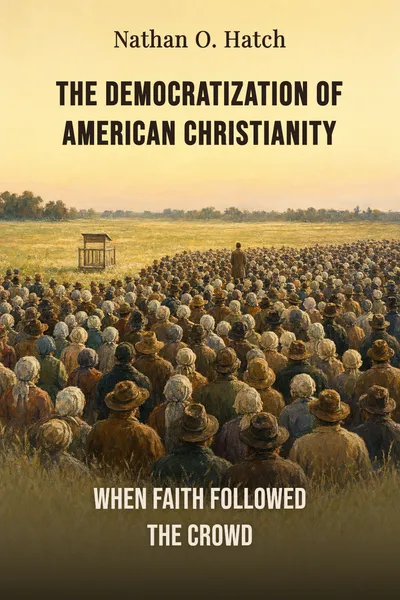
The Democratization of American Christianity
When faith followed the crowd
Description
Between roughly 1780 and 1830, the American religious landscape flipped. In 1776, the respectable denominations — Congregationalists, Episcopalians, Presbyterians — held the center, staffed by educated ministers who preached from a settled Calvinist inheritance. Fifty years later they had been overtaken by movements almost nobody in 1776 would have predicted: Methodists exploding from a few thousand to the largest church in the country, Baptists multiplying across the frontier, and brand-new groups — the Disciples of Christ, the Mormons, the Black churches — built by men with little formal schooling and enormous popular reach. The old order didn't just lose ground. It lost the argument about who gets to speak for God.
This is the story Nathan Hatch tells in The Democratization of American Christianity, published in 1989. His claim is that the decades after the Revolution were the most formative period in American religious history — more decisive than the Puritan founding, more decisive than any revival since. Something specific happened: religious authority slid from the clergy to the people. Ordinary believers, not seminaries, would now decide what counted as true faith, and preachers who wanted a following learned to give the crowd what it wanted to hear.
Hatch is not simply cheering the little guy against the establishment. He tracks what that transfer of authority cost as much as what it won. A faith answerable to the audience is a responsive faith — and also a faith that can drift wherever the audience drifts, including into ideas that its own founders would have called strange, self-flattering, or plainly unchristian.
The question we’re asking : How did American Christianity move from being run by an educated clergy to being run by the popular audience — and what did faith lose on the way?What we’ll see : How a handful of unschooled populists dismantled the old religious order in a single generation, and what happened once the crowd itself became the judge of true belief.
Table of contents
01Chapter 1 — The half-century that broke the clergy's monopoly
Before the Revolution, American religion looked like a smaller version of Europe's. A learned ministry, trained in Latin and theology, stood between the ordinary believer and the truth. The minister interpreted Scripture; the congregation received it. Calvinism gave this arrangement its backbone — a demanding, God-centered theology in which human beings were fallen, salvation was God's sovereign choice, and no amount of popular enthusiasm changed the fixed order of things. Authority ran downward, from the educated few to the many.
The Revolution cracked this open. Hatch's argument is that the same democratic language that toppled political deference — the rhetoric of the common man, the suspicion of elites, the conviction that ordinary people could govern themselves — spilled directly into religion. If a farmer could vote, why couldn't he read the Bible for himself and reject what a Yale-trained minister told him it meant? The deference that held the old churches together simply evaporated in the new republican air.

02Chapter 2 — Five men who took God to the people
Hatch builds his history around figures who embodied the shift, and the pattern across them is striking: they were outsiders, most without formal theological training, all gifted at reaching crowds. Francis Asbury drove the Methodist expansion by living the itinerant life himself, riding thousands of miles a year and building an army of preachers who answered to the road, not the academy. He understood that a faith would grow where it went to the people rather than waiting for the people to come to it.
Lorenzo Dow, a wandering evangelist, pushed the populist style to its edge — eccentric, theatrical, wildly popular, printing his own writings and drawing enormous audiences who had never seen a minister behave like this. He was proof that the new religious market rewarded personality and access over pedigree. Barton Stone and Alexander Campbell, meanwhile, launched the movement that became the Disciples of Christ on a deceptively simple promise: throw out the creeds, throw out the theological systems, and let every believer go straight to the New Testament with no clergy in between.
03Chapter 3 — Sovereignty of the audience
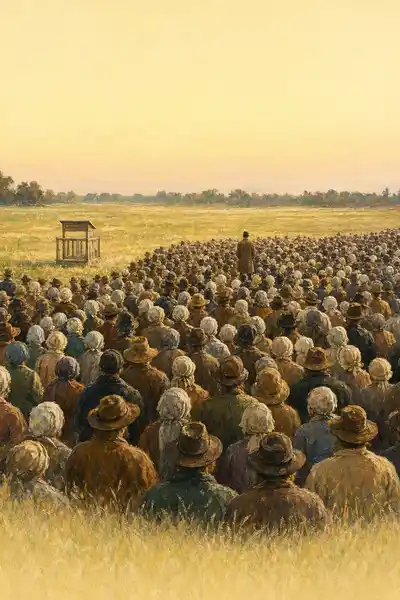
Once the people held the authority, the incentives changed for everyone who wanted to lead them. A minister paid by a state church could preach doctrines his congregation disliked. A frontier preacher who depended on a voluntary following could not. If the crowd found a doctrine gloomy, insulting, or hard, it could simply walk to the tent next door. This is the market logic Hatch identifies at the heart of the transformation, and it did quiet theological work long before anyone noticed.
Calvinism was the first casualty. The old theology told people they were helpless, that God alone chose who would be saved, and that human effort earned nothing. That is not a message a voluntary audience rewards. What sold, instead, was a faith that flattered human capacity: you can choose to be saved, your decision matters, your feelings are a reliable guide to God's presence. The stern God-centered inheritance gave way to a warmer, more manageable religion centered on the believer's own experience and will. Hatch traces how this happened not by formal debate but by attrition — the harsh doctrines simply stopped being preached because they stopped drawing crowds.
04Chapter 4 — When the crowd becomes the authority
Step back from the circuit riders and the camp meetings and Hatch's history describes a deeper pattern, one that reaches well beyond the early republic. When a tradition hands its authority to the popular audience, the audience becomes the measure of truth. Whatever the crowd will accept survives; whatever it finds unwelcome is quietly dropped. The mechanism is not conspiracy or corruption. It is simply what happens when belief must recruit its own adherents in an open market, with no established authority to hold an unpopular doctrine in place.
This is the American religious invention Hatch is really documenting. Europe kept its state churches and its trained clergy, and its faith remained, for better and worse, answerable to institutions. America let the institutions go and made faith answerable to the people. That produced an astonishingly vital, adaptive, endlessly proliferating Christianity — and one that had traded the old danger of a dead, hierarchical orthodoxy for a new danger: a faith so responsive to its audience that it could be reshaped by whatever the audience happened to want.
05Conclusion
The fifty years after the Revolution did not just add new churches to the American map. They rewrote the question of who decides what Christianity is. The educated clergy that had assumed it would guide the new nation lost that role to circuit riders, farmer-preachers, and prophets who trusted the crowd more than the creed — and who built, in a single generation, the largest and most vital religious movements the country had ever seen. The transfer of authority from the pulpit to the pew was, on Hatch's telling, the defining event of American religious history.
Related books