The Construction of Social Reality
Facts we invent, facts we find
Description
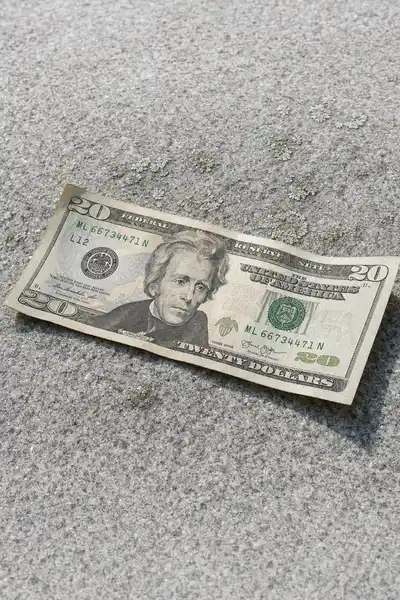
Reach into a pocket and pull out a twenty-dollar bill. Ask what makes it worth twenty dollars, and the honest answer is unsettling: nothing about the paper. Not the cotton, not the ink, not the portrait. A twenty is worth twenty because a very large number of people agree it is, and go on agreeing every morning without ever discussing it. Now do the same with a rock. The rock weighs what it weighs whether anyone believes anything at all. Two objects, two completely different kinds of existence — and most of the time we don't notice the seam between them.
This is the seam the American philosopher John Searle set out to trace in his 1995 book The Construction of Social Reality. Searle had spent decades on language and mind, and he arrived at a deceptively plain question: how can there be an objective world of mountains and molecules and, sitting right on top of it, a world of money, marriage, property, presidents and borders — things that are utterly real and yet exist only because we treat them as real? We move between the two constantly. We rarely ask how they fit together.
Searle's wager is that the answer isn't mystical and isn't a matter of opinion. There is a structure underneath our social world, a small set of moves that turns brute stuff into institutions. Once we see those moves, the whole architecture of human life — the part we built rather than found — comes into focus, along with the strange fact that it stays standing at all.
The question we’re asking : How can some facts be true no matter what anyone thinks, while others are true only because we all think so — and what connects the two?What we’ll see : How Searle takes apart the machinery that turns brute matter into money, borders and everything else we agree into existence.
Table of contents
01Chapter 1 — A twenty-dollar bill and a mountain
Searle begins by drawing a line that sounds obvious until you push on it. Some facts, he says, are true independently of us: that Mount Everest has snow near its summit, that hydrogen atoms have one electron, that the sun is bigger than the earth. He calls these brute facts, or observer-independent facts. They would hold even if humans had never evolved to notice them. The snow doesn't need a witness.
Other facts are different in kind. That a certain piece of paper is money, that a line in the sand is a national border, that a particular man is the president, that two people are married — none of these would survive the disappearance of human beings. Searle calls them institutional facts, and their defining feature is that they depend on us. Not on any single one of us, but on collective acceptance. They are observer-relative all the way down.

02Chapter 2 — The formula that builds a world
The heart of the book is a single, oddly compact formula. Searle proposes that institutional reality is created and maintained by moves of the form: X counts as Y in context C. This piece of paper (X) counts as a twenty-dollar bill (Y) in the United States (C). This person (X) counts as a licensed driver (Y) in this jurisdiction (C). This gesture of raised hands (X) counts as a vote (Y) in this assembly (C). It looks almost too simple to do serious work, and that simplicity is the point.
What the formula captures is the assignment of what Searle calls a status function. We take something — an object, a person, an act — and we assign it a function it cannot perform through its physical properties alone. A wall keeps you out by being solid; that's physics. A line on a map keeps you out by being agreed to be a border; that's a status function. The paper doesn't buy bread because of any chemistry. It buys bread because we have collectively imposed on it a status that carries a function, and we all act as though the status is there.
03Chapter 3 — Language does the heavy lifting
If status functions are the bricks, Searle argues, language is the mortar — and more than the mortar. His striking claim is that institutional facts are impossible without language, because there is nothing physical for the status to consist in except the fact that we represent it as being there. A dog can be trained to fear a fence, but a dog cannot recognize a hundred-dollar bill as legal tender, because being legal tender isn't a feature you can smell or see. It exists only insofar as it is symbolized, thought, and talked about.
This is what he means by saying institutional facts are, at bottom, linguistically constituted. Money, property and marriage don't merely get described by words after the fact, the way a mountain does. They are partly made of words. To impose the status "this counts as money" is already to deploy symbols that stand for something beyond themselves — and only a creature with language can do that. Animals share cooperation and even something like territory, but they don't build institutions, because they can't represent one thing as counting as another.
04Chapter 4 — Why we can't see what holds us up
Step back from the formula and something larger comes into view about the world Searle is describing. The institutions that organize nearly every waking hour — the money we earn, the job that pays it, the government that taxes it, the marriage or citizenship or property that anchors us — are held up by nothing sturdier than continuous collective acceptance. There is no physical foundation under a currency, only a standing agreement. And yet these are among the most stable, coercive facts in our lives. Searle's account explains a paradox: the things that feel most solid are the ones made purely of agreement.
The reason we can't feel their contingency is built into how they work. An institution functions best when nobody has to think about it. If we had to renegotiate the value of money each morning, the system would seize up. So the acceptance goes underground, becomes habit, disappears into the texture of ordinary action. What Searle exposes is precisely the part of reality that is designed to be invisible — self-effacing by nature. The construction succeeds exactly to the degree that it stops looking constructed.
05Conclusion
Take the twenty out again. Searle's book leaves the paper exactly where it was and changes everything about it. The bill is brute matter carrying a status we assigned by the simple, endlessly repeated move of treating X as counting as Y, holding it in place with language and collective acceptance until it feels as fixed as the mountain it can't be compared to. Two kinds of facts, layered so tightly that we walk across the seam a thousand times a day without a stumble.
Related books