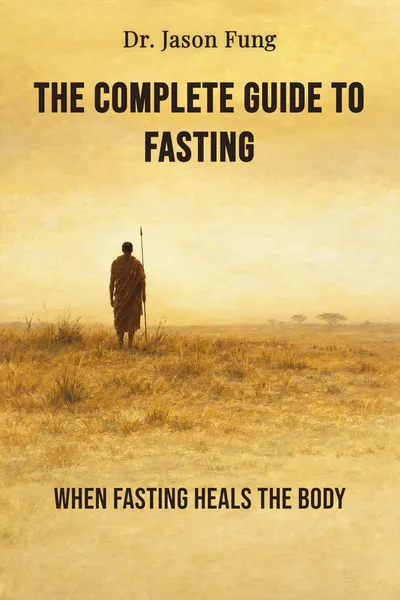
The Complete Guide to Fasting
When fasting heals the body
Description
For most of human history, going without food was not a choice. It was the weather, the hunt, the season. The body that came out of all that has two settings: fed, and unfed. When food arrives, it stores. When food stops, it lives off what it stored. Simple, elegant, and — according to the Toronto kidney specialist Jason Fung — almost completely forgotten in a world where breakfast, lunch, dinner and three snacks are treated as a biological law rather than a modern habit. In The Complete Guide to Fasting, Fung argues that the second setting, the unfed one, isn't a hardship the body merely survives. It's a state the body actively uses to repair itself.
Fung came to this from an unlikely angle. He spent years treating type 2 diabetes the conventional way — more insulin, more medication — and watched his patients get steadily sicker. The disease of too much sugar was being managed with the very hormone that tells the body to store sugar. Somewhere in that contradiction he started asking a question doctors rarely ask out loud: what if the fix wasn't adding something, but subtracting? What if the oldest dietary intervention in the world, the one every major religion built into its calendar, had a metabolic logic we'd stopped bothering to understand?
The book that came out of that question is part physiology lesson, part practical manual. It explains what actually happens inside a body that goes twelve, twenty-four, or several days without eating — and then it tells the reader, with unusual specificity, how to do it without falling over. It is a guide in the plain sense: protocols, schedules, what to drink, when to stop. But underneath the how-to there's a claim worth taking seriously, and worth examining before we accept it.
The question we’re asking : If the body is built to go without food, why did we decide it never should — and what happens when it finally does?What we’ll see : How fasting works on insulin and metabolism, the different ways it can be done, and why Fung treats it less as a diet than as a return to something the body already knows.
Table of contents
01 Chapter 1 — The switch nobody flips anymore
Fung starts with a distinction that sounds obvious once it's said and yet reorganizes everything after it. The body is either in the fed state or the fasted state — never both. In the fed state, which begins the moment we start eating and runs for hours afterward, the pancreas releases insulin, and insulin's job is storage. It shuttles incoming sugar into cells for immediate use and packs the surplus away, first as glycogen in the liver, then, when the glycogen tank is full, as body fat. In the fasted state, the process reverses. Insulin falls, the body reaches back into its stores, and it burns what it saved.
The trouble, in Fung's reading, is that most people now live almost permanently in the fed state. Eating starts at breakfast and, with snacks, coffees, and late dinners, barely stops until bed. Insulin stays elevated for most of the waking day. And here's the part that matters: when insulin is high, the body is being told to store, not to burn. You can eat less, count every calorie, and still struggle to lose fat, because the hormonal signal to release that fat almost never gets sent.

02 Chapter 2 — What insulin does when the food stops
Once the food stops, the body moves through a sequence Fung lays out step by step. For the first several hours it burns the sugar still circulating from the last meal. Then it turns to glycogen, the stored sugar in the liver, which lasts roughly a day. When that runs low, the real shift begins: the liver starts converting fat into ketones, an alternative fuel the brain and muscles can run on. This is the metabolic state — sometimes called nutritional ketosis — that longer fasts are designed to reach. The body is now running, cleanly and steadily, on its own fat.
Insulin is the hinge of the whole story. Fung's central concern is not weight for its own sake but insulin resistance, the condition in which cells stop responding to the hormone, forcing the pancreas to pump out ever more of it. Chronically high insulin, he argues, sits underneath type 2 diabetes, much stubborn obesity, and a cluster of related problems. The conventional response — give more insulin — treats the symptom while feeding the cause. Fasting does the opposite. By giving insulin long stretches to fall, it lets cells slowly recover their sensitivity.
03 Chapter 3 — The many ways to skip a meal on purpose
The practical half of the book is where Fung is most useful, because he refuses to prescribe a single method. Fasting, in his account, is a spectrum, and the right point on it depends on the person, the goal, and how much room life leaves for it. The gentlest end is intermittent fasting — most commonly the sixteen-eight pattern, in which all eating happens inside an eight-hour window and the remaining sixteen hours, mostly overnight, are food-free. For many people this means little more than skipping breakfast, which Fung is happy to point out was never the sacred meal marketing made it.
From there the intensity climbs. Twenty-four-hour fasts, done once or a few times a week, typically run dinner to dinner, so no full day passes without food. Alternate-day fasting swings between eating days and fasting days. And then there are extended fasts — several days or longer — which Fung reserves for specific goals and stronger supervision, particularly for anyone managing diabetes or on medication. The longer the fast, the more it belongs under a doctor's eye, and he says so plainly rather than selling the extreme as the ideal.
04 Chapter 4 — Fasting as memory, not medicine
Step back from the protocols and the deeper move in Fung's book becomes clear. He isn't presenting fasting as a new discovery, the way a drug or a device would be launched. He's presenting it as something recovered — a capacity the body always had, buried under a modern habit of eating that is, in the long view of the species, extremely recent. Three meals a day plus snacks is not how humans ate for most of their existence, and it's not how our metabolism was built to run. What looks like an intervention is, in his framing, closer to a return.
This is why he keeps reaching for the word natural, and why the religious tradition matters to his argument. Nearly every major faith built fasting into its year — Ramadan, Lent, Yom Kippur, the fasts of Hindu and Buddhist practice. Fung reads these not as coincidence but as accumulated human wisdom about a state the body benefits from entering periodically. Culture, in other words, remembered something medicine forgot. The book tries to translate that memory back into physiology.
05 Conclusion
Fung's guide ends more or less where it began — with a body that has two settings and a modern life that only ever uses one. The protocols, the schedules, the lists of what to drink are all in service of a single, unglamorous idea: give the fasted state its turn. Lower the insulin long enough and often enough, and the machinery that stores fat, resists insulin, and skips its own repairs gets a chance to reset. Not through anything added, but through something withheld.
Related books