
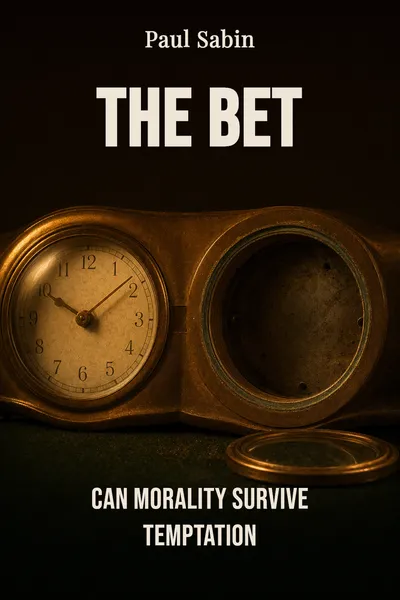
The Bet
Can morality survive temptation
Description
Two friends are sitting across a table, and one of them makes an offer the other should refuse on sight. Richard Moreland — wealthy, precise, a collector of other people's behavior — tells John Pearson that he can corrupt him. Not tempt him into a small lie or a moment of weakness, but walk him, step by deliberate step, to the edge of a genuinely terrible act, and do it inside a year. Pearson laughs. Then he accepts. That handshake is the engine of Paul Sabin's novel The Bet, and it works because both men believe something flattering about themselves: Moreland that he understands people well enough to move them like pieces, Pearson that his own character is a thing he owns outright.
What makes the setup land is how ordinary Pearson is. He is not a saint. He is a decent man with a settled sense of his own limits — the kind of person who assumes that decency, once earned, stays put. Moreland's wager is really an argument about that assumption. He is betting that a good man's goodness is not a fixed property but a running result, held in place by comfort, habit, and the absence of real pressure. Remove the supports one at a time, and see what stands.
Sabin builds the book as a slow siege rather than a single seduction. There is no lightning-strike moment where Pearson turns. Instead there is a year of small adjustments, each one defensible on its own, none of them the whole story until they are. The reader watches a man remain sure he is winning long past the point where the reader has stopped being sure with him.
The question we’re asking : If someone set out to corrupt us deliberately, patiently, one small concession at a time, how much of our character would actually hold?What we’ll see : How a friendly wager becomes a controlled experiment on a single human soul, and what its outcome suggests about where morality really lives.
Table of contents
01Chapter 1 — The proposal no friendship should survive
The bet is not a gamble in the ordinary sense, and Sabin is careful to establish that from the first pages. Moreland does not propose to guess what Pearson will do. He proposes to determine it. His fortune has left him with the one thing money reliably buys — time, and freedom from consequence — and he has spent years pointing both at the study of people. He watches how they decide, where they flinch, what they tell themselves afterward. Pearson is, in his eyes, less a friend than the ideal test subject: intelligent enough to resist, honest enough to make the resistance mean something.
Pearson accepts for reasons that feel, at the time, like strength. He is genuinely offended by the suggestion that he could be steered. His integrity is not performance; he has built a life around not being the kind of man who does terrible things, and he treats that life as proof. What he misses is that Moreland is not challenging the proof. He is challenging the idea that the proof will keep working once someone starts pulling at its foundations. Confidence, in Sabin's telling, is exactly the vulnerability a manipulator wants — a man certain he cannot be moved rarely notices the first inch.

02Chapter 2 — Moreland's method, one thread at a time
Moreland's campaign is built on a simple insight that Sabin dramatizes with unpleasant clarity: no one crosses a moral line in a single stride, but almost anyone will drift across it if the line is redrawn slightly, repeatedly, by someone they trust. He never asks Pearson to do the terrible thing. He asks for the small thing that makes the next small thing thinkable. A favor that requires a minor deception. A silence that protects a friend. A judgment softened because the alternative is inconvenient. Each request is reasonable. The cumulative direction is not.
What gives the manipulation its grip is that Moreland works with Pearson's own reasoning rather than against it. He does not argue that wrong is right; he arranges circumstances so that Pearson argues it himself, quietly, and feels clever for having done so. Sabin shows temptation working the way it actually does — not as a voice urging sin, but as a series of situations in which the principled choice keeps costing a little more and the compromised one keeps costing a little less. A man defending his own good opinion of himself will rationalize a great deal to keep it.
03Chapter 3 — The slow give of a good man
The transformation of Pearson is the novel's central achievement, and Sabin refuses to make it a sudden fall. There is no scene where the good man becomes a bad one. There is only a long sequence in which the distance between what Pearson would once have done and what he now does opens by degrees, each degree explained away in the moment. He remains, in his own account, the same person acting reasonably under unusual pressure. The reader, holding the whole year at once, sees a man becoming someone he would previously have condemned.
What corrodes first is not action but perception. Pearson starts to see his old principles as naive — rules for people who have never been tested, which he now flatters himself he has been. The moral certainty that made him accept the bet curdles into something more dangerous: a belief that his judgment is subtle enough to handle exceptions the rules were too crude to allow. Sabin catches the particular vanity of the corrupted, who rarely feel debased. They feel enlightened, liberated from scruples they now regard as childish.
04Chapter 4 — When corruption stops feeling like corruption
Step back from the two men and the novel's real argument comes into focus. The Bet is not finally about whether Pearson is strong or weak. It is about whether the categories themselves are as solid as we treat them. Sabin's disturbing proposition is that character is not a possession but a maintenance — a standing arrangement between a person and the conditions they live in. Pearson's decency was never a fixed core untouched by circumstance; it was a result produced daily by comfort, company, routine, and the absence of anyone with a motive to test it. Moreland's genius is simply to become that motive.
This reframes what temptation is. We tend to imagine morality surviving temptation the way a wall survives a blow — a discrete resistance to a discrete assault. Sabin suggests the truer image is erosion. There is no blow to withstand, only water finding the seams, and the wall reports itself intact long after the shape has changed. What makes this frightening is that it does not require a Moreland with a fortune and a plan. Circumstance corrupts routinely, without intent, wherever the supports of a person's better judgment are quietly withdrawn.
05Conclusion
The bet resolves, but Sabin denies us the comfort of a verdict clean enough to file away. We return to that first table, two friends and a handshake, and understand that the outcome was decided less by either man's will than by whether the conditions around Pearson would hold — and that Moreland made sure they would not. Whatever Pearson becomes by the year's end, he arrives there by the same small steps any of us take daily, most of them in directions no one is measuring.