The Activist's Tao Te Ching
Ancient wisdom for modern struggle
Description
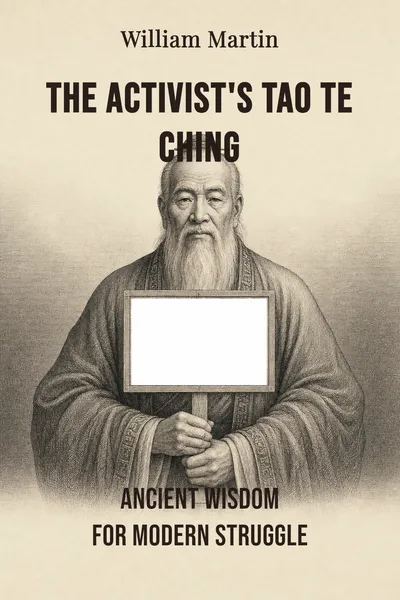
William Martin has spent decades doing something slightly unusual for a living: taking the Tao Te Ching, the roughly 2,500-year-old Chinese text attributed to Lao Tzu, and rewriting it for people who don't sit in monasteries. He did it for parents, for caregivers, for people at work. In 2016 he did it for activists — the ones marching, organizing, calling representatives, showing up to the fourth meeting of the month. The result, The Activist's Tao Te Ching, keeps the book's eighty-one short verses and reimagines each one for someone in the middle of a fight for justice. It's a strange pairing on paper. Taoism is famous for stillness and letting go; activism is famous for the opposite.
And that's exactly the tension Martin is interested in. Movements burn people out. The urgency that gets someone to a protest is the same urgency that has them exhausted, bitter, or gone within two years. Anger is a good match and a bad fuel — it lights fast and runs out. Martin's wager is that a text written for court advisers and hermits in ancient China happens to say something precise about how to act hard without hardening, how to push without breaking, how to keep going when the win isn't coming this year, or this decade.
We tend to file wisdom literature under contemplation and activism under confrontation, as if they were opposite temperaments. Martin's book asks whether the people most desperate for the first might be the ones doing the second.
The question we’re asking : Can a text built around stillness and yielding actually have anything useful to say to people whose whole life is pushing?What we’ll see : How Martin bends Lao Tzu toward the picket line — and what the old text turns out to know about surviving a long fight.
Table of contents
01Chapter 1 — The oldest text a burned-out organizer could pick up
The Tao Te Ching is short — around 5,000 characters, eighty-one brief verses, no argument in the philosophical sense, just image after image circling the same few ideas. Tradition credits it to Lao Tzu, an older contemporary of Confucius, though scholars have long doubted whether one person wrote it or whether Lao Tzu existed at all. What survives is a book about the Tao, the "way" that underlies things, and about wu wei, usually translated as non-action or effortless action — not doing nothing, but acting without forcing, the way water finds its level.
Martin's move is to keep this frame and change the reader. Where a classic verse speaks to a ruler, his version speaks to someone running a campaign. Where the original warns a sage against grasping, his warns an organizer against the hunger for a quick, total victory. He isn't correcting Lao Tzu or dressing him in slogans. He's asking a specific question of each verse: what would this mean to a person who cannot, and should not, stop caring about the world?

02Chapter 2 — Doing by not-forcing, winning by not-grasping
The center of gravity in Martin's adaptation is wu wei — action without forcing. It's easy to hear that as a recipe for doing less, which is precisely backwards. Wu wei describes the farmer who plants and waters but does not yank the seedling to make it grow faster. Applied to a movement, it separates the work you can do from the outcome you cannot command. You can organize the meeting, write the letter, hold the line. You cannot decide when the culture turns. The verse Martin draws on again and again says the sage acts but does not cling to the results.
This is not resignation, and Martin is careful about the difference. Clinging to results is what produces the frantic activist — the one who measures every action by whether it visibly moved the needle this week, and who collapses when it didn't. Non-attachment doesn't lower the commitment; it protects it. You keep acting because the action is right, not because you've been promised a payoff on your timeline. Lao Tzu's line that the softest thing overcomes the hardest becomes, in Martin's hands, an argument about stamina.
03Chapter 3 — The self that has to outlast the cause
A recurring worry in the book is the activist's own body and mind — the resource that movements spend first and replenish last. Martin returns often to verses about balance, rest, and the danger of extremes. The Tao Te Ching distrusts anything stretched too far: the bow bent to its limit, the blade honed too keen, the wealth hoarded past use. Overreach is built into its warnings. He reads these as direct counsel about the pace of engagement, because burnout isn't a personal weakness in his framing. It's what happens when a person tries to sustain a sprint through a marathon.
So he treats self-care not as an indulgence stolen from the cause but as part of the cause. An organizer who runs themselves into the ground removes a worker from the movement as surely as an arrest does. The old text's insistence on returning to the source — coming back to stillness the way breath returns to rest — becomes a practical rhythm: act, withdraw, restore, act again. Not a betrayal of urgency. Its condition.
04Chapter 4 — Why softness keeps outlasting the hard line
Step back from the individual reader and the book starts to say something about movements as living things, not just the people in them. The image the Tao Te Ching keeps reaching for is the contrast between the rigid and the supple. The living tree is flexible; the dead one is stiff. The living tongue outlasts the hard teeth. Water, the softest element, wears through stone given time. Martin's adaptation quietly proposes that these aren't just consolations for tired individuals — they're a description of how change actually happens and, more importantly, how it endures.
Hard movements tend to shatter. A struggle built entirely on rage, purity, and the demand for total immediate victory is brittle: it fractures over doctrine, it can't absorb setbacks, and it exhausts its people before the slow work is done. The movements that persist across generations — the ones that outlast the founders, the arrests, the disappointments — usually have something water-like in them. They adapt. They yield where yielding costs nothing and hold where holding matters. They keep the pressure on without needing to see the stone crack today.
05Conclusion
Martin never pretends the fit is perfect. A book of eighty-one verses about the way of nature was not written with picket lines or petition drives in mind, and some of his adaptations reach further than others. But the core pairing holds up better than it should. The Tao Te Ching's suspicion of force, its trust in patience, its warning against grasping and its praise for what bends rather than breaks — these map onto the actual failure modes of modern struggle with uncomfortable precision. Movements really do die of exhaustion, contempt, and the need for a fast, clean win.
Related books