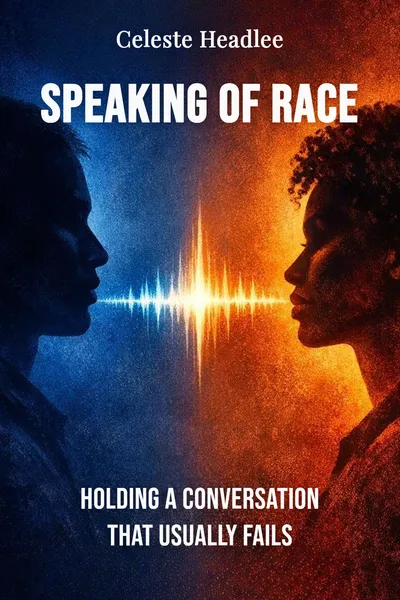
Speaking of Race
Holding a conversation that usually fails
Description
Celeste Headlee has spent most of her working life talking to strangers for a living. She hosted public radio programs, interviewed thousands of people, wrote a small bestseller on how to have better conversations. She is also biracial — her grandfather was the composer William Grant Still, sometimes called the dean of African American composers — and she has been having conversations about race since long before it was a phrase people put in workshop titles. So when she sat down to write a whole book about those particular conversations, it was not because she found them easy. It was because she kept watching them fail, including her own.
That is the premise of Speaking of Race, published in 2021. Headlee starts from an uncomfortable observation: most of us, when the subject comes up, do one of two things. We stay silent because we are afraid of getting it wrong, or we dive in and get it wrong in a way that confirms everyone's worst fears. The exchange curdles into defensiveness, someone shuts down, and both people walk away more certain that the other side cannot be reasoned with. The topic that most needs airing is the one we have quietly agreed to route around.
Her book is not a set of scripts for winning an argument. It is closer to a mechanic's manual for a machine that breaks in the same places every time. Headlee is interested in why the conversation collapses, what our brains are doing while it collapses, and whether the whole thing can be structured so that it survives long enough to be worth having.
The question we’re asking : Why do conversations about race fail so reliably, and can they be built to hold?What we’ll see : How a seasoned interviewer takes apart a conversation everyone dreads and rebuilds it into something that can survive discomfort.
Table of contents
01 Chapter 1 — The conversation that keeps collapsing
Headlee opens with a pattern she has watched play out for decades, on air and off. Someone raises race — a comment at dinner, a headline, an offhand remark — and within a few exchanges the temperature spikes. Voices tighten. One person feels accused, the other feels dismissed. Someone says "I don't even see color" or "you're being too sensitive," and the shutters come down. What could have been a real exchange becomes a standoff, and both people file it away as proof that talking about this stuff never works.
The failure, she argues, is not random. It is structural, and it is remarkably consistent across settings. The same conversation breaks in the same spots whether it happens between colleagues, family members, or strangers online. That predictability is oddly encouraging, because a problem that fails the same way every time is a problem you can study. Headlee's whole approach rests on treating the collapse not as a moral failing on either side but as a mechanical one.

02 Chapter 2 — Why good intentions make it worse
One of Headlee's sharper points is that the people most eager to prove they are not racist often make the conversation harder, not easier. The instinct to defend one's own goodness — to establish, quickly and firmly, that one is one of the good ones — hijacks the whole exchange. The conversation stops being about race and becomes about the speaker's self-image, which the other person is now expected to reassure. That is a heavy and unfair job to hand to someone.
She draws on research about how the brain handles perceived threats to identity. When we feel our moral standing is under attack, the reaction is physiological before it is rational — the same stress response that fires in genuine danger. Blood pressure rises, attention narrows, and the capacity for nuance drops away. This is why a person can be well-read, well-meaning, and still turn defensive the instant a conversation implies they might have benefited from or participated in something unjust. The body treats it as an accusation and mounts a defense.
03 Chapter 3 — What actually holds the talk together
Having diagnosed the breakdown, Headlee turns to structure — the concrete habits that keep a conversation upright. None of them are complicated, which is precisely the point. She is not offering a rhetorical trick that wins the exchange; she is offering the unglamorous mechanics of staying in it. The first is preparation of a specific kind: going in with the goal of understanding rather than the goal of being understood. That single reordering changes everything downstream.
The core move is genuine listening, which she distinguishes sharply from waiting to talk. Most of us, in a tense exchange, are silently drafting our rebuttal while the other person speaks. Headlee argues that if you are composing your response, you are not listening — you are performing the posture of listening while gathering ammunition. Real listening means being willing to be changed by what you hear, which is uncomfortable, and which is exactly why it works. It signals to the other person that the conversation is not a trap.
04 Chapter 4 — Race as the thing we were never taught to discuss
Step back from the individual techniques and a larger claim comes into view: conversations about race fail more reliably than other hard conversations because of what race is wired into. It is not just a topic. It sits at the intersection of history, identity, guilt, safety, and self-image, and it carries a national history that most people were never given the vocabulary to discuss. We learn to argue about politics and money from a young age, clumsily but constantly. Race, by contrast, is often the subject the household agreed to keep quiet, and quiet is not the same as resolved.
Headlee's book lands, then, as an argument about a specific American habit: the preference for avoidance dressed up as manners. The country has treated silence about race as a form of politeness, when it more often functions as a way of protecting the people who can afford not to think about it. The result is a society fluent in many difficult conversations and strangely mute on this one, so that every attempt feels like starting from zero. What she is describing is less a personal deficiency than a collective one — a muscle a whole culture declined to build.
05 Conclusion
Headlee never pretends the conversation gets easy. She wrote a whole book about it precisely because it stayed hard for her, someone who talks to strangers for a living and who grew up inside the subject. What she offers instead is a shift in what we are aiming for: not a resolution, not a verdict on anyone's character, not the relief of finally agreeing. Just the exchange itself, kept alive through the moment it usually dies — the moment someone feels accused, or dismissed, or suddenly unsure of their own goodness.
Related books