Shortcut
The price of taking shortcuts
Description
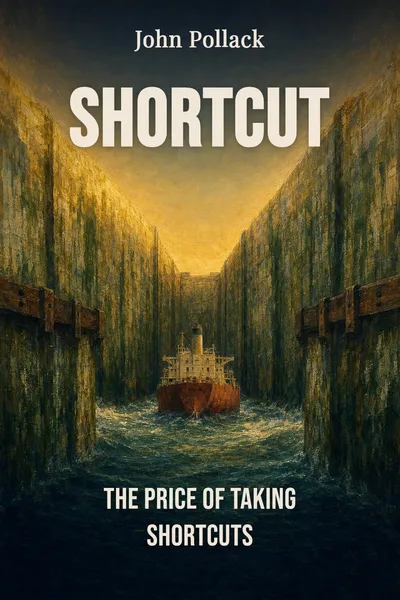
In the early 1880s, a French company led by Ferdinand de Lesseps — the man who had triumphed at Suez — set out to dig a canal across Panama. The plan was to slice a sea-level channel straight through the isthmus, the shortest possible line between two oceans. It was the ultimate shortcut, and it turned into one of the great disasters of the nineteenth century. Yellow fever and malaria killed an estimated twenty thousand workers. The company collapsed in scandal by 1889. The Americans who took over years later succeeded only by abandoning the straight-line dream and building a system of locks that lifted ships up and over the terrain.
That story sits at the heart of John Pollack's book Shortcut, published in 2014. Pollack, a former speechwriter in the Clinton White House, is fascinated by the gap between the shortcut we imagine and the one we get. The canal was supposed to save time and money. The rush to save time and money is exactly what killed so many people. And yet the canal, once finished the harder way, remains one of the most valuable shortcuts ever built — a passage that spares ships a journey of thousands of miles around Cape Horn.
Pollack's argument is that this tension is everywhere, not just in engineering. From the cheat sheet a student smuggles into an exam to the metaphor a politician uses to win an argument, we are a species obsessed with finding the faster way through. Some of these shortcuts are genius. Some are catastrophe wearing the mask of genius. The trouble is that from the inside, they look identical.
The question we’re asking : Why are humans so drawn to shortcuts, and how do we tell the ones that save us from the ones that ruin us?What we’ll see : How a former speechwriter traces the shortcut instinct from Panama to the shape of our own thinking.
Table of contents
01Chapter 1 — The oldest human instinct
Pollack opens with a claim that sounds almost too simple: the desire to take shortcuts is not a modern failing born of laziness or the internet. It is one of the oldest and most productive instincts we have. Every path worn across a field, every tool ever invented, every convention that lets us skip a step someone else already figured out — all of it is the shortcut instinct at work. He points out that even the deer trails through a forest are shortcuts, the accumulated wisdom of thousands of animals finding the least costly route. Humans just formalized the habit and turned it into civilization.
The word itself carries the doubleness Pollack cares about. A shortcut is a shorter way, but the phrase also means cutting a corner, doing something the quick and dirty way. Both meanings live in the same seven letters, and Pollack argues we've never fully resolved which one we mean. When we praise someone for finding an elegant shortcut, we mean the first. When we accuse someone of taking shortcuts, we mean the second. The genius and the cheat are separated by outcome, and outcome is only visible afterward.

02Chapter 2 — When the shortcut pays and when it costs
The heart of Pollack's investigation is a distinction he keeps circling: some shortcuts genuinely eliminate unnecessary work, while others simply hide the cost and move it somewhere you can't see. The good shortcut removes steps that were never needed. The bad shortcut removes steps that were doing something important, and the bill arrives later, usually with interest. From the outside, in the moment of choosing, the two feel exactly the same. That, he suggests, is the whole trap.
He is fond of examples where the shortcut works beautifully. A surgeon who has performed a procedure a thousand times moves faster than a novice, not because she is cutting corners but because experience has compressed the decision into something close to instinct. Expertise, in Pollack's telling, is a bank of well-earned shortcuts. The pilot who lands in a crosswind, the chess master who sees the strong move at a glance — they aren't skipping the thinking, they've internalized it so thoroughly that it happens without the slow deliberation a beginner would need.
03Chapter 3 — Analogy — the shortcut of thought
Here the book takes its most original turn. Pollack, a working speechwriter, argues that the most powerful shortcuts we take are not physical at all — they are the mental ones, and chief among them is analogy. When we say a new thing is like some familiar thing, we skip the enormous labor of understanding it from scratch. We borrow a ready-made frame. Analogy is the shortcut that lets a listener grasp in seconds an idea that took the speaker years to reach, and Pollack thinks it may be the most underrated force in human persuasion and decision-making.
He shows how this works in the rooms where decisions get made. A policy debate is very often a fight over which analogy wins. Is this conflict another Vietnam, a quagmire to avoid, or another Munich, an aggressor who must be stopped before he grows? Whichever comparison sticks tends to determine the choice, because the analogy smuggles a conclusion inside it. The person who controls the metaphor controls the argument, and usually the audience never notices a shortcut has been taken at all. That, from a speechwriter, is a confession as much as an observation.
04Chapter 4 — The double edge we can't put down
Stepping back, what Pollack has really written is a book about a tool that is inseparable from a trap. He resists the two easy conclusions a reader might expect. He does not scold us for taking shortcuts, in the manner of the self-help book that preaches slow, honest, painstaking effort as the only virtue. Nor does he celebrate shortcuts as pure cleverness, in the manner of the productivity culture that sells life hacks by the dozen. His position is harder and more honest: the shortcut is neither vice nor virtue. It is the mechanism by which almost everything human gets done, and by which a great deal gets ruined.
The reason we can't simply choose better, he suggests, is that the shortcut hides its own nature. Every genuine advance and every disastrous corner-cut presents itself the same way — as an obviously smart way to save time, money, or effort. The wheel and the Ponzi scheme both look, at the moment of adoption, like a good idea. This is why intelligence and even expertise offer only partial protection. Smart people don't take fewer shortcuts; they take more, faster, and their confidence can make the failures larger when they come.
05Conclusion
Pollack closes where he began, with the isthmus. The Americans who finished the canal did not succeed because they were less ambitious than de Lesseps. They succeeded because they finally treated the disease and the terrain as the real work rather than as inconveniences to be rushed past. They still built a shortcut — one of the greatest ever made — but only after they stopped pretending it could be free. The corner that couldn't be cut had to be gone around.
Related books