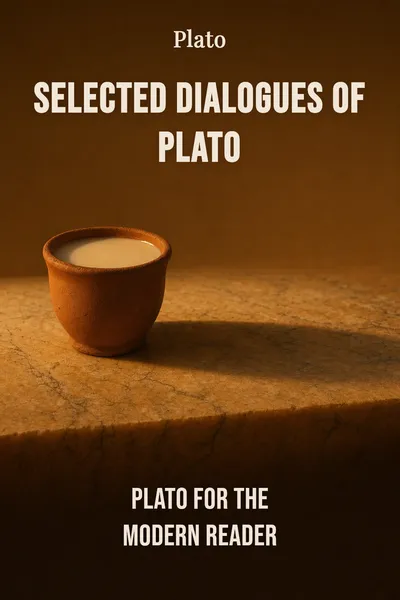
Selected Dialogues of Plato
Plato for the modern reader
Description
There is a strange thing that happens when we open a book of Plato expecting philosophy and find, instead, people talking. A young man just back from a poetry recital. A famous teacher cornered at a wealthy house. Drunk Athenians toasting the god of love until dawn. And an old man on trial for his life, refusing, with maddening calm, to grovel. These are not treatises. They are scenes — arguments caught mid-flight, complete with interruptions, boasts, jokes, and the occasional walkout. Selected Dialogues of Plato gathers five of them: Ion, Protagoras, Phaedrus, Symposium, and the Apology. Together they make an unusually good door into a body of work that can feel, from the outside, like a locked library.
The volume has a particular history worth knowing. Its English comes from Benjamin Jowett, the Victorian master of Balliol College whose translations of Plato became classics in their own right — read for a century as much for their prose as for their fidelity. But Jowett wrote for readers of the 1870s, and time thickens even great translation. Here the classicist Hayden Pelliccia has gone back through Jowett's renderings and revised them, keeping what still sings and clearing what has gone stiff, aiming at a Plato faithful both to Jowett at his best and to the sharp, quick style of the Greek itself.
What emerges is not a museum piece but something closer to overheard conversation — which is exactly what Plato seems to have wanted. He wrote nothing in his own voice. He handed everything to characters, above all to his old teacher Socrates, who almost never states a conclusion and almost always asks another question. Reading these five dialogues in a fresh translation, we are less students receiving doctrine than eavesdroppers at a very good, very dangerous table.
The question we’re asking : What do five of Plato's liveliest dialogues actually do when we stop reading them as doctrine and start reading them as conversations?What we’ll see : How a Victorian translation, carefully revised, reopens Plato as a living voice — and why that voice still lands.
Table of contents
01Chapter 1 — The friend who talks you into a corner
The first thing to know about Socrates, as Plato draws him, is that he claims to know nothing. This is not modesty. It is a method, and it is faintly terrifying to anyone on the receiving end. In dialogue after dialogue he approaches someone who is certain — a poet's champion, a celebrated teacher, a lover convinced he understands love — and asks a small, reasonable question. Then another. Each answer seems safe. But the questions accumulate, and somewhere along the line the confident person discovers he has agreed to things that contradict each other. The certainty dissolves. This is the Socratic method, and Ion, the shortest dialogue here, is where we watch it work in miniature.
Ion is a reciter of Homer, proud that he can speak beautifully about the one poet and dead silent about all the others. Socrates finds this odd. If Ion had real knowledge of poetry, wouldn't it apply to every poet? The conversation gently forces Ion toward an uncomfortable admission: what he has is not knowledge at all but something more like possession, an inspiration that passes through him the way a magnet passes force through a chain of iron rings. He performs; he does not understand. It is a modest topic that opens onto a large one — the difference between doing a thing well and knowing why.

02Chapter 2 — Five conversations, one loose thread
Read together, these five dialogues do not add up to a system, and part of the pleasure is that they refuse to. Plato lets each occasion have its own weather. Ion is quick and playful. Protagoras is a crowded, competitive affair, Socrates matching wits with the most famous teacher of the age before an audience of hangers-on, the two of them even sparring over how to interpret a difficult poem. The dialogue argues, by its own performance, that patient question-and-answer gets closer to the truth than a grand set-piece speech — which is convenient, since Socrates is far better at the former than the latter.
Then the register shifts. Phaedrus takes Socrates out of the city and into the countryside, an almost unheard-of move for a man who says the trees have nothing to teach him. There, under a plane tree by a stream, he and a young enthusiast talk about rhetoric, about the soul, and about love — including the famous image of the soul as a charioteer struggling to drive two horses, one noble, one unruly. Symposium keeps love as its subject but changes the setting entirely: a dinner party where each guest, in turn, delivers a speech in praise of Eros, the drink flowing, the tone sliding between the comic and the sublime until Socrates and, later, a gate-crashing Alcibiades raise the stakes.
03Chapter 3 — When the argument stops being a game
The Apology sits at the end of the volume and changes its color. Everything before it is, in some sense, play — high-stakes play, but play. Reputations get bruised; nobody dies. The Apology is the record, as Plato reconstructs it, of Socrates on trial in Athens in 399 BC, charged with impiety and with corrupting the young. Here the same method that deflated Ion and needled Protagoras is turned to a use that is not a game at all. Socrates is arguing for his life.
And he argues badly, on purpose. A defendant who wanted acquittal would soften, apologize, propose a gentle penalty, appeal to the jury's pity. Socrates does almost the opposite. He explains, with unbearable steadiness, why the god at Delphi called him the wisest of men: because he alone knows that he knows nothing, while everyone else mistakes ignorance for wisdom. He treats the jurors as he has treated everyone — as people whose certainties deserve examination. When convicted and invited to name his own punishment, he suggests, half-seriously, that the city ought to reward him with free meals. It is the least tactful move imaginable, and it is entirely in character.
04Chapter 4 — Why we still read a man who wrote nothing down
Step back from the five dialogues and a peculiar fact stands out. Socrates himself wrote nothing. Everything we have of him comes filtered through others, mostly through Plato, who chose to preserve his teacher not in summary but in scene — in talk. That formal decision is not incidental. It carries an argument about where understanding lives. For Plato, and for the Socrates he draws, a truth you can only recite is closer to Ion's inspired babble than to knowledge. Real understanding has to be worked out live, tested against objection, defended in the presence of someone who might catch you out. Put it in a fixed text and it goes inert; Phaedrus even worries out loud that writing weakens memory and cannot answer back.
This is why the dialogue form has proven so durable, and why revising an old translation is more than housekeeping. The whole point of these works is that they stage thinking as a shared, unfinished activity, something that happens between people rather than inside a single authoritative head. A translation that stiffens the exchanges into pronouncements betrays the form itself. Keeping them quick, colloquial, capable of interruption — that is fidelity of the deepest kind, faithful not just to the words but to what the words are trying to do.
05Conclusion
The five dialogues gathered here span the whole range of what Plato could do — the quick comedy of Ion, the crowded sparring of Protagoras, the open-air lyricism of Phaedrus, the drunken ascent of the Symposium, and the grave calm of the Apology. They share a method and a man: Socrates, claiming to know nothing, asking the questions that unpick everyone else's certainties, until the day the questions get him killed. Read as conversations rather than as doctrine, they turn out to be far more alive, and far more unsettling, than any summary of Plato's 'ideas' could suggest.
Related books