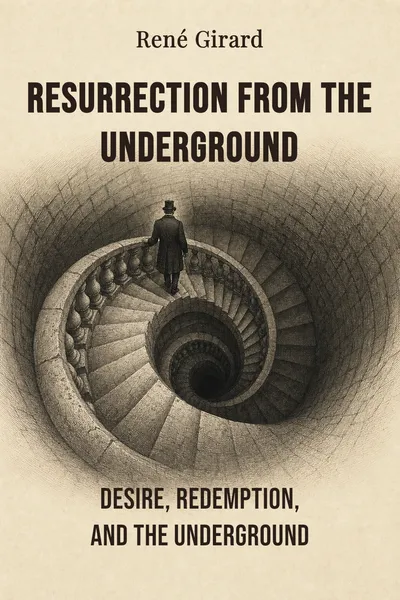
Resurrection from the Underground
Desire, redemption, and the underground
Description
In 1864, Fyodor Dostoevsky published a short, strange, corrosive book with no plot to speak of. A retired civil servant, unnamed, sits in a shabby room in St. Petersburg and talks. He talks for pages about how much he despises himself, how he cannot act, how he holds a grudge against a man who once shoved him aside in a bar and how he plotted revenge for years. He is spiteful, ridiculous, and impossible to look away from. Notes from the Underground became one of the founding texts of modern literature, the voice everyone from Nietzsche to Kafka to Sartre would later claim as an ancestor.
A century later, a French literary critic named René Girard read that same underground man and saw something the existentialists had missed. They had made the underground into a monument to freedom, the pure isolated self refusing the world. Girard read it as the opposite: a diagnosis of how thoroughly the self is not free at all, how the man's every feeling is borrowed from the people around him, especially the ones he claims to hate. Where others saw a hero of alienation, Girard saw a case study in a mechanism he would spend his life describing.
That mechanism has a name, and the book Girard built around Dostoevsky is where he works it out in full. He does not treat the novelist as an illustration of a theory he already held. He reads him as the man who found the theory first, in fiction, and paid for it in his own life. The result is a book about desire, resentment, and what it might mean to climb out of the underground at all.
The question we’re asking : Why did René Girard read Dostoevsky's most alienated character as proof that we are never as alone, or as free, as we think?What we’ll see : How a strange 1864 novella became the key to Girard's whole account of what we want and why we want it.
Table of contents
01Chapter 1 — The man who could not stop watching others
The underground man's problem is not that he is cut off from other people. It is that he cannot stop measuring himself against them. He rehearses an insult for two years. He engineers a dinner with former schoolmates he despises, then sits in agony over whether they respect him. He follows an officer down the street, obsessed with whether the man will yield the pavement. Every scene turns on the eyes of someone else. Solitude, for him, is a stage he performs on for an audience he cannot see and cannot escape.
Girard's first move is to take this seriously as a portrait rather than a pathology. The underground man is not simply neurotic; he is showing us, in extreme form, something ordinary. We tell ourselves that our tastes, our ambitions, our resentments come from inside us, that we are the authors of what we want. Dostoevsky's narrator exposes the lie. His feelings arrive secondhand. He wants what he sees others valuing, and he hates the others precisely because they hold what he wants and because they are more at ease in wanting it than he is.

02Chapter 2 — Desire has three corners, not two
Here is the idea that organizes everything Girard writes. We imagine desire as a straight line: a subject reaching toward an object. I want the thing because the thing is desirable. Girard says the line is a fiction. Real desire is a triangle. Between me and what I want stands a third figure, a model, whose wanting teaches me to want. I desire the object because he desires it, or because I imagine he does. Girard calls this mimetic desire, desire copied from a mediator.
Once you see the triangle you see it everywhere in Dostoevsky. Characters fall for the people their rivals love. They covet what a admired figure possesses. They stage elaborate scenes whose real audience is a model they are trying to impress or overthrow. The object almost stops mattering. What matters is the relationship to the mediator, that mixture of worship and hatred Girard would later make famous. We adore the model for showing us what to want, and we loathe him for standing in the way of getting it.
03Chapter 3 — The underground is a room with a mirror
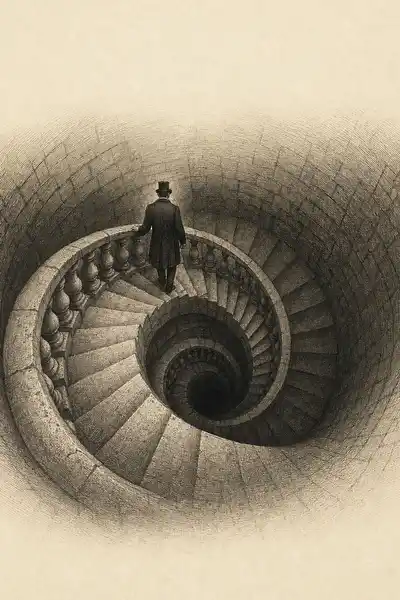
The underground, then, is not a place of freedom. It is what mimetic desire looks like when it turns inward and rots. Cut off the possibility of any real object, keep only the rivalry, and you get a person who feeds on his own humiliation because humiliation is at least a form of contact with the others he cannot stop imagining. He would rather suffer with a full consciousness of his suffering than be nothing. The famous line, that he is a sick man and a spiteful man, is the sound of desire eating itself.
Girard reads Dostoevsky's later novels as a slow working-out of whether there is any exit from this room. The great characters, Raskolnikov, the figures of The Possessed, the Karamazovs, are all caught in versions of the same triangle, all consumed by mediators they cannot forgive. The pride that says I answer to no one is revealed, again and again, as the deepest servitude, because the proud man is the one most enslaved to the judgment of his rivals. Autonomy is the mask; mimicry is the face.
04Chapter 4 — Why Dostoevsky mattered to Girard
It is worth asking why a literary critic staked his life's work on a novelist. Girard began as a scholar of the French and Russian nineteenth century, and he could have stayed there. Instead he came to believe that novelists know something about human beings that psychology and philosophy keep missing, and that Dostoevsky knew it most acutely of all. The claim is bold: that fiction is not decoration on top of truth but a way of reaching truths that arguments cannot.
The truth Girard drew out is uncomfortable because it dismantles our favorite story about ourselves. We are attached to the belief that our desires are original, that they well up from an authentic inner self. Every advertisement, every social feed, every quiet comparison with a neighbor's life runs on the opposite mechanism, on wanting because someone else wants. Dostoevsky's underground man is the ancestor of a very contemporary figure: the person who scrolls through other people's lives and cannot tell whether the ache he feels is envy, admiration, or contempt, because it is all three at once and always borrowed.
05Conclusion
Dostoevsky's narrator never leaves his room. The novella ends with him still talking, still spiteful, still unable to stop the loop, and Dostoevsky cuts him off mid-sentence rather than granting him a resolution he has not earned. Girard honors that honesty. He does not soften the underground or pretend the exit is obvious. What he does is refuse to accept the underground as the final word, the way a whole century of readers had. He reads it as the beginning of a question Dostoevsky spent the rest of his career trying to answer.
Related books